



Understanding Why Organizations Struggle to Foster Personal Development and Change
Why Are Organizations Struggling to Foster Change?
Introduction
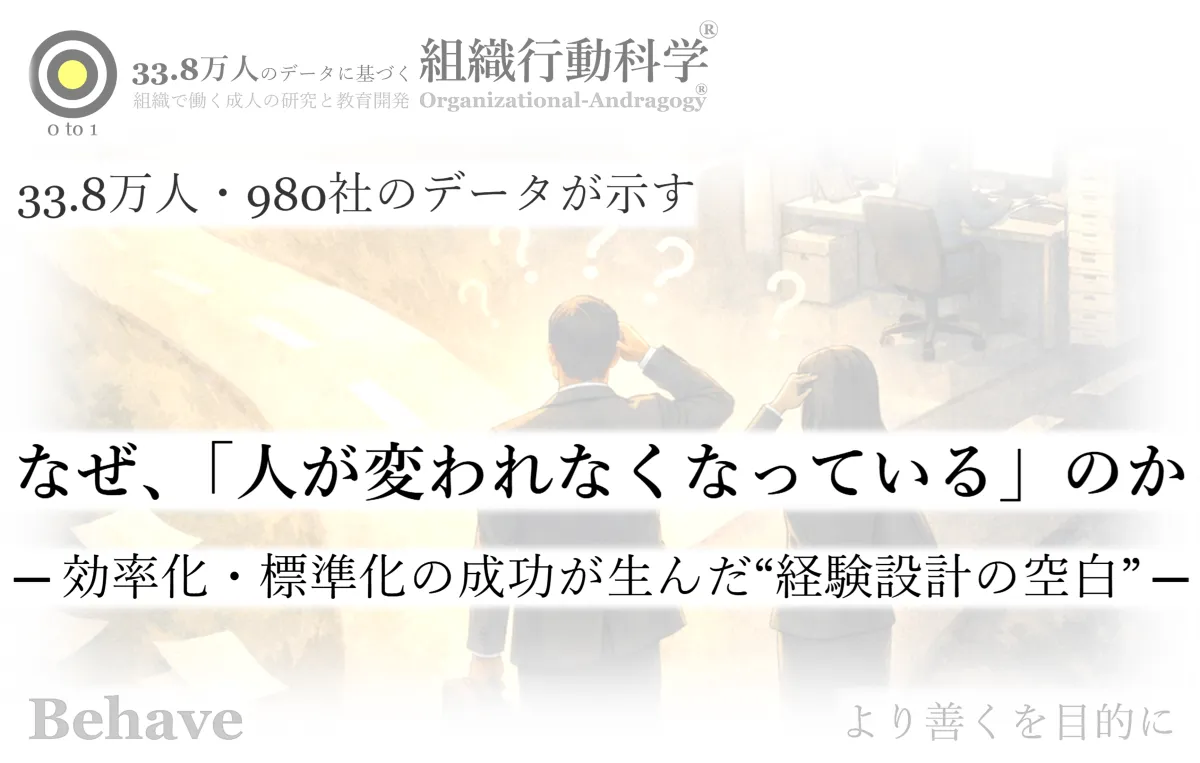
A recent report, produced by Request Inc. and grounded in the analysis of behavioral data from over 338,000 individuals across 980 companies, has shed light on the pervasive issue within organizations: the inability to foster personal development and drive change. This report titled "Why Can't People Change in Any Company?" challenges the common perceptions surrounding individual shortcomings and highlights the structural barriers at play.
The Core Issue: Structural Constraints, Not Individual Failings
Often, discussions around the stagnation of employee development point to individual issues such as a lack of motivation or insufficient management skills. However, the findings of this report indicate that the problem is broader and more structural than these individualistic explanations. Many employees within organizations share a sense of unease, recognizing that while something feels amiss, it is not as simple as blaming a person or group.
Common Business Conditions of the Past Decade
The report identifies several shared conditions that companies have faced over the past 10 to 15 years, which have shaped the current corporate landscape:
- - Time constraints resulting from work style reforms.
- - Population decline and market contraction.
- - Continuous pressure to maintain performance levels despite these challenges.
In response to these enduring challenges, organizations have pursued strategies such as:
- - Increased efficiency.
- - Standardization of processes.
- - Clearer delineation of roles.
- - Reduction of individual subjectivity.
These approaches, while seemingly rational at the time, have inadvertently resulted in a rigidity that stifles growth and change within the workforce.
The Quiet Side Effects of Efficiency
Paradoxically, the push for efficiency and standardization has led to a counterintuitive outcome:
- - Work processes have become overly reliant on precedents.
- - Decision-making has been alleviated to the point where tasks proceed without active judgment.
- - Individual discretion is perceived as a liability rather than an asset.
This rigid structure has led to a decline in diverse experiences, which the report defines as a lack of “experience” rather than a degradation of individuals. Employees are performing their duties but are not accumulating valuable experiences that inform their development.
The Lack of Reflective Opportunities
One notable observation in many organizations is the paradox of adequate task performance yet insufficient opportunity for reflection. Employees find themselves in situations where:
- - There is no time allocated to contemplate their processes or outcomes.
- - Available perspectives for understanding outcomes are lacking.
- - Lessons learned from successes or failures are not integrated into future practices.
As a result, employees are left with isolated “experiences” that do not evolve into functional “knowledge.” This gap inhibits their growth as learning is not transferred effectively into future scenarios.
Why Increased Training Isn’t the Solution
The report posits a clear framework for what it takes for individuals to effectively change:
- - Change occurs when the cycle of "training → practice → experience" is activated.
- - The role of training is not merely to impart knowledge but to facilitate the transformation of practical work into usable experience.
When training fails to align with these principles, organizations will see minimal to no change.
Conclusion: Re-evaluating Work Structures
The central message of this report is simple yet powerful: if you experience discomfort in your role, recognize that you are likely correct in your assumptions. The stagnation of personal development is not due to individual laziness but results from a lack of intentionally designed experiences that facilitate change. Thus, the call to action should be to reassess not the people within the organization, but rather the structures and processes that shape their work.
Report Overview
Title: Why Can't People Change in Any Company? - The 'Experience Design Gap' Created by Success in Efficiency and Standardization
Analysis Target: 338,000 individuals and 980 companies in Japan
Format: PDF Report
Produced By: Human Capital Development Planning® Center
For more information and access to the full report, please visit Request Inc's official site or contact them directly.

Topics People & Culture)



【About Using Articles】
You can freely use the title and article content by linking to the page where the article is posted.
※ Images cannot be used.
【About Links】
Links are free to use.