



The Importance of Organizational Transparency in Gender Wage Gap Disclosure
The Importance of Organizational Transparency in Gender Wage Gap Disclosure
As the practice of disclosing gender wage gaps becomes more prevalent, organizations must understand not only the numbers but also the structures that allow these disparities to exist. Recent data from SHEHUB, a career platform dedicated to women's advancement, reveals that while companies are increasingly reporting these disparities, explanations for the underlying causes remain scarce.
Current State of Gender Wage Disclosure
With the Women's Empowerment Law expanding its scope, businesses employing more than 100 individuals are now required to disclose gender wage disparities. However, the current challenge is not merely the act of disclosure but rather understanding the organizational framework that leads to these outcomes. Factors such as family responsibilities, including childbirth and child-rearing, often influence career trajectories, creating unconscious biases that affect organizational decision-making. Data disclosure should not be viewed as the destination; instead, it is the beginning of a journey toward improvement.
Lack of Context in Gender Wage Reports
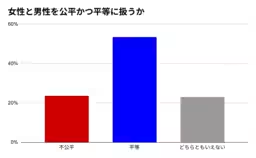
While metrics related to gender wage discrepancies and the proportion of female managers are now more frequently disclosed, many organizations fail to provide context as to why these gaps exist. Analyzing 2,438 reviews on the SHEHUB platform, we found that gender equality ratings averaged 3.6 out of 5. Although around 60% of respondents affirmed the presence of equality, nearly 25% expressed that they felt unequal treatment in various aspects, including evaluation criteria and promotion opportunities. This indicates that gender equality issues not only stem from institutional frameworks but also from operational practices within the organization.
Insights from Employee Reviews
Some comments highlight the stark contrast in perceptions towards gender equality:
- - "I feel there still exists an expectation that women should handle tasks like serving tea and cleaning."
- - "I was told my evaluation was adjusted out of 'consideration for male colleagues’, even though my performance was rated higher."
- - "After taking parental leave, I worry about being assigned less critical tasks."
These insights suggest that while policies for women's advancement are in place, challenges remain regarding evaluations and placements.
Limited Perceptions of Promotion Equality
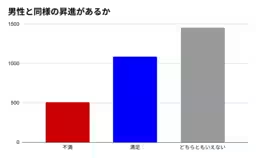
When asked about equal opportunities for promotions, only 45% of respondents felt that they had the same upward mobility as their male counterparts. Meanwhile, 21% rejected this idea entirely, and 34% were indecisive. These statistics indicate that while some organizations have established promotion processes, employees often do not perceive these as equitable. Since promotion opportunities can lead to gender wage gaps, transparency in evaluations and available career pathways is now essential.
Key Challenges Identified
Analysis of the reviews identified several significant factors impeding equitable promotion:
- - Disparate Evaluation Criteria: Males may be evaluated based on potential and expectations, while females may need to prove their worth with concrete results before being considered for advancement.
- - Impact of Life Events: Taking maternity leave often resets a woman's career path, making it difficult to reclaim previous standing upon return.
- - Influence of Informal Relations: Observations suggest that promotions may favor those with closer ties to leadership, often disadvantaging women.
- - Gender Bias in Roles: Although there is an increase in movements to promote women into managerial roles, in practice, significant responsibilities are often still held by men.
- - Lack of Role Models: The scarcity of successful women managing career paths while raising children makes it difficult for younger women to visualize their futures.
Essence of the Women's Empowerment Law
The aim of the Women's Empowerment Law is not just to ensure information is displayed, but to guarantee that companies accurately understand their organizational health, ultimately driving necessary improvements. Gender wage disparities arise from a confluence of factors—including positioning, promotion opportunities, evaluation systems, and flexibility in work arrangements—making singular policy implementations inadequate. Therefore, it is crucial for companies to recognize structural challenges and effectively engage with them, as this perspective becomes critical for sustained growth.
Significance of Gender Empowerment Disclosures
In an era when human capital management is crucial, information on women's empowerment should be viewed not as a compliance tick-box but as vital data for making informed executive decisions. Without addressing questions about where talent is stagnating, whether skills are adequately utilized, and understanding long-term barriers to success, mere numerical disclosures will not enhance the value of human capital.
The expansion of disclosure obligations under the Women's Empowerment Law signals to companies the importance of having the capability to explain their internal mechanisms effectively.
Future Expectations for Organizations
Going forward, what is required regarding gender empowerment and human capital disclosures encompasses more than simply improving numbers or refining policies. More importantly, companies need to grasp their current situation, identify existing challenges, and articulate them accurately. Disclosure of numbers is merely a starting point; the ability of organizations to maintain an objective grasp of their condition and demonstrate a genuine commitment to improvement will foster trust among society, job seekers, and investors.
Conclusion: A Commitment to Addressing Social Issues
In Japan, the proportion of women in managerial positions hovers around 10%, far from the government’s goal of 30%. Furthermore, structural challenges complicate career continuity, particularly when promotion periods align with significant life events like childbirth. SHEHUB aims to confront these societal barriers and information inequities head-on, facilitating an environment where women can navigate their careers based on personal conviction rather than external expectations. By fostering transparency and providing safe spaces for discussion, we strive to empower women to forge their unique career paths. This commitment underpins our mission. SHEHUB will continue to work towards organizational transparency through data and personal insights, aiding in more informed decision-making for both companies and individuals.

Topics People & Culture)
【About Using Articles】
You can freely use the title and article content by linking to the page where the article is posted.
※ Images cannot be used.
【About Links】
Links are free to use.