




Significant Discoveries: Mammal Fossils from the Dinosaur Era in Kuji, Iwate Prefecture
Discovering Mammal Fossils from the Dinosaur Era in Kuji City, Iwate
In a groundbreaking revelation, the Kuji Amber Museum in Iwate Prefecture has unearthed mammal fossils from the dinosaur era, specifically from around 90 million years ago. The museum, known for its rich collection of fossils, has been collaborating with Waseda University in excavating this significant site. The findings are integral to elucidating Japan's biodiversity during the Mesozoic Era, especially the Cretaceous period.
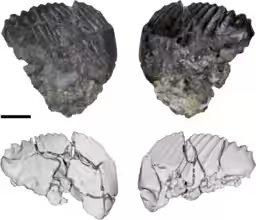
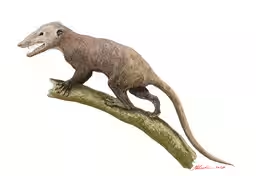
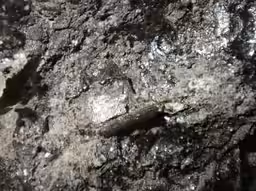
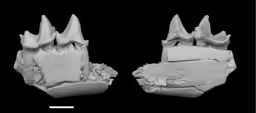
The site has yielded over 3,700 specimens, including teeth from dinosaurs and skeletons of turtles and crocodiles, making it one of Japan's critical fossil sites for studying the prehistoric ecosystem. Among the latest findings are remarkably rare mammalian fossils that have never been reported in Iwate before, consisting of jaw and tooth specimens from two distinct groups: Multituberculates and Eutherians. This is the first account from Iwate, placing it as the seventh prefecture in Japan to present such fossils.
Excavation and Research Background
The excavation site spans along the Osawada River in Kuji City, specifically in the Taragawa layer, which dates back to the Late Cretaceous. Research has been ongoing since March 2012 under the guidance of Professor Hiyama and his team, leading to significant discoveries of various vertebrate fossils, including large herbivorous dinosaurs, carnivorous dinosaurs, turtles, and sharks. The amber mining experiences offered by the museum have also contributed to finding vital specimens, further establishing the Kuji area as an exceptional hotspot for both amber and fossils.
Detail on Discoveries
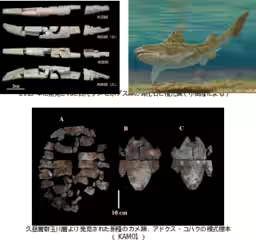
Among the notable fossil finds are amphibious reptiles like the recently identified Coristodera, along with numerous other species. The collective findings span a variety of flora and fauna, allowing researchers to piece together the diversity of the terrestrial ecosystem during the Late Cretaceous.
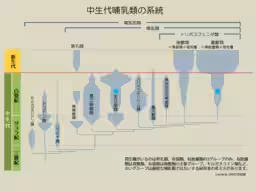
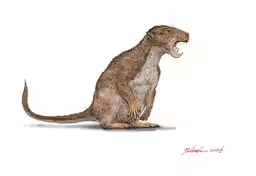
Specifically, the mammalian fossils offer insights into the evolutionary history of these groups. For instance, the recently reported specimens from the “Multituberculates” group, such as the jaw and teeth characterized by specific dental structures, suggest they survived the Cretaceous-Paleogene extinction event yet went extinct shortly after. In contrast, those from the “Eutherian” lineage, which corresponds closely to modern placental mammals, are paramount for understanding the lineage leading to today’s mammals.
Contributions to our Understanding of Evolution
The significance of these findings is multilayered. They provide evidence of mammalian evolution during a pivotal period when mammals began diversifying. The fossil record indicates that Iwate's multitudes of species can help piece together the evolutionary relationships and adaptations of these ancient creatures.
While the Multituberculates inhabited the Earth from the mid-Jurassic to the beginning of the Eocene, the fossils found in Kuji could represent a significant evolutionary bridge, contributing to both morphological adaptations and biodiversity.
Moreover, the Eutherians discovered showcase an intermediary evolutionary form, bridging primitive mammals to the more modern forms we recognize today. These specimens align with findings from Central Asia and North America but remain distinct in their characteristics, indicating unique evolutionary paths in isolated geographies.
As these discoveries continue to reshape our understanding of prehistoric life, they underscore the essential role of the Kuji region not just as a fossil site but as a vital location for learning how mammalian life evolved in response to environmental changes during the Cretaceous period.
Conclusion
The recent discovery of mammal fossils in Kuji City signifies a notable stride in paleontological research, illuminating aspects of mammalian evolution during the dinosaur era. The diversity of fossils found suggests that not only were these mammals adapting, but they were also thriving in a landscape dominated by dinosaurs. As ongoing studies are expected to yield more findings, they promise to enhance our understanding of the complex dynamics of life on Earth during one of its most creatively fertile periods. This adds to the growing list of twelve known species of mammalian fossils from the era in Japan, marking Kuji’s distinct contributions to paleontological research.





Topics Other)
【About Using Articles】
You can freely use the title and article content by linking to the page where the article is posted.
※ Images cannot be used.
【About Links】
Links are free to use.