




Exploring Leadership in the AI Era: A Guide for Tech Leaders
Introduction to the Book
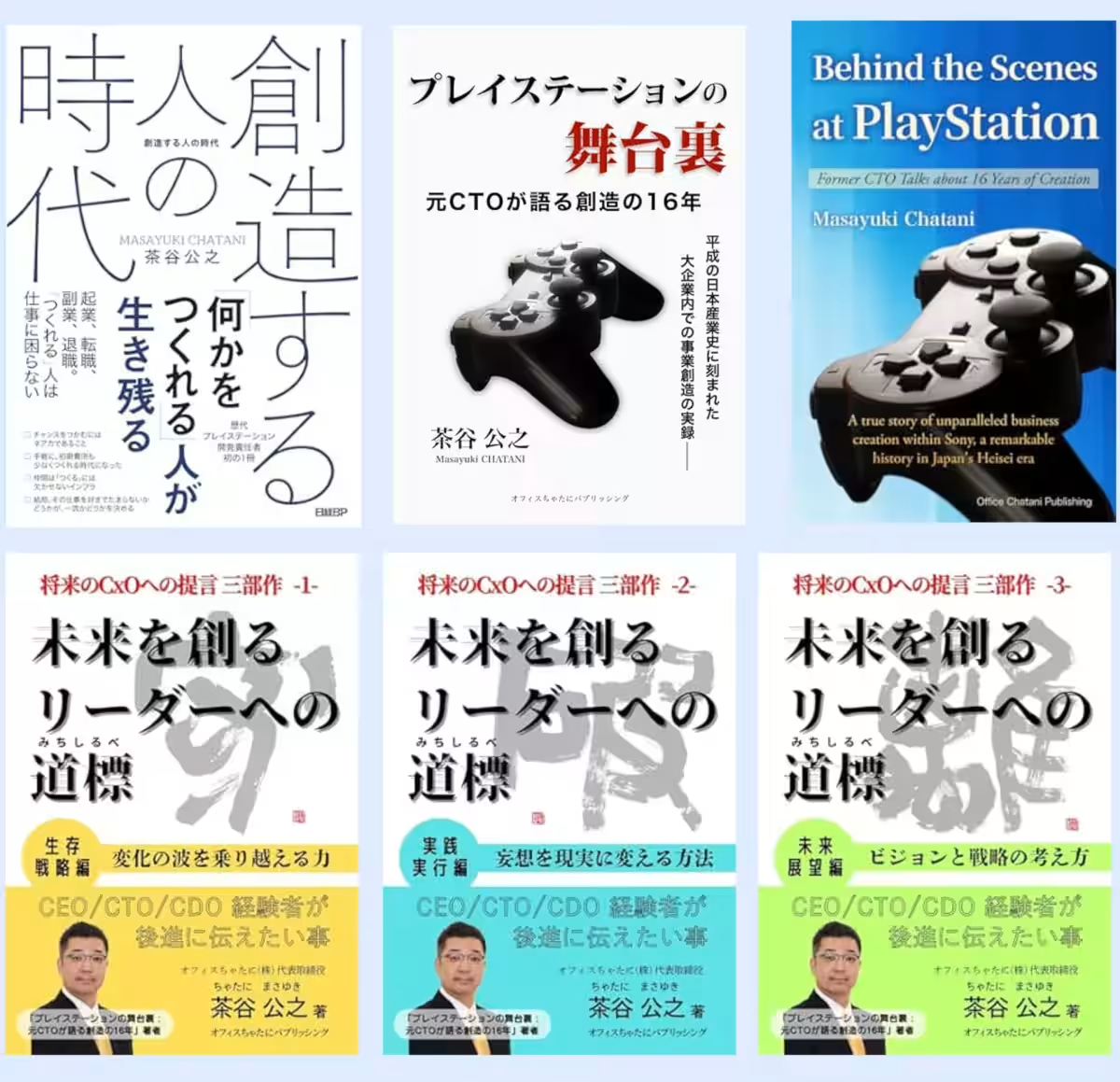
Mikiyuki Chatani, the former Chief Technology Officer of Sony Computer Entertainment and a pivotal figure in the development of PlayStation, has recently published a groundbreaking book titled AI時代のテックリーダー論消えゆくテックリーダーたち (The Theory of Tech Leaders in the AI Era: Vanishing Tech Leaders). This book serves as a comprehensive guide for current and aspiring tech leaders navigating the complexities of leadership in an age dominated by artificial intelligence.
Originally structured as a series on note, Chatani’s insights have been expanded and reorganized into a book that delves into the shifting dynamics of leadership roles triggered by AI proliferation. Chatani, who has worked with leading firms such as Rakuten, KPMG, and McKinsey, illustrates the profound changes impacting how leaders engage with technology and their teams.
Key Themes of the Book
The book identifies several critical themes that are crucial for understanding the evolution of leadership in the AI era:
- - Leaders as Targets for Replacement: One of the most provocative assertions made by Chatani is that the first roles likely to be replaced by AI are not operational positions, but leadership roles themselves. He argues that AI excels at synthesizing information, making decisions, and crafting strategic plans, which have traditionally defined the responsibilities of leaders.
- - Practitioner Insights Over Theoretical Perspectives: Unlike many authors who approach the subject from a purely academic standpoint, Chatani draws from his rich practical experience as an executive who has successfully integrated multiple AI systems into business strategies. His firsthand knowledge empowers readers with actionable insights and approaches.
- - Shift in Leadership Metrics: The book suggests a paradigm shift from measuring leadership by team size to evaluating leaders based on their ability to manage AI tools effectively. This reflects a significant transformation in what constitutes effective leadership in modern organizations.
- - Reconstructing Leadership Identity: Chatani reframes AI not as a threat, but as a collaborative partner in the creative process. He emphasizes the need for a holistic understanding of science, technology, and business, proposing a new model for leadership that aligns with the integration of AI into daily operations.
The Background For Revisiting Tech Leadership
The urgency behind Chatani’s exploration stems from the rapid integration of generative AI into workplace practices. Conventional discussions surrounding AI have often revolved around the potential for these technologies to displace workers, particularly at the operational level. However, as Chatani points out, the tasks that involve strategic decision-making are increasingly the domain where AI demonstrates superior capability.
In this context, the role of a leader is evolving from that of a classic figurehead overseeing a large team to an agile





Topics Other)


【About Using Articles】
You can freely use the title and article content by linking to the page where the article is posted.
※ Images cannot be used.
【About Links】
Links are free to use.