



Exploring Clinical Organizational Science and Senge's Learning Organization: How Learning Embedded in Organizations
Exploring Clinical Organizational Science and Senge's Learning Organization
In the realm of organizational development, Clinical Organizational Science (COS) stands at the intersection of complex systems science, neuroscience, organizational psychology, and behavioral science. The latest publication from DroR Co., Ltd., led by CEO Makoto Yamanaka, presents a crucial paper titled "Clinical Organizational Science: An Integrative Framework for Structural Intervention in Complex Organizations" published in the Frontiers in Psychology. This paper explores how Senge's concepts of learning organizations relate to COS, emphasizing that learning isn't merely an individual desire but a product of structured interactions, organizational rhythms, and self-correcting learning loops.
Defining Clinical Organizational Science
COS theorizes the structural components that actively reproduce an organization's stable state. Unlike traditional views that emphasize individual behavior changes, COS positions organizational transformations as shifts in what it terms organizational attractors. The framework introduces essential techniques like Field Gradient Theory, Loop Conversion Design, and Neural Base Design to strategically intervene at the structural level within organizations. One pivotal concept emerging from COS is the emergence bridge, which connects individual habits to organizational-level changes.
Contributions from the Learning Organization Model
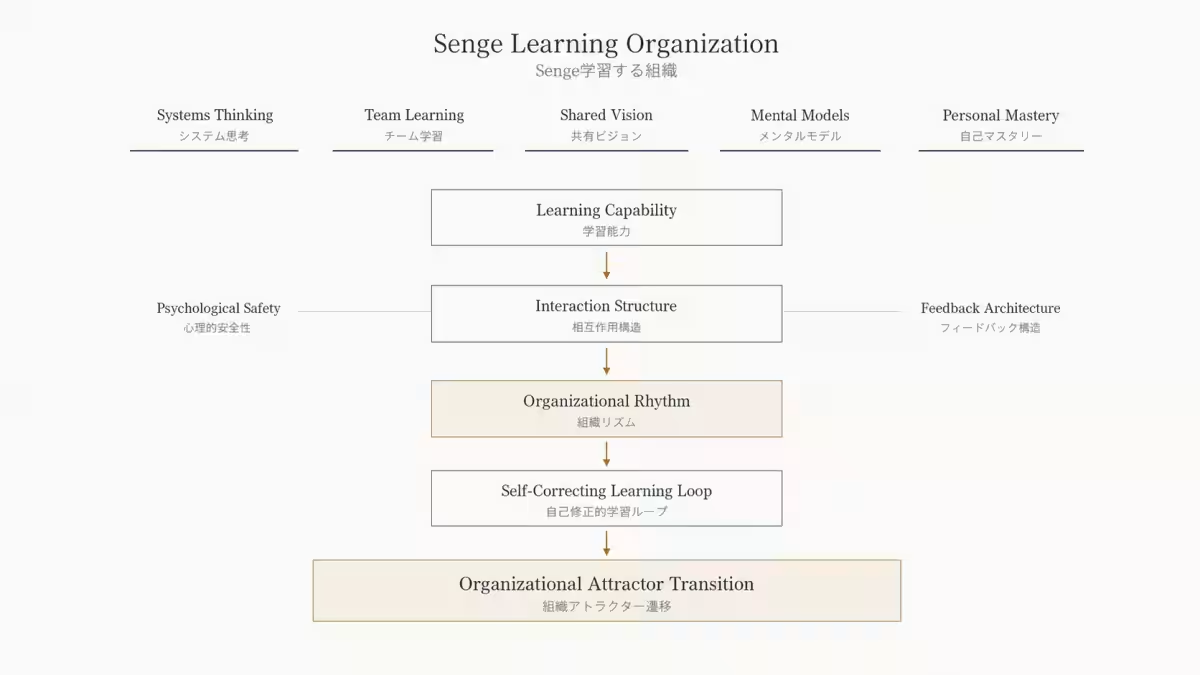
Peter Senge's framework for learning organizations emphasizes multiple areas essential for Adaptation, advocating the need for team learning, a shared vision, mental models, system thinking, and mastery. COS closely inherits these perspectives, reinforcing that organizational transformation is an ongoing process that requires the ability to observe, attribute meaning, correct, and reproduce patterns of interaction within the organization.
The Role of Interaction Structures in Learning
For a learning organization to flourish, its structural aspects must support learning. This includes fostering environments where failures can be shared openly, junior members feel empowered to contribute ideas, and feedback is directed towards collective improvement rather than individual blame. COS outlines conditions necessary for such interactive structures, including psychological safety, feedback loops, organizational attractors, and the 3Good1More approach.
The connection of Senge's model to COS's interaction structure emphasizes how learning capabilities demonstrated through system thinking, team learning, shared vision, mental models, and self-mastery are reproduced through processes like psychological safety and structured feedback.
Linking System Thinking to COS
Senge’s emphasis on system thinking aligns with COS's Loop Conversion Design, underscoring the interconnected nature of organizational dilemmas that stem from feedback loops, delays, and reinforcing loops. COS seeks to redesign feedback architectures, facilitating the transformation from self-amplifying loops into self-correcting ones through structured protocols like 3Good1More.
The Supplementary Role of COS
COS strengthens the framework of learning organizations by clarifying that learning does not solely reside in the individual's internal drive. An environment that stifles communication, punishes failures, or promotes defensive feedback can inhibit continuous learning. To actualize a learning organization, COS posits the necessity of establishing attractors that allow self-reproductive learning. The research and theoretical design laid out in COS serves as a guiding framework for organizations looking to cultivate a genuine learning culture.
Comments from CEO Makoto Yamanaka
Makoto Yamanaka articulates that while the concept of a learning organization is appealing to many companies, the real potential for learning necessitates the ability to share bad news, articulate discomfort, and receive constructive feedback. COS aspires not only to depict the idea of a learning organization but also to provide a substantial structure for the day-to-day interactions that underpin it.
Theoretical Framework of the Paper
The recently published paper serves as a Conceptual Analysis, offering a synthesized theoretical framework that does not claim immediate effectiveness but integrates existing fragmented scientific knowledge. COS aims to reconceptualize organizational transformation as a matter of structural intervention, presenting propositions that require validation and rebuttal in further research.
Looking Forward
Upcoming communications in this series will explore how COS interacts with human capital management and the reasons beneath the superficial understanding of organizational culture in Japan. This initiative will target domestic executives and CHROs to further clarify COS's role.
About DroR Co., Ltd.
DroR is a research-driven practice firm that observes and designs the invisible interaction structures within organizations founded on complex systems science and neuroscience. Their holistic approach to BPO (business process outsourcing) integrates organizational development, wellbeing, and digital transformation support, fostering a cycle where theory is derived from practical experiences and returns to practice. The conduct of research and practical implementations led by Makoto Yamanaka positions DroR as a leader in cultivating engaged organizational cultures.
For further details about COS, visit the corporate website and stay tuned for more insights on the ongoing development of a collaborative learning environment within organizations and how DroR is facilitating these transformations.
Topics People & Culture)
【About Using Articles】
You can freely use the title and article content by linking to the page where the article is posted.
※ Images cannot be used.
【About Links】
Links are free to use.