


Mastering Geometric Dimensioning and Tolerancing (GD&T) in a Day with Practical Sessions
Intensive GD&T Training Seminar
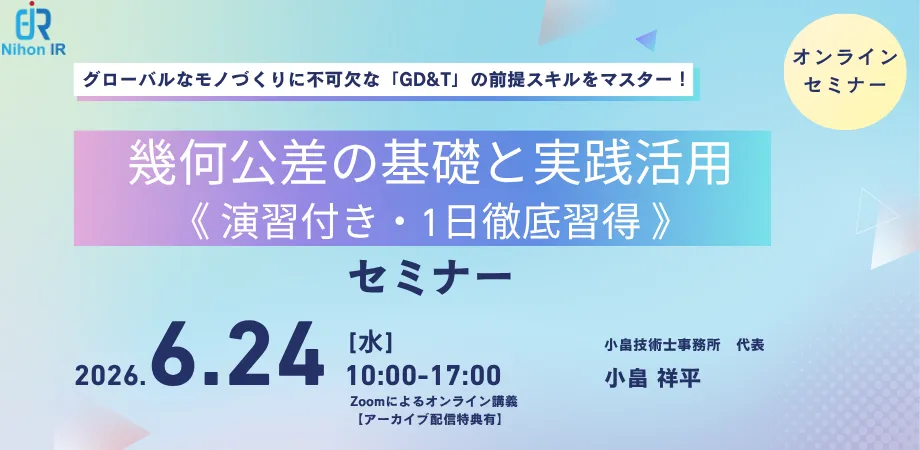
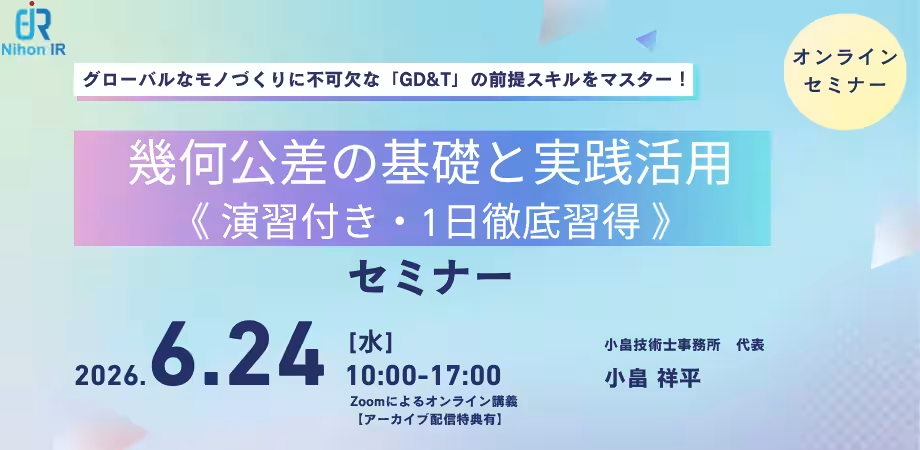
The IR Technical Education Institute is excited to announce a one-day public seminar designed to equip participants with the essential skills for interpreting geometric tolerancing (GD&T) correctly. Scheduled for June 24, 2026, from 10:00 AM to 5:00 PM, this online seminar will provide valuable insights into creating reliable blueprints that are recognized internationally.
Importance of GD&T
In 2016, JIS highlighted the importance of geometric tolerances as a necessary component for achieving unambiguous interpretation of technical drawings. However, it has become evident that this knowledge is not yet widely adopted in the field. The recommendations emphasized two main points: first, that interpretation clarity can only be guaranteed when GD&T is applied, and second, that there exists a risk of Japanese blueprints failing to comply with international standards. In an era of global manufacturing, understanding how to express crucial dimensions like length and diameter through size tolerances, along with positioning through positional tolerances, is vital. Therefore, appropriate applications of technical drawings and tolerances are essential.
Seminar Overview
Title: Fundamentals and Practical Application of Geometric Tolerancing
Format: Online via Zoom Live broadcast
Date: June 24, 2026 (Wednesday)
Fee: 49,500 JPY (tax included) per participant, with discounts available for multiple attendees.
Instructor: Shohei Obata, Senior Instructor at Obata Technology Office
Learning Objectives
This seminar aims to provide attendees with a concrete understanding of the 'rules of geometric tolerancing’ and their interpretations, highlighting the differences from size tolerances. It is essential for designers, manufacturers, and quality control personnel to grasp these concepts to improve the production and evaluation of blueprints adapted for global standards.
Seminar Program
1. Difference between Size and Geometric Tolerances
(1) Understanding of the independence principle
(2) Insights into variations in machining and measurement
2. Basics of Geometric Tolerancing: Datums and Geometric Characteristics
(1) How to denote datums with illustrations
(2) Priority of datums
(3) Relationship between machining, measurement, and datums
(4) Shape definitions prescribed by GD&T
(5) How to fill in tolerances
3. Control of Shape: Understanding Geometric Deviations
- Straightness, roundness, contour of lines, flatness, cylindrical form, contour of surfaces
- Practical Session: Understand correct and incorrect applications of geometric deviations
4. Control of Orientation: Understanding Positional Deviations
- Parallelism, perpendicularity, angularity
- Practical Session: Comprehending correct applications of positional deviations
5. Control of Position: Understanding Position Tolerances
- Coaxiality, symmetry, positional tolerances
- Practical Session: Correct vs. incorrect applications of position tolerances
6. Control of Runout: Understanding Runout Tolerances
- Circular runout and total runout
- Practical Session: Correct vs. incorrect applications of runout tolerances
Target Audience
This seminar is designed for engineers looking to enhance their drafting skills, machinists, production technologists, and inspection personnel involved with GD&T in blueprints. A minimum of three years of experience in reading/drawing technical plans is recommended for attendees.
For more details, visit our official seminar page.
The IR Technical Education Institute is committed to providing practical knowledge and expertise through educational offerings such as seminars, e-learning, training, and publishing for professionals in the manufacturing industry.
Company Profile
Nihon IR Co., Ltd.
With over 50 years of experience, we offer specialized services in patent and intellectual property solutions, technical information research and analysis, technical education for manufacturing, and the creation of technical content. More about us can be found on our website: Nihon IR and IR Technical Education Institute.
Location: 3rd floor, CYK Kanda Iwamotocho, 15-1 Kanda Iwamotocho, Chiyoda-ku, Tokyo 101-0033, Japan.
Phone: 03-6206-4966
Topics People & Culture)

【About Using Articles】
You can freely use the title and article content by linking to the page where the article is posted.
※ Images cannot be used.
【About Links】
Links are free to use.