




The Connection Between School Songs and Nature Experiences for Kids in Hachioji City
Unveiling the Connection Between School Songs and Nature in Hachioji City
In a groundbreaking study, Kazuki Miyauchi, a graduate student at Tokyo Metropolitan University, along with Associate Professor Takeshi Osawa, has investigated the relationship between school songs' lyrics and nature-oriented educational activities in public elementary and junior high schools located in Hachioji City, Tokyo. This study collects data from 67 elementary schools and 35 junior high schools, revealing insights into how natural elements are represented in school culture and their potential impact on students' attitudes towards nature.
The Research Highlights
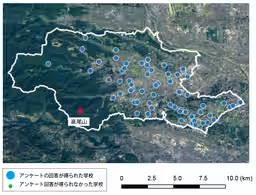
The researchers meticulously gathered the lyrics of school songs from official school websites, focusing on terms related to nature, particularly mountains. They examined the presence or absence of words like "Takao Mountain," "mountain," and "peak." Complementing this linguistic analysis, a survey was distributed to schools to collect information about their nature-related activities. This included whether they undertook nature experience activities, participated in local conservation efforts, and utilized nearby green spaces for educational purposes. From a total of 103 schools surveyed, 63 provided valid responses, leading to significant findings.
The results indicated a notable correlation. Schools that featured general mountain-related terms in their songs were more likely to engage with nearby green spaces for educational activities. For instance, while only 7 schools included the specific term "Takao Mountain," 30 songs contained more general mountain-related vocabulary. Interestingly, the survey revealed that 29 schools conducted nature experience activities, and 42 utilized nearby green spaces. However, participation in local conservation initiatives was disappointingly low, with only 3 schools involved.
Implications of the Findings
These results imply that the incorporation of natural imagery in school songs plays a significant role in how schools relate to their environmental surroundings. The presence of generic mountain terms possibly fosters a culture where educational institutions actively engage with their nearby natural environments. This aligns with the idea that cultural expressions, such as lyrics, can influence behaviors—especially concerning environmental awareness and nature interactions among students.
The Importance of Cultural Services
The study also emphasizes the non-material benefits that nature provides, often described as cultural services. It identifies that our surrounding natural beauty, sense of place, and cultural symbols can significantly impact personal values and behaviors. As cultural representations, school songs serve as a medium to express and reinforce the relationship between students and their local ecosystems.
Children's early experiences with nature can have lasting impacts on their future environmental consciousness. This suggests that school songs, which root themselves in the local natural environment, could play a pivotal role in nurturing a generation of environmentally-minded individuals.
Expanding the Framework of Study
While this study sets the groundwork for understanding the connection between school culture and local nature, it is important to note its limitations. Future research could explore other natural elements beyond mountains—such as rivers, forests, and wildlife—to provide a more holistic understanding. Furthermore, the analysis primarily explores correlations rather than causal relationships, indicating a need for further investigations to clarify whether school songs influence educational practices or reflect broader regional environmental orientations.
Conclusion and Future Perspectives
This enlightening research sheds light on how school songs, often overlooked elements of school culture, can embody and influence the relationship between educational institutions and their natural surroundings. By intertwining cultural expression with environmental awareness, the study opens avenues for enhancing environmental education and community development.
Further Reading
This research was published on April 8th in the journal "Nature Conservation," underlining the vital interplay between cultural ecosystem services and educational frameworks. The full study can be accessed at Nature Conservation.
Keywords and References
Cultural services: Non-material benefits such as aesthetic beauty and symbolic values.
Ecosystem services: Divided into four categories, including cultural services that encompass human experiences and interactions with nature.
- ---


Topics People & Culture)








【About Using Articles】
You can freely use the title and article content by linking to the page where the article is posted.
※ Images cannot be used.
【About Links】
Links are free to use.