



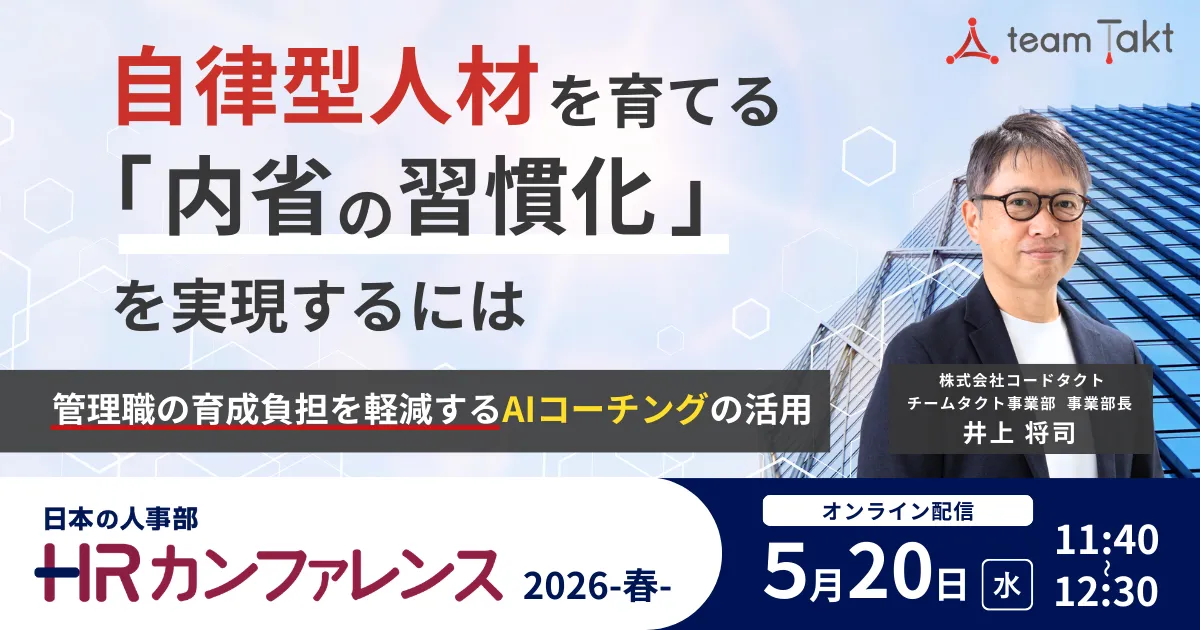
Overcoming the Challenge of Managerial Burden with AI and Self-Driven Learning
Introduction
In the contemporary corporate landscape, the burden placed on managers, particularly in Japan, is reaching unprecedented levels. The traditional model of leadership often assumes that managers will not only guide their teams but also shoulder the lion's share of training and developmental responsibilities. This dependency creates a damaging dynamic where development feels less like growth and more like a punitive exercise. Addressing these structural challenges is essential, especially as organizations aim to foster environments where employees can take charge of their own growth.
Key Issues Facing Managers
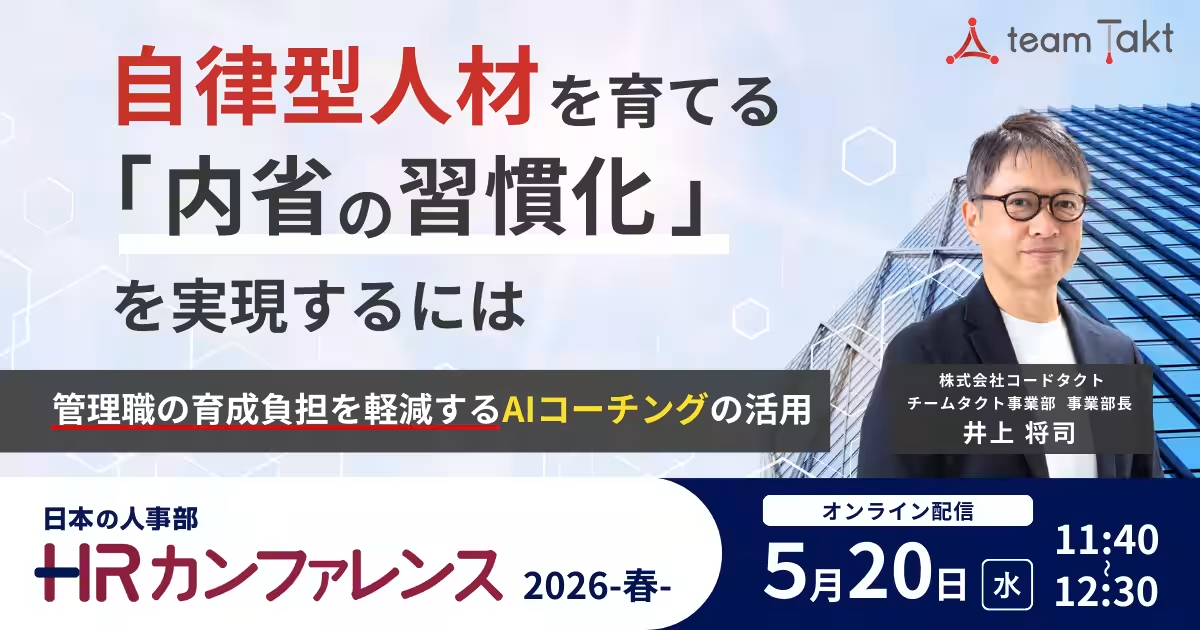
As discussed by Masashi Inoue, Director of Team Takt from Code Takt, during the upcoming HR Conference 2026, many young employees tend to adopt a passive waiting posture, waiting for directives instead of taking initiative. This situation is exacerbated by the fact that skill development heavily relies on the individual qualities and availability of their direct supervisors, leading to inconsistencies in training quality.
Moreover, managers are often overwhelmed with numerous responsibilities, making it almost impossible for them to engage in deep, meaningful conversations with each team member. As a consequence, training has started to feel like a punitive task rather than an opportunity for growth. The talk aims to offer new solutions that leverage AI coaching alongside practices that encourage self-reflection among employees.
AI Coaching and Self-Driven Learning
The upcoming presentation at the HR Conference will introduce innovative methods aimed at alleviating managerial load by instilling a sense of self-driven motivation among team members. By integrating AI coaching, organizations can empower employees to engage in self-reflective practices that facilitate personal growth and encourage them to take the reins of their learning experiences.
When employees are motivated to derive lessons from their own experiences, it not only enhances their capability to navigate challenges independently but also fosters a culture of accountability and proactivity within teams. This transformation shifts the focus from a manager-centric development model to one that encourages team members to be the engines of their advancement.
Practical Demonstrations
During the conference, Inoue will share practical case studies demonstrating how organizations have successfully implemented AI coaching methods to save time and resources, while greatly improving employee engagement and performance outcomes. These examples will highlight how technology can support the foundational shift needed to cultivate a workforce that is equipped and eager to learn autonomously rather than relying solely on managerial guidance.
Importance of Self-Reflection
The significance of instilling self-reflection habits in employees cannot be overstated. When staff can independently analyze their performance, they develop critical thinking skills that empower them to ask questions, seek assistance when necessary, and ultimately take initiative. This independence can lead to meaningful cultural shifts within teams and across entire organizations, reducing the prevalent dependency on managerial oversight.
Conclusion
As we approach HR Conference 2026, the importance of addressing the structural challenges faced by managerial staff has never been more crucial. The integration of AI coaching into professional development frameworks offers a beacon of hope, promising to lighten the load on managers while fostering self-sufficient employees capable of ongoing growth. Join Inoue as he elaborates on strategies aimed at creating self-directed teams that reflect positively on overall organizational performance.
By addressing these key issues collaboratively, participants can explore solutions that will not only enhance workplace dynamics but also build a robust foundation for future organizational success.
Topics People & Culture)





【About Using Articles】
You can freely use the title and article content by linking to the page where the article is posted.
※ Images cannot be used.
【About Links】
Links are free to use.