



Innovative Bioactive Glass Developed to Enhance Bone Regeneration and Antibacterial Properties
Newly Developed Bioactive Glass: A Leap Forward in Dental and Tissue Engineering
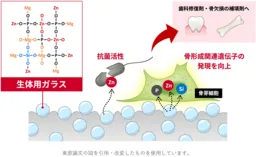
A recent collaboration between researchers from AIST, Chubu University, Osaka University, and Nagoya Institute of Technology has led to a significant advancement in the field of bioactive materials. They have created a new bioactive glass, specifically designed to enhance both antibacterial properties and bone regeneration functions, known as the MgO-ZnO-P2O5-SiO2 glass. The innovative glass structure is composed solely of ortho-tetrahedra, which makes it unique compared to traditional phosphate glasses.
Bioactive glass is a vital material used in various medical applications, such as bone grafts, treatment for periodontal disease, and sensory hypersensitivity care. One popular form, phosphate glass, allows for a diverse range of elements to be introduced, which can be released as inorganic ions to activate cellular functions. However, if inorganic ions are released excessively, they may hinder cellular activity.
Zinc (Zn) is known as an essential trace element that plays a significant role in bone formation and exhibits antibacterial characteristics. The challenge when developing bioactive materials utilizing zinc lies in the need to control the release amount due to the potential toxicity it can pose to cells.
The research team successfully controlled the release of zinc ions by incorporating zinc into the glass structure, allowing for a balanced combination of excellent antibacterial activity and promotion of bone formation. Unlike conventional phosphate glasses, which consist of PO4 tetrahedra connected by oxygen-sharing covalent bonds forming long-chain structures, this new glass features a unique lattice structure devoid of such long-chain formations. This innovation allows other elements like zinc to enhance gene expression related to bone formation when released from the glass.
The advancements made by this research are expected to significantly impact the development of new bioadaptive materials that effectively stimulate biological processes. The details of this groundbreaking research were published in the journal Advanced Healthcare Materials on September 6, 2025.
The Societal Context of Bioactive Materials
Bioactive materials have been developed since the 1960s and 1970s, focusing on materials that can safely interact with biological systems without adverse effects. This development has evolved into the creation of bioactive materials and bioabsorbable materials since the 1980s. Nowadays, there is significant interest in materials that possess tissue regeneration capabilities through cellular activation.
Among these materials, bioactive glass has been particularly noted for its ability to elicit cellular responses and release inorganic ions that promote bone growth when in contact with biological tissue. Traditional phosphate glasses are generally easier to manipulate than silicate glasses, as they allow for the introduction of various elements that can positively impact cellular activities. However, it's crucial to control the release rates of these ions to prevent any inhibitory effects on cellular functions.
The Research Framework and Findings
In this study, the core structural components of the glass—Zn (zinc) and Mg (magnesium)—were identified as essential for forming the needed lattice structure. The project involved meticulous modeling of the structure to ensure that the glass network would support optimal ionic release behaviors.
The newly developed MgO-ZnO-P2O5-SiO2 glass is structured so that zinc and magnesium serve as connecting elements between phosphate and silicate tetrahedra, which are fundamental to the glass network. The new bioactive glass was confirmed through solid-state NMR analyses, indicating that the ortho-tetrahedra remain intact without forming long chains.
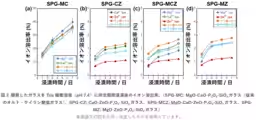
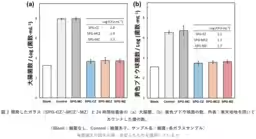
Significantly, this glass was engineered to limit the total release of zinc ions to less than 0.08 mM, which is well below toxic levels for human osteoblasts. Comparative tests showed that this new glass demonstrated antibacterial properties against pathogens, significantly reducing the number of bacteria present under controlled conditions.
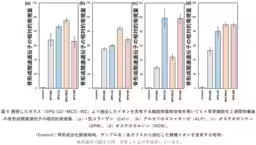
Furthermore, the zinc-containing glass displayed pronounced effects on key genes related to bone regeneration. Cells cultured with the ions released from this glass exhibited an over 50-fold increase in gene expression levels related to osteogenesis compared to controls.
In conclusion, this study marks an important step toward developing innovative materials that can be utilized in dental and tissue engineering applications. The research team's focus going forward will be on fully utilizing the antibacterial and osteogenic properties of this glass, paving the way for future advancements in clinical applications.
Future Directions
Looking ahead, the research team plans to explore applications of the developed glass in dental materials and scaffolding for tissue engineering. The potential for biomaterials to drive regenerative medicine forward is vast, and this innovation could set new standards in biocompatibility and functional effectiveness.
Publication Information
- - Journal: Advanced Healthcare Materials
- - Title: Preparation of Bifunctional Orthosilicophosphate MgO-CaO-ZnO-P2O5-SiO2 Glasses: in vitro Evaluation of Antibacterial Activity and Osteoblast Gene Expression Behavior
- - Authors: Sungho Lee, Hayato Asano, Makoto Sakurai, Takayoshi Nakano, and Toshihiro Kasuga
- - DOI: 10.1002/adhm.202502546


Topics Health)
【About Using Articles】
You can freely use the title and article content by linking to the page where the article is posted.
※ Images cannot be used.
【About Links】
Links are free to use.