



Impacts of Common Test Difficulty on University Applications in Japan: An Overview of 2026 and Projections for 2027
Overview of 2026 University Entrance Exams and Projections for 2027
The landscape of university admissions in Japan has faced significant transformations, primarily driven by the rising complexities of standardized tests. A recent release from Kawai Juku, showcased on the educational information platform "Kei-Net Plus," elucidates the outcomes of the 2026 university entrance exams and anticipates trends for the upcoming 2027 academic year.
Decline in Applicants for Public Universities
In the aftermath of the 2026 general selection examinations, it was observed that the average scores on the Common Test, in its second year of implementation, led to a notable decrease in applicants for mid- and late-stage entry schedules at national and public universities. Despite the 18-year-old population remaining stable at around 1.103 million, many students opted out of applying to these challenging programs in light of their average scores.
- - For Public Universities: While the number of applicants for the early entry schedule remained constant at 100% compared to the previous year, a discernible trend emerged where candidates who struggled with their Common Test scores were reluctant to apply for the more competitive mid- and late-stage schedules.
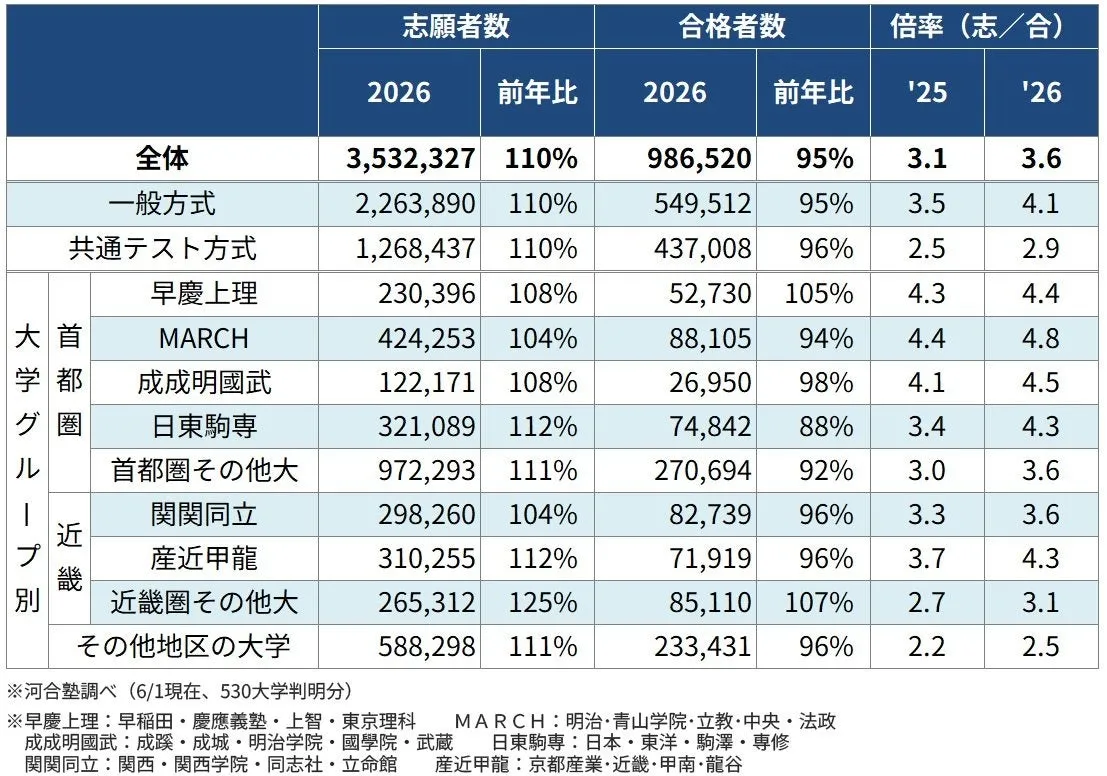
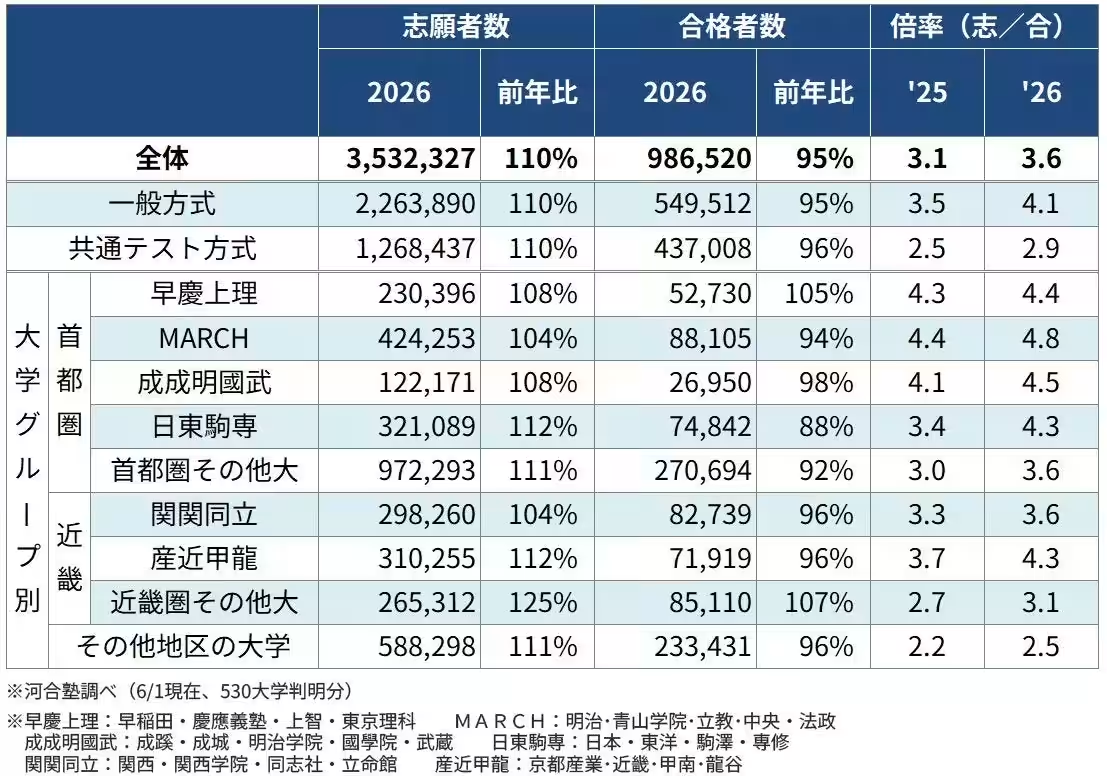
- - For Private Universities: Interestingly, the total number of applicants surged to 110% year-over-year. Students displayed a tendency to apply to more institutions to mitigate risks; however, the expansion of admissions and management of capacity by universities resulted in increased competition and higher acceptance ratios.
Continued Decline in Medical Student Applicants
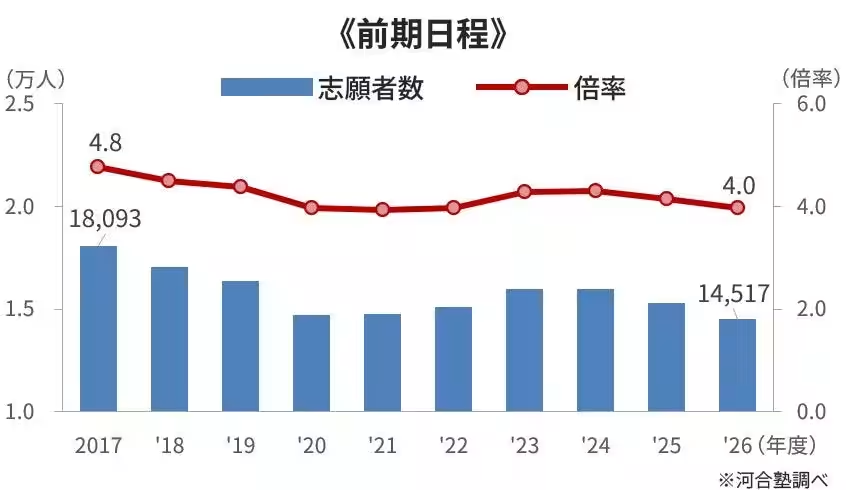
The trend of declining applicants for medical programs at national and public universities persisted. This was reflected in the average acceptance ratio, which dropped from 4.8 in 2017 to 4.0 this year, indicating a steady decline over the past decade.
- - For Medical Programs: The waning popularity of medical fields, paired with the increased difficulty of the Common Test, has made students more cautious in their applications. For private medical schools, while there was a slight increase of 104% compared to last year, this paled in comparison to the overall increase in private universities (110%).
Trends for 2027: A Shift Towards STEM and New Educational Programs
The release also highlighted key focal points as we advance to the 2027 academic year.
- - Emphasis on STEM Fields: The Ministry of Education aims for half of university enrollments by 2040 to be in fields such as science, technology, agriculture, and digital systems. This has encouraged the establishment of new programs that align with current market demands, including information technology and sustainable practices.
- - Emergence of Innovative Programs: Prestigious institutions like the University of Tokyo and Tohoku University are unveiling new academic programs that defy traditional educational frameworks.
- - Changes in Admission Rules: From 2027, interviews will become mandatory for certain admission categories, including comprehensive and school recommendation selections. For a more detailed exploration of these topics and regional variations, resources are available for educators on Kei-Net Plus.
The future of university admissions in Japan appears to be on a transformative path, with shifting interests towards more technical and scientific domains. As universities adapt to these changes, prospective students are encouraged to stay informed and proactively strategize their applications.
Related Articles
- - Summary of 2026 Entrance Exam Results
- - Summary of Medical Admissions for 2026
- - Outlook for 2027 University Admissions
For Media Inquiries
If quoting or reproducing this release, please credit "Kawai Juku Kei-Net Plus". We welcome discussions for clarifications or interviews with our representatives.
Topics Other)
【About Using Articles】
You can freely use the title and article content by linking to the page where the article is posted.
※ Images cannot be used.
【About Links】
Links are free to use.