




Innovative Approach to Assess Ilmenite Content on the Moon's Surface Using Reflectance Spectroscopy
New Developments in Lunar Resource Assessment
Recent advancements at the National Institute of Advanced Industrial Science and Technology (AIST) have focused on improving methods to accurately estimate the amount of ilmenite (FeTiO3) present on the Moon. Understanding the distribution of this important mineral is crucial for resource development, particularly for planned human activities on lunar surfaces. Ilmenite is a significant source of essential resources such as water, oxygen, iron, and titanium, making it a component of great interest for future lunar missions.
Understanding Ilmenite's Importance
Ilmenite is often found within basalt on the Moon, and its unique properties could provide vital materials needed for sustaining human activities in the harsh lunar environment. Notably, determining the precise distribution of ilmenite is essential for selecting optimal sites for lunar bases and other resource extraction initiatives. Moreover, ilmenite serves as a key to understanding the Moon's geological history, functioning like a 'bottle letter' containing information about the Moon's magma composition and evolutionary processes.
Overcoming Challenges in Spectral Analysis
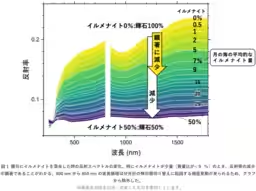
The research team, led by Moe Matsuoka and Satoru Yamamoto, has tackled the significant challenge in remote sensing analysis: the difficulty in accurately estimating ilmenite content due to its varying spectral characteristics when mixed with other minerals. Traditional methodologies struggled with this because the spectral data of rocks containing ilmenite changes significantly with mixing ratios. To address this, researchers recreated a lunar regolith sample by mixing ilmenite and pyroxene (another mineral found on the Moon) in proportions of up to 50% ilmenite in 25 stages. The samples were meticulously mixed and analyzed to improve the reliability of spectral data that will facilitate lunar exploration.
Experimental Approach and Findings
The researchers conducted a series of experiments wherein they varied the mass ratio of ilmenite to pyroxene, achieving precise control over the mixing proportions. This led to the discovery of specific spectral properties characterized by a significant decline in reflectance, termed ‘darkening,’ which occurs even with minimal amounts of ilmenite present. Through this painstaking comparison of mixed samples with varying ratios, the team identified how these changes affect the spectral data, providing a clearer understanding of ilmenite’s reflective characteristics.
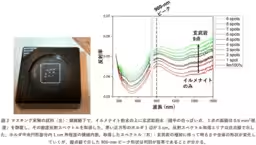
Moreover, a novel experimental approach was introduced that utilized both mixing and masking techniques to analyze different configurations of mineral presence. The hypothesis was that variations could yield insights into how ilmenite-rich areas might react when exposed to other types of rock from meteoric impacts.
Future Implications
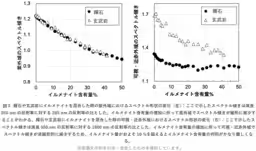
One key finding is that the ultraviolet spectral characteristics of ilmenite displayed a strong linear relationship, which opens up a pathway for more accurate estimations of its presence on the lunar surface. This research not only aims to bolster lunar scientific understanding but also supports industrial ambitions for lunar resource utilization. The findings will provide a robust foundation for a database on mineral reflectance spectra, essential for pinpointing resource-rich locations on the Moon.
In conclusion, the capabilities established through this research lay critical groundwork for future lunar missions and resource development initiatives aimed at utilizing the Moon’s natural wealth. The full details of this research are set to be published in the upcoming edition of The Planetary Science Journal on February 24, 2026, illustrating the scientific community's commitment to deepening our comprehension of lunar geology through innovative and methodical approaches.
References
- - The Planetary Science Journal
- - AIST Press Release: Link

Topics Entertainment & Media)
【About Using Articles】
You can freely use the title and article content by linking to the page where the article is posted.
※ Images cannot be used.
【About Links】
Links are free to use.