



FANCL Unveils New Research on Supplement Formulations at 40th Annual Meeting
FANCL's Presentation at the 40th Annual Meeting
FANCL Corporation made a significant impact at the 40th Annual Meeting of the Japanese Pharmaceutical Association, where it presented four key research projects related to formulation development. The studies primarily focused on creating supplements that are easier to swallow and ensuring a stable supply of products for customers. Here are the highlights from their presentation:
1. Research on Swallowability of Supplement Tablets
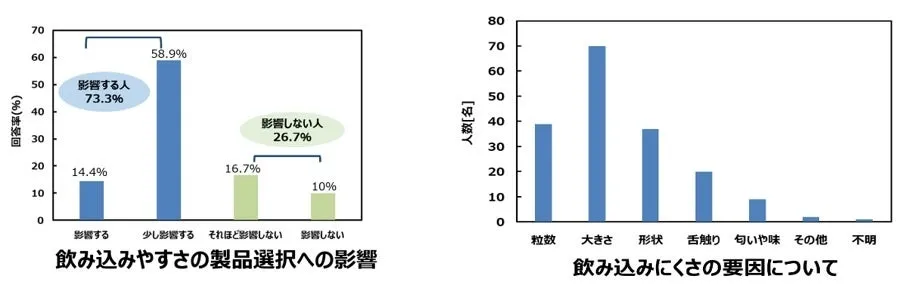
An in-depth customer survey revealed that approximately 70% of consumers prioritize "swallowability" when choosing supplement products. FANCL has been actively working on reducing tablet size and quantity to enhance swallowability. This year, they expanded their investigation to include factors such as tablet shape and texture.
Shape Considerations
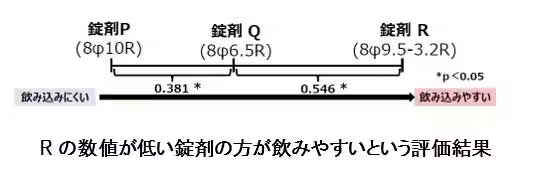
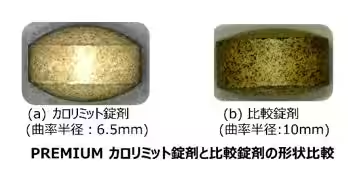
Most standard tablets have a dome-like shape. In their research, FANCL assessed how the curvature of this dome affects swallowability by varying the radius of curvature (referred to as R). They found that even if tablets weigh the same, reducing R results in a visibly rounder tablet, which significantly enhances ease of swallowing based on the feedback from test subjects.
Surface Texture
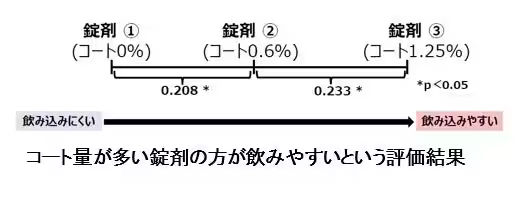
Coating tablets to mask bitterness is a commonly accepted method in supplement manufacturing. The study explored how the thickness of these coatings impacts swallowability. By varying the coating's proportional weight from 0% to 1.25%, FANCL established that increased coating thickness correlates with improved swallowability. These insights have now been utilized in the development of their premium "Calorie Limit" product line, which features smaller tablets with a coating thickness exceeding 1.0% for better user experience.
2. Designing Chitosan-Containing Tablets for Acidic Environments
Typically, supplement tablets undergo a "disintegration test" in a water environment to ensure they dissolve effectively. As part of their research, FANCL sought to simulate the stomach's acidic conditions using a standard liquid (JP 1st Liquid) to analyze the disintegration properties of chitosan tablets.
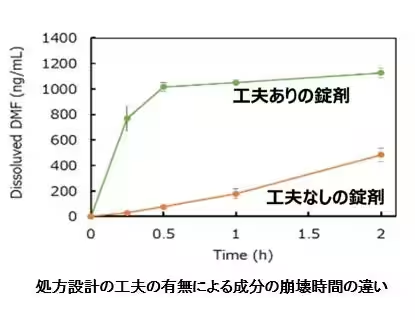
They discovered that while chitosan tablets dissolved well in water, in acidic conditions, they formed a gel layer that inhibited the release of active ingredients. Consequently, FANCL optimized the formulation by modifying the chitosan processing and integrating materials that can neutralize acidity. This led to the successful design of tablets that reliably disintegrate in acidic environments, ensuring active ingredients work efficiently within the gastrointestinal tract.
3. Stable Supply Technologies
Beyond the studies mentioned, FANCL gained valuable insights into technologies aimed at ensuring a stable supply of products. Two key innovations were introduced:
- - Compression Property Evaluation: This technique predicts manufacturing issues that can arise from compressing difficult-to-machine ingredients for tablets.
- - Rheometer Evaluation for Soft Capsules: This approach assesses potential manufacturing problems that may occur during the production of soft capsules.
A Commitment to High-Quality Supplements
A spokesperson from FANCL emphasized that no matter how effective the ingredients are, without appropriate formulation design, customers cannot realize their benefits. FANCL remains dedicated to optimizing formulations by considering manufacturability, usability, and absorption from multiple perspectives. The recent research outcomes contribute to their ongoing commitment to developing high-quality supplements that deliver effective results. Moving forward, FANCL aims to incorporate practical quality assessments to further enhance their production of superior products that support customer health and satisfaction.
Glossary
1. JP 1st Liquid: An acidic testing solution compliant with Japanese Pharmacopoeia, simulating the gastric environment with a pH of 1.2, used for evaluating the dissolution of drugs.
2. Chitosan: A polysaccharide derived from the shells of crustaceans such as crabs and shrimp through processing chitin.
3. Gel Layer: A swelling layer formed when high molecular weight compounds react with moisture, significantly influencing disintegration and dissolution properties.
Topics Health)
【About Using Articles】
You can freely use the title and article content by linking to the page where the article is posted.
※ Images cannot be used.
【About Links】
Links are free to use.