



Revealing the Invisible Connections Among Neurons: A New Method for Detecting Functional Neural Connections
New Method for Neural Connection Detection
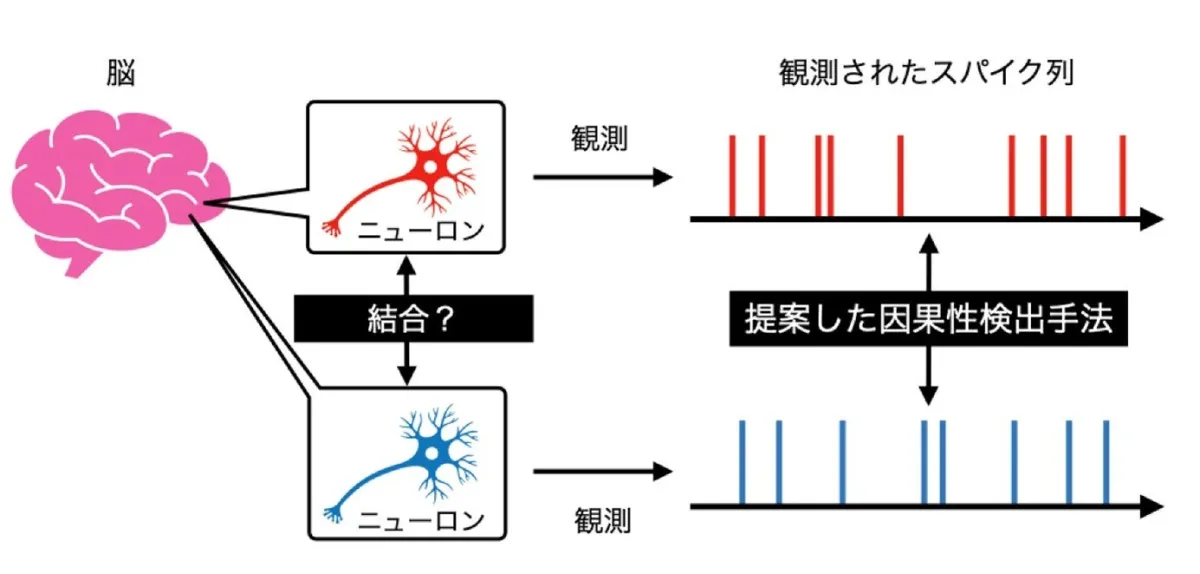
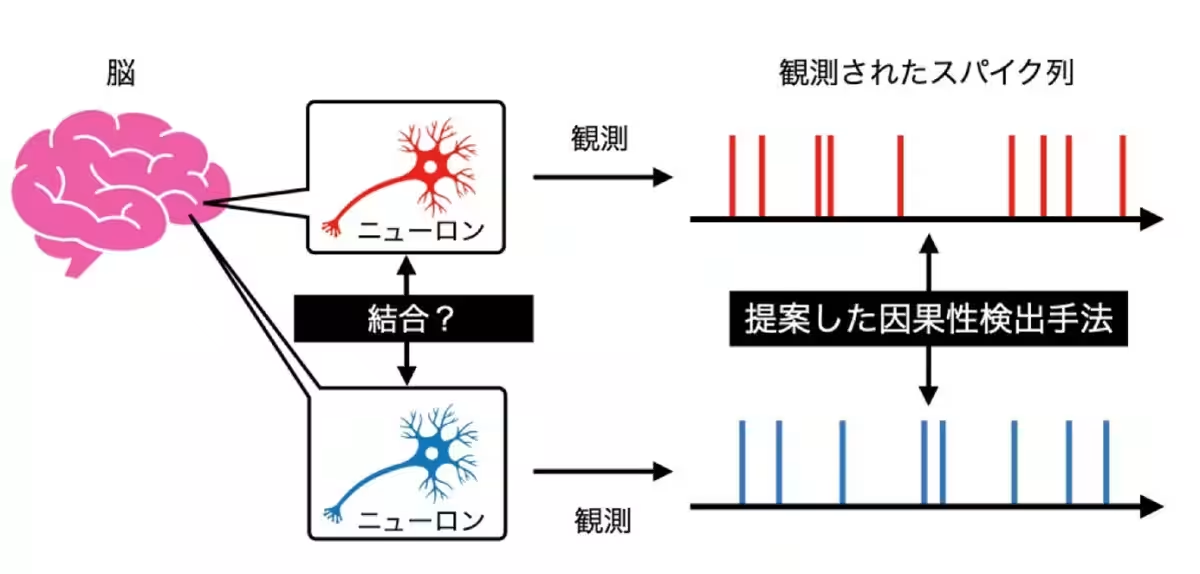
Researchers from the Faculty of Engineering at Tokyo University of Science, led by Assistant Professor Kazuya Sawada, have developed an innovative technique to elucidate the causal relationships among neurons using only the spike train data recorded from these neural cells. This advancement is anticipated to significantly contribute to understanding treatments for neurological disorders and mental health conditions.
Understanding Neural Activity
The electrical signals generated by neurons when they fire are known as spikes. Recently, we've made advancements in accurately recording these spikes over time. These recorded spike trains allow researchers to study how neurons connect and interact. However, previous methods for inferring causal relationships were not suitable for spike trains that exhibit chaotic behavior.
Presenting a New Approach
The newly developed technique effectively detects causal relationships in point process data like spike trains, particularly from complex non-linear systems. By identifying the connections among neurons, this method aims to provide not only a deeper insight into how neuronal networks function but also support the treatment of disorders and mental illnesses caused by these neural connections.
This research was published online on July 28, 2025, in the international journal "Physical Review E."
Background of the Study
Neurons work intricately in a network, providing complex responses and interactions. Despite advancements in measuring multiple spike trains simultaneously, the nature of these relationships—especially their causal aspects—remains relatively unclear. Previous techniques such as Granger causality (GC) and transfer entropy (TE) have been widely used for time series data but struggle with non-linear causal relationships due to their specific requirements.
For instance, GC works primarily with linearly separable data, while TE demands extensive data for probability distributions, often complicating the analysis of time-lagged relationships. Although the Convergent Cross Mapping (CCM) method is effective for non-linear data, it is also restricted to uniformly sampled datasets and therefore cannot be directly applied to the irregular sampling typical of spike trains.
Advancing CCM Methodology
To overcome these limitations, the approach adapted CCM for spike trains by utilizing interspike intervals (ISI) instead of raw spike data. By establishing a correspondence between ISI data and predicting spiking events based on the closest prior firing times from another neuron, researchers can detect causal relationships and validate them through the
Topics Health)
【About Using Articles】
You can freely use the title and article content by linking to the page where the article is posted.
※ Images cannot be used.
【About Links】
Links are free to use.