



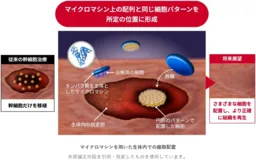
Revolutionizing Tissue Regeneration Through Cell Patterning with Micromachines
Advanced Tissue Engineering Using Micromachines
Researchers at the National Institute of Advanced Industrial Science and Technology (AIST) have developed groundbreaking technology utilizing micromachines to position cells in desired patterns within living organisms. This new method is geared towards facilitating intricate tissue regeneration, providing a significant leap in regenerative medicine.
Overview of the Research
The team, led by Takamitsu Yamazoe from AIST's Molecular BioSystems Research Division and Shinichiro Shinzaki of Hyogo Medical University, has demonstrated the capability to quickly arrange stem cells in specific patterns when implanted into injured tissues, particularly in an animal model of ulcerative colitis. This represents a major advancement over conventional stem cell therapies that have struggled with precise control over the complex processes involved in tissue repair.
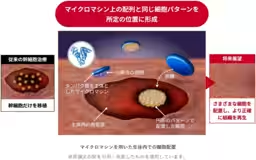
Historically, stem cell treatments have involved a straightforward transplantation of cells to damaged areas without ensuring the ideal arrangement needed for effective tissue regeneration. With precise cell placement, it is anticipated that the interaction among various cell types will drive more successful repair processes, ultimately leading to the regeneration of normal tissue structures.
Challenges in Current Treatments
Current therapeutic approaches mainly focus on categorically placing stem cells at damaged sites. However, these methods have been insufficient in controlling the subsequent and complex stages of tissue repair that require the harmonious interaction of various cell types. Thus, there was a critical need for a technique allowing for the specific and rapid arrangement of cells in living organisms, while ensuring safety and minimizing invasiveness.
Introducing Micromachines for Cell Placement
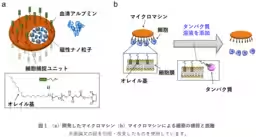
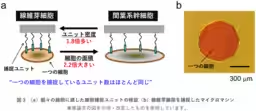
The recently developed micromachines are designed to fulfill several practical criteria: they can precisely position multiple cells in a predetermined pattern, operate through minimally invasive techniques, and do so within incredibly short time frames. This has been achieved through innovative engineering, where the micromachines are composed primarily of proteins, ensuring biocompatibility and safety in addition to utilizing iron oxide nanoparticles for magnetic response.
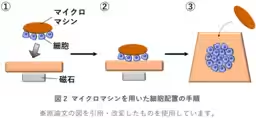
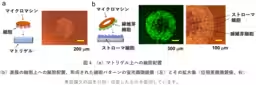
The novel method deploys micromachines containing specialized cell-capturing units that secure cells and enable them to detach precisely where required, forming desired cellular patterns within just 30 minutes. By employing collective cell placement rather than arranging cells individually, the technique significantly reduces the time and complexity involved in cell pattern fabrication.
Practical Applications in Medicine
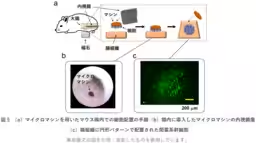
In an experimental application, the team successfully placed therapeutic mesenchymal stem cells into the intestinal tissues of ulcerative colitis model mice. Utilizing endoscopy, they were able to position the micromachines directly above intended target areas, allowing for the precise placement of cells in complex patterns within the tissues. The results showed clear establishment of the cell patterns, validating the effectiveness and rapidity of the technique.
The application of this cell-placement technology is expected to revolutionize regenerative medicine by providing insights into how to optimally configure various cell types for effective tissue repair. Future studies will focus on understanding how the positioned cells contribute to tissue regeneration and healing processes, driving advances in stem cell therapies.
Future Directions
The ongoing research and development will continue to refine this micromachine technology, exploring its potential in treating various tissue injuries across organs like the intestines, liver, and heart. Further innovations are expected to enhance the precision and effectiveness of cell therapy significantly.
This research was published in "Materials Today Bio" on December 17, 2025, marking a notable achievement in advancing medical treatment for chronic diseases. By integrating practical methodologies from tissue engineering, researchers are paving the way for a new standard in regenerative medicine.
Conclusion
The innovative approach of using micromachines for in vivo cell arrangement represents a promising frontier in regenerative medicine, with the potential to drastically alter the landscape of how we treat chronic tissue injuries and diseases. As we move forward, the implications of this research promise to unlock new possibilities in both scientific understanding and clinical applications in cell therapy and tissue engineering.
Topics Health)

【About Using Articles】
You can freely use the title and article content by linking to the page where the article is posted.
※ Images cannot be used.
【About Links】
Links are free to use.