



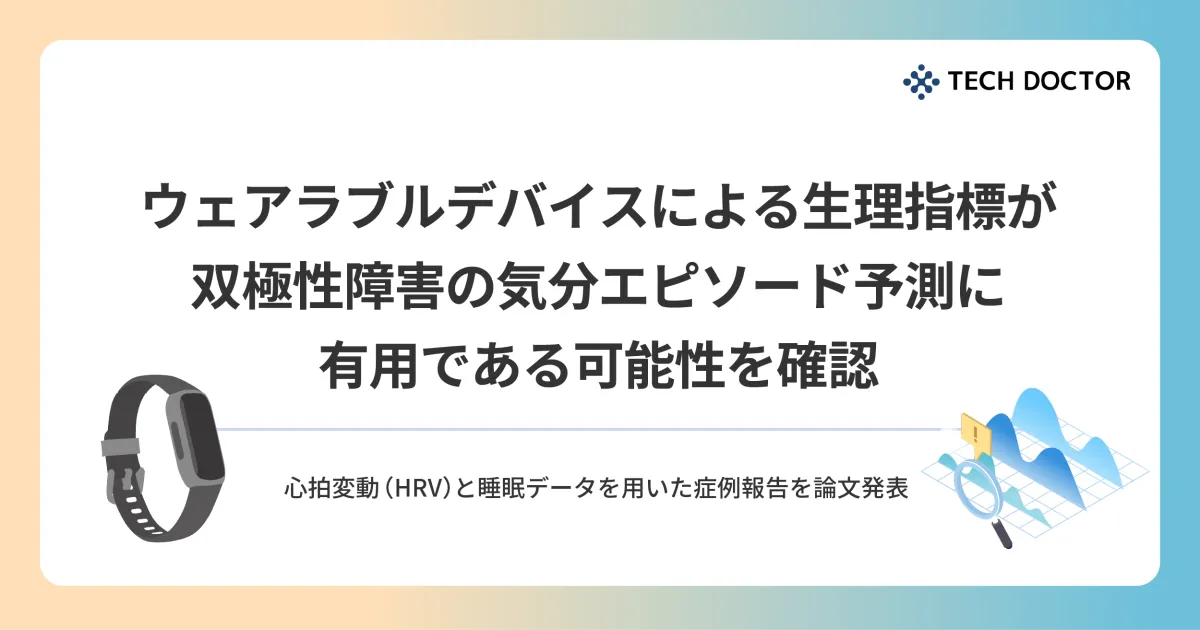
Exploring the Predictive Power of Wearable Devices for Mood Episodes in Bipolar Disorder
Exploring the Predictive Power of Wearable Devices for Mood Episodes in Bipolar Disorder
Tech Doctor, led by President Kazushi Minato, recently shared significant findings regarding predicting mood episodes related to bipolar disorder in the esteemed journal, Frontiers in Psychiatry. This research established the potential of utilizing physiological indicators obtained from wearable devices, particularly heart rate variability (HRV) and sleep data, to identify changes preceding mood episodes.
Background and Research Overview
Bipolar disorder is a chronic mental illness characterized by cyclical manic and depressive episodes, severely impacting patients' social lives and overall quality of life (QOL). Early detection and prevention of mood episodes remain a crucial clinical challenge, as symptom onset can be sudden, making it difficult for patients to recognize changes as pathological. Moreover, various triggers, such as psychosocial stress and disruptions in sleep-wake rhythms, complicate the predictability and management of mood episodes.
Traditionally, mood assessment relied heavily on interviews and self-report questionnaires, which can be influenced by subjective factors like memory accuracy and personal bias, often leading to missed signs and delayed interventions.
Against this backdrop, the use of objective and continuously monitored physiological indicators is gaining attention. Recent advancements in wearable technology have provided the necessary tools to gather physiological and behavioral data, positioning HRV and sleep parameters as potential digital biomarkers for more objective clinical evaluations.
Research Details
The case study focused on a male patient in his 40s diagnosed with bipolar disorder, and data collection was carried out over approximately eight months. Key details of the research included:
- - Research Period: February to November 2024
- - Subject: One male patient diagnosed with bipolar disorder
- - Objective Data: Heart rate, sleep, and activity levels obtained from a Google Fitbit Charge 6
- - Subjective Assessment: Daily self-evaluations recorded via the eMoods app, where mood states were rated on a scale of 1 (none) to 4 (severe) across four categories:
- Elevated Mood (EM)
- Irritability
- Anxiety
Through continuous monitoring, the study aimed to capture physiological changes preceding mood episodes.
Key Findings
The analysis uncovered several important correlations:
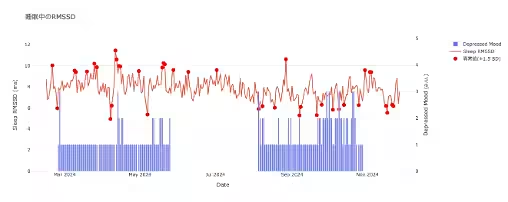
1. Decrease in Night-time RMSSD among Depressed Symptoms: A significant finding was that a decrease in night-time RMSSD exceeding 1.5 standard deviations from the individual's baseline indicated an approximately 87% probability (13 out of 14 days) for exacerbation of depressed mood scores within seven days.
2. Shorter Sleep Duration Linked to Elevated Mood Severity: Results suggested that as sleep duration decreased, the severity of elevated mood symptoms (EM score) tended to increase. Statistically significant differences were observed in the time spent in bed between groups classified by their EM scores (Welch's t-test, mean difference of 60.6 minutes).
3. No Clear Correlation between Daytime HRV, Activity, and Mood: Interestingly, no significant relationship was found between daytime HRV, activity levels, and mood states.
Social Significance and Future Outlook
This research emphasizes the innovative use of commercially available wearable devices in conjunction with mobile applications to collect and analyze mood-related data consistently. The identification of physiological patterns associated with both depressive and elevated mood symptoms presents a unique contribution to the field, especially considering the difficulty in capturing pre-episode changes through self-reporting.
The fluctuation of night-time RMSSD may serve as a promising indicator for early recognition of mood shifts, highlighting its potential utility in clinical practice.
Looking ahead, conducting larger-scale follow-up studies and developing predictive models of these physiological indicators will be crucial for further validating their clinical relevance and applicability in psychiatric settings.
Tech Doctor remains committed to exploring the potential of physiological data analysis through wearable devices, aiming to contribute to the development of objective evaluation methods in the mental health sector and enhancing data-driven healthcare.
Reference Information
- - Published in: Frontiers in Psychiatry
- - Publisher: Elsevier B.V.
- - Paper Title: Wearable-Derived Heart Rate Variability and Sleep Monitoring as Predictors of Mood Episodes in Bipolar Disorder: A Case Report
- - DOI: 10.3389/fpsyt.2025.1695158
- - Authors: Eto A, Mochizuki K, Fukami T, Sakakibara W, Izumi K.
- - Company Overview:
- Website: Technology Doctor
- Vision:
Topics Other)
【About Using Articles】
You can freely use the title and article content by linking to the page where the article is posted.
※ Images cannot be used.
【About Links】
Links are free to use.