



Strengthening One-Stop Support System for Chemical Substance Testing and Applications
Strengthening One-Stop Support System for Chemical Substance Testing and Applications
Toray Research Center (TRC), headquartered in Nihonbashi, Tokyo, and Toray Technology Inc. (TTK), based in Otsu, Shiga, have announced a significant bolstering of their one-stop support system in response to amendments to the Chemical Substances Control Act (CSCA) scheduled for implementation in 2025. This enhancement facilitates comprehensive assistance from the design of testing schemes required for applications of new chemical substances to actual testing execution and consulting on applications. By doing so, TRC and TTK can offer optimal testing plans and schedules that align with regulatory compliance, thus aiding customers in minimizing application risks, expediting product launches, and alleviating in-house burdens.
Background and Importance of Regulatory Compliance
Manufacturers and importers of new chemical substances must undergo pre-screening regarding toxicity to prevent any potential human health issues through environmental pathways as mandated by the CSCA. For low-molecular compounds, multiple tests are required, including those related to biodegradability, bioaccumulation, ecological impact, and genotoxicity. In contrast, high molecular compounds are evaluated using less stringent assessment methods, acknowledging their unique characteristics, such as difficulty penetrating biological membranes. The high polymer flow scheme test specifically assesses stability, solubility, and the concentration of low-molecular components to determine the environmental impact of chemical substances.
With the amendments to be implemented post-2025, the scope for utilizing existing knowledge and exemptions from testing requirements will be broadened. This increases the importance of designing suitable testing schemes and application strategies.
TRC and TTK's Comprehensive Support Approach
In the high polymer flow scheme tests, it is crucial to not only conduct tests but also to predict solubility and biodegradability in advance based on the chemical structure and composition ratio of the subject substances. This complex process integrates regulatory interpretation with chemical insights, which significantly influences the setting of testing conditions and the feasibility of execution.
Since the establishment of the testing protocol in 1987, TRC and TTK have accumulated a strong track record of testing and supporting applications for a wide variety of materials, including organic solvent-soluble polymers, water-soluble polymers, and those that decompose under acidic or alkaline conditions. Leveraging this extensive experience allows them to provide integrated support for designing testing schemes, strategizing applications, and optimizing schedules tailored to the properties of the substances involved.
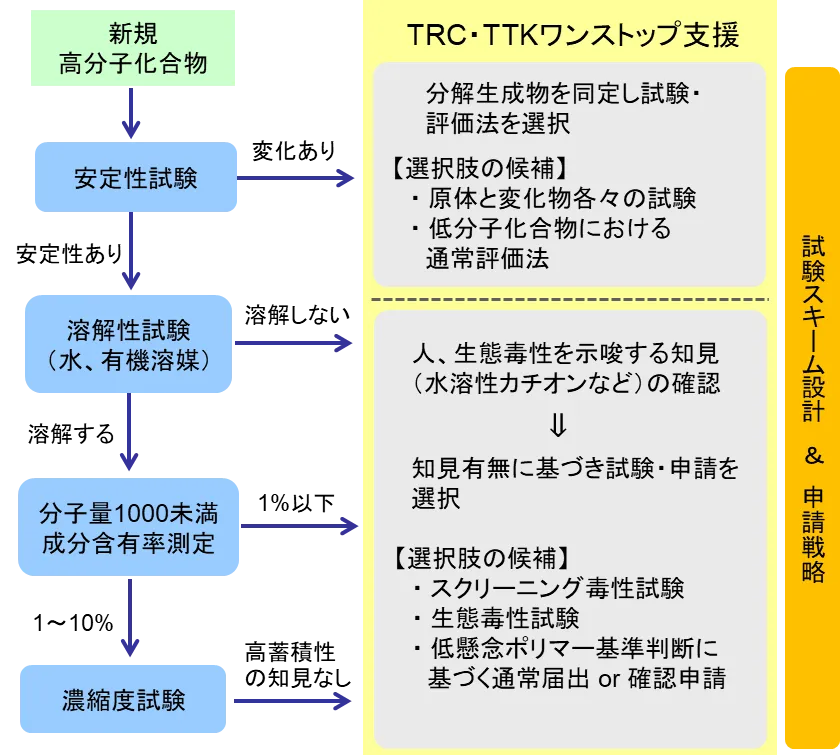
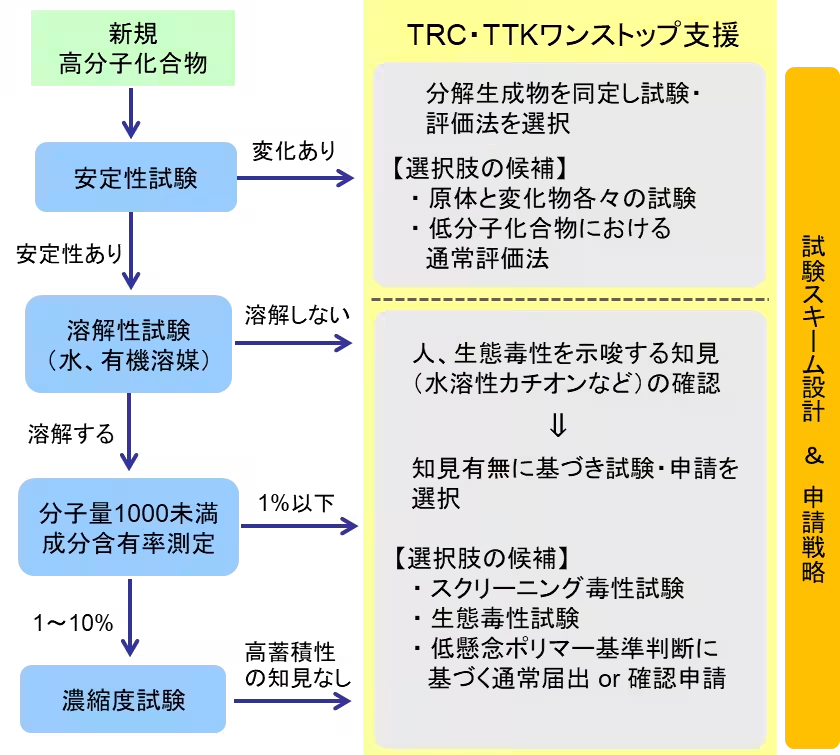
The decision-making process in high polymer flow scheme tests, depicted in Diagram 1, shows that continuous bifurcation based on physical property evaluations emphasizes the necessity of proficient design capabilities, including pre-assessment predictions.
Recent Enhancements to Support System
The recent enhancement in support systems follows the amendments to operational notifications effective from October 6, 2025, and the revisions to known knowledge notifications from April 24, 2026. TRC and TTK have bolstered their team of technical experts well-versed in the CSCA and related regulations, while also systematically organizing knowledge related to testing design and application strategies to accommodate these legislative changes.
This improvement enables a more efficient and precise provision of services compared to their previous individualized response strategies, allowing for a more comprehensive support structure from testing scheme formulation to application consulting.
Future Developments and Continuous Adaptation
The landscape of regulatory compliance for chemical substances extends beyond the CSCA and is anticipated to undergo continuous amendments and operational revisions. TRC and TTK plan to leverage their enhanced one-stop support system as a foundation not only for application support but also for providing insights into the latest regulatory trends through in-house seminars and facilitating consulting from the early stages of development. They aim to contribute substantially to customers’ smooth product development and social implementation.
Glossary of Terms
- - CSCA (Chemical Substances Control Act): Established in 1973 to regulate the manufacture, importation, and use of chemical substances deemed hazardous to human health through environmental exposure, requiring pre-approval from the government for new chemicals.
- - Operational Notification (Amended October 6, 2025, enforceable April 1, 2026): Guidelines detailing the operational methods and criteria of the CSCA.
- - Known Knowledge Notification (Amended April 24, 2026, enforceable June 1, 2026): Defines how existing knowledge regarding chemical properties can be utilized during applications.
Topics Consumer Products & Retail)
【About Using Articles】
You can freely use the title and article content by linking to the page where the article is posted.
※ Images cannot be used.
【About Links】
Links are free to use.