



Exploring the Potential of AI in Security Trade Management at Okayama University
AI in Security Trade Management: A Paradigm Shift at Okayama University
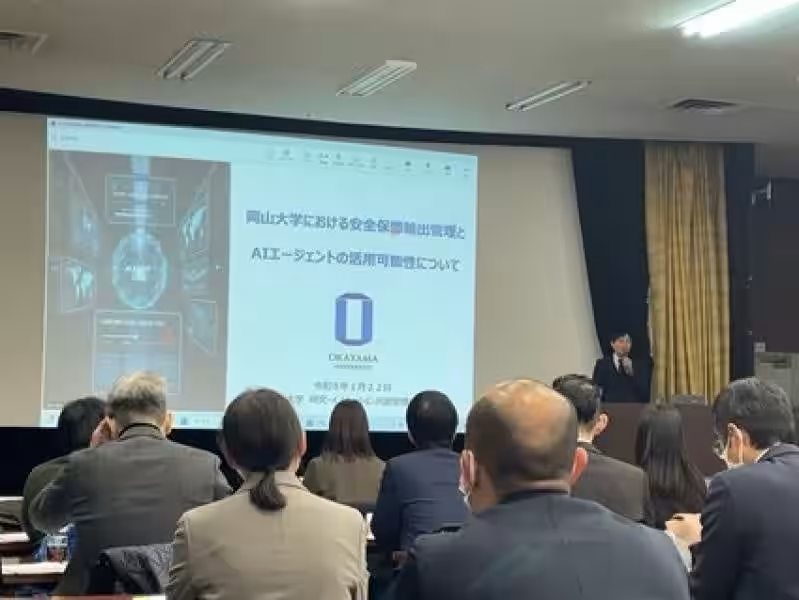
On February 4, 2026, Okayama University hosted a significant conference focusing on enhancing security trade management systems within universities and research institutions. Held at the Osaka Government Building, this event, organized by Japan's Ministry of Economy, Trade, and Industry, aimed to bolster security trade management frameworks nationally.
A key speaker at the conference was Takao Funakura, the Deputy Director of the Research and Innovation Collaboration Headquarters at Okayama University. During his presentation, he introduced practical examples of security trade management and the potential application of AI agents, underscoring their effectiveness and future expansion opportunities.
As global research collaboration increases, the complexities of export management tasks are on the rise. Funakura highlighted the growing demand for specialized judgment and the increasing workload placed on administrative staff due to challenges such as determining the applicability of cargo and technology, and verifying usage and end-users.
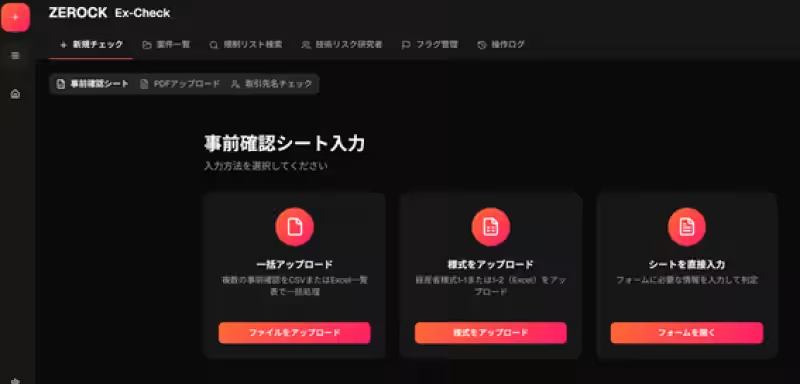
To address these challenges, Okayama University is advancing the “Administrative Staff Skill Enhancement Project” as part of the Ministry of Education’s “Regional Core and Distinctive Research University Enhancement Promotion Project (J-PEAKS).” In collaboration with the startup company TIMEWELL, the project focuses on developing AI agent tools designed to support security trade management tasks.
The AI tools aim to streamline the exhaustive matching tasks linked to large lists of cargo and technology while organizing judgment bases. This initiative seeks to prevent human error and improve overall efficiency in operations. The developing tools will feature functionalities that automatically organize and present concerns about usage and end-users in contention with catch-all regulations, thereby aiding administrative staff in making final decisions.
Throughout his presentation, Funakura emphasized that AI should not replace human judgment but should serve as supportive tools for human final decisions. This perspective on the realistic integration of generative AI in university practices generated considerable interest among conference attendees, who posed numerous questions regarding the implementation timeline, accuracy, and strategies for university deployment.
Comments from participants indicated a growing interest in AI agents as potential solutions to alleviate burdens associated with increasingly complex export management roles. Observations such as “AI agents can significantly reduce administrative workload amid rising complexities in export management tasks” and “Okayama University’s pioneering examples are invaluable for other institutions confronting similar challenges” were particularly striking.
Going forward, Okayama University will continue to promote the specialization of administrative staff through the J-PEAKS project and actively communicate novel initiatives based on on-the-ground challenges, contributing to the construction of a secure and reliable research environment while fostering university-originated innovations.
For universities and research institutions interested in the ongoing projects and AI agent tools, inquiries can be directed to the Research and Innovation Collaboration Headquarters at Okayama University.
Stay tuned for more updates on Okayama University's efforts as a leading regional core and distinctive research university.


Topics Other)
【About Using Articles】
You can freely use the title and article content by linking to the page where the article is posted.
※ Images cannot be used.
【About Links】
Links are free to use.