



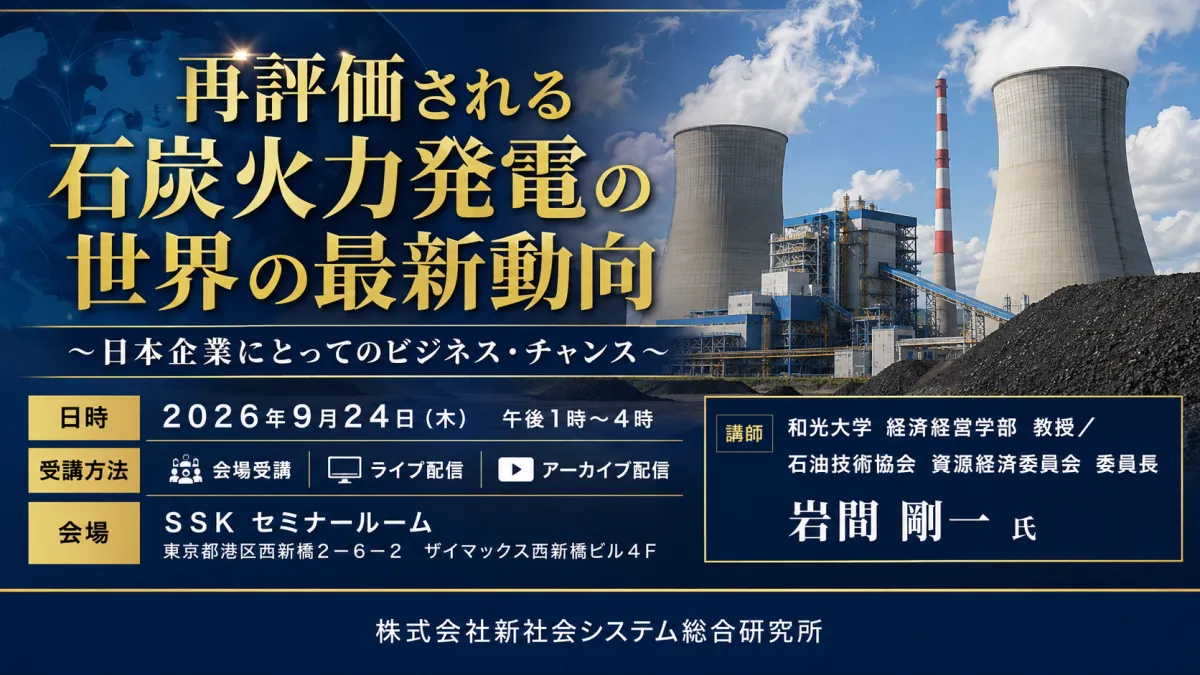
Exploring the Global Trends of Coal-Fired Power Generation: A New Business Opportunity
Recent Trends in the Re-Evaluation of Coal-Fired Power Generation
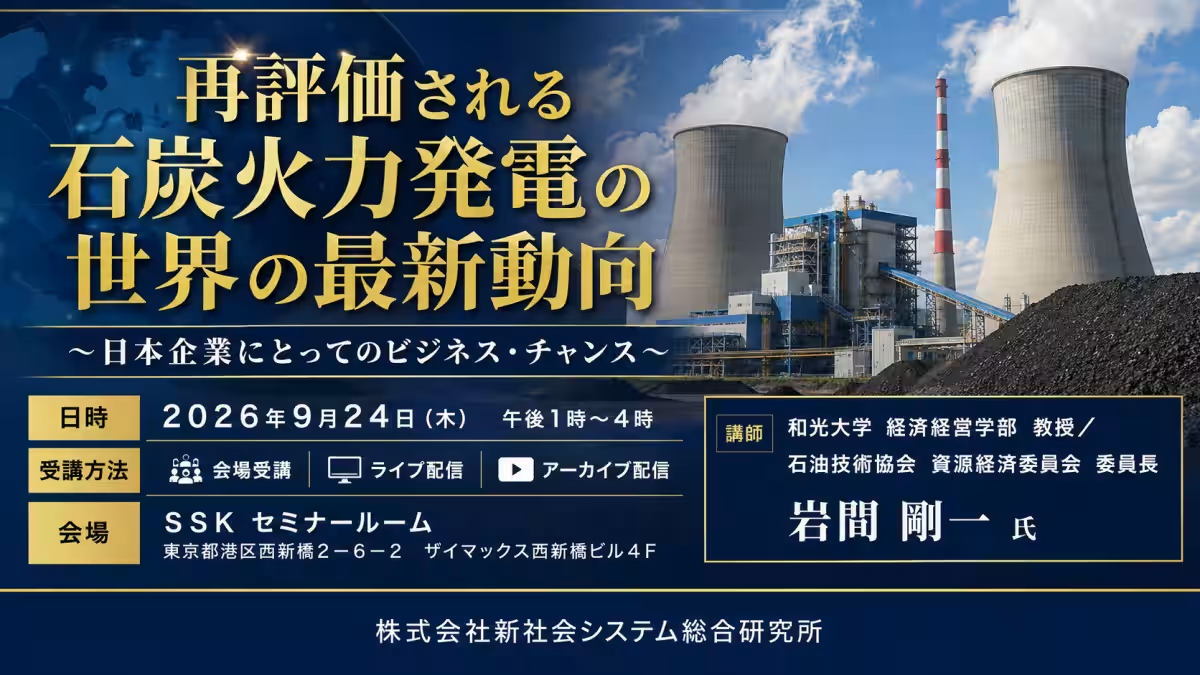
On September 24, 2026, a seminar is set to take place that focuses on the shifting landscape surrounding coal-fired power generation, featuring Taketoshi Iwama, a professor at Wako University and chairperson of the Resource Economy Committee at the Petroleum Technology Association. The ongoing global implications of geopolitical events are bringing the advantages of coal-fired power, especially for Japanese companies, back into focus.
Seminar Overview
This seminar will be held at the SSK Seminar Room in Minato-ku, Tokyo, with options for live streaming via Zoom and archival access for two weeks post-event. Iwama will delve into various pressing issues affecting coal power generation today, such as the geopolitical risks in oil pricing and the influences driving Asian nations towards increased reliance on coal.
Key Issues Addressed
A notable development impacting the global energy market is the closure caused by conflicts in the Strait of Hormuz, prompting soaring crude oil prices and a renewed awareness of geopolitical risks associated with oil. In this context, coal-fired power generation is being revisited due to its competitive pricing per unit of thermal output and lower geopolitical risks. Japan has recently lifted restrictions on coal-fired power generation for the 2026 fiscal year, a shift from its previous plans to phase it out due to lack of efficiency.
As LNG prices rise sharply due to supply constraints, countries in Asia like China and India are increasing their dependency on coal-fired power. The anticipated adverse weather conditions resulting from El Niño, including extreme heat and drought, further reinforce the significance of coal-fired power in the region.
Asian countries, including India, Vietnam, and the Philippines, historically reliant on Middle Eastern oil, are actively re-evaluating their coal power strategies. In April 2026, Mitsubishi Corporation began operations at a coal-fired power station in Vietnam, emphasizing the continued relevance of coal sourced from countries like Australia and Indonesia, which entail lower geopolitical risks and are not as closely linked to fluctuating crude prices.
The Future of Coal in Asia
Countries with lower per capita income, such as Bangladesh, are stepping up their coal power initiatives as crude oil and LNG prices surge. Furthermore, nations like Japan, South Korea, Thailand, and the U.S. are delaying plans to shut down coal-fired power plants, with experts within Japan’s Ministry of Economy, Trade and Industry increasingly asserting the necessity of coal power in the energy mix.
The International Energy Agency (IEA) anticipates a substantial increase in power demand driven by AI advancements and the establishment of new data centers worldwide. It predicts that global electricity demand from data centers will triple by 2030 compared to 2024 levels. As developing nations in Asia and Africa experience population growth and greater air conditioning use, the demand for electricity is on the rise.
Renewable energy sources, such as solar and wind power, will likely fall short of meeting rising electricity demands. The stability and cost-effectiveness of coal-fired power generation will be essential to augmenting the energy supply. Data reveals that global coal consumption is set to reach 8.79 billion tons in 2024, marking a record high, with China and India exhibiting significant increases in their respective coal consumption.
In contrast to declining coal power use in Western countries, the rising energy demand in Asian nations is propelling the growth of coal-fired power generation. Recently, former President Trump has sought to ease regulations on coal power, reaffirming its status as a key energy source.
Addressing the Future Energy Landscape
The ongoing risks of drought and heatwaves will likely continue to diminish hydropower outputs, necessitating coal-fired power generation to meet electricity shortages. Although there appears to be an upward trend in prices for coal, particularly for coking coal used in steel production, countries like China are simultaneously expanding domestic coal production while pursuing decarbonization strategies.
As seen at COP28, although there are calls to phase down coal power, full abandonment has yet to be articulated. The upcoming COP30 also postponed the creation of roadmaps for phasing out fossil fuels. Despite a global electricity demand of 29 trillion kilowatt-hours being reliant on coal-derived energy—36% of total electricity—it is evident that coal will continue to play a pivotal role in the energy landscape beyond 2026, especially in light of the current geopolitical challenges in the Strait of Hormuz.
In conclusion, the interplay of monopolization within the coal sector alongside stable demand suggests a potential price increase for coal, yet it remains comparatively cheaper than oil and gas. As Japan investigates high-efficiency coal power technologies, including USC and IGCC, alongside the possibility of reducing CO2 emissions through ammonia co-firing, the chances for Japanese companies in the coal-fired power generation business are on the rise. This seminar promises to provide in-depth insights into these developments, alongside additional opportunities inherent in the coal power sector for Japanese enterprises.
Contact Information
For further inquiries, please reach out to SSK at:
- - Email: [email protected]
- - Phone: 03-5532-8850
- - Fax: 03-5532-8851
- - Website: SSK
Topics Energy)
【About Using Articles】
You can freely use the title and article content by linking to the page where the article is posted.
※ Images cannot be used.
【About Links】
Links are free to use.