



Innovative Ocean Thermal Energy Conversion Assessment Pioneers Environmental Monitoring Technology
Transforming Ocean Thermal Energy Assessments
Mitsui O.S.K. Lines, Ltd. (MOL), under the leadership of President Takeshi Hashimoto, has made significant strides in environmental assessment concerning the cold discharge from Ocean Thermal Energy Conversion (OTEC) systems. In partnership with prominent institutions such as the University of Tokyo, the University of the Ryukyus, and Japan Science and Technology Agency (JST), MOL is driving a research initiative that enhances the monitoring and evaluation of environmental impacts on marine ecosystems.
Cutting-edge Tools for Effective Monitoring
The joint research project utilized innovative systems designed to survey coral distribution and seabed topography, ultimately publishing their findings in the prestigious journal, The International Journal of Applied Earth Observation and Geoinformation. A primary goal of this environmental assessment is to ensure that the cold water released from OTEC operations is managed responsibly to mitigate ecological impacts.
To achieve this, MOL has established a specialized committee that will conduct extensive studies starting from the fiscal year 2024. This will include literature reviews, legal regulations analysis, coral distribution research, and simulations of cold water dispersion. Such comprehensive investigations are necessary, as deep ocean water is known for its nutrient richness and stability, making it vital for various sectors such as fisheries, agriculture, and air conditioning.
The Importance of Ecosystem Protection
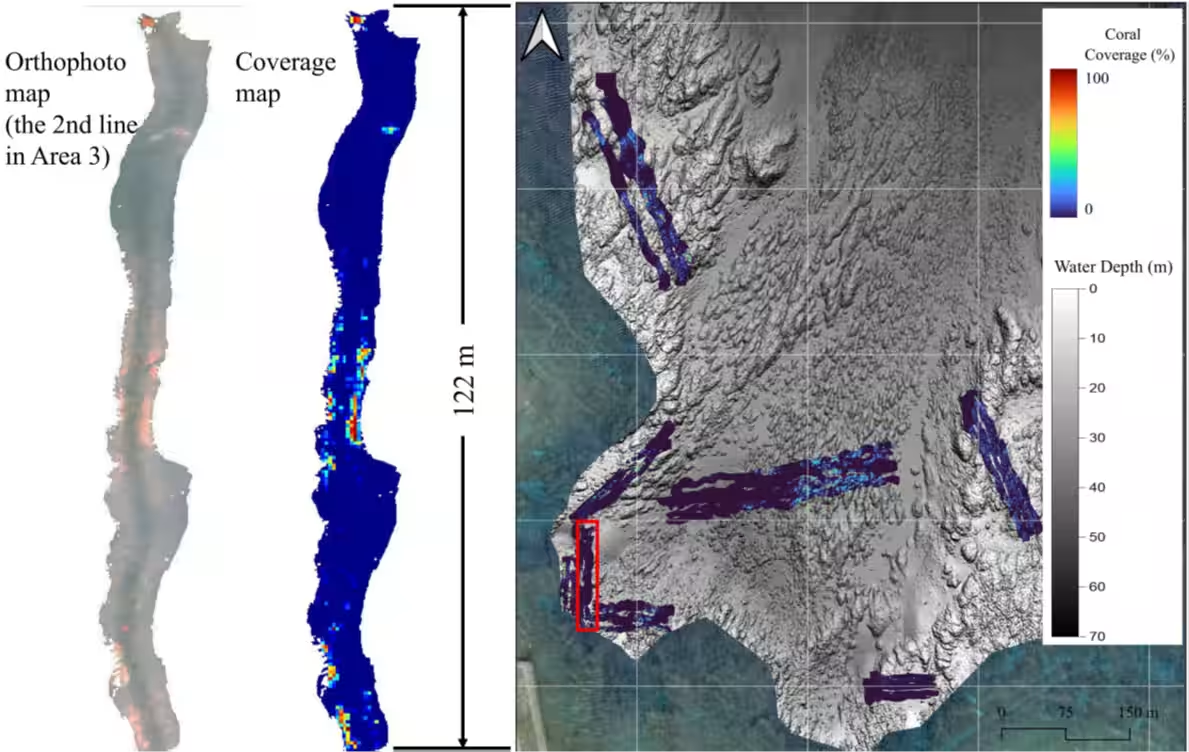
Given the large volumes of deep ocean water utilized in OTEC projects, understanding the impact of cold water discharge on marine environments becomes imperative. This concern led to the development of the high-efficiency seabed survey tool known as the Speedy Sea Scanner, created through collaboration between the University of Tokyo and Windy Network, alongside a new segmentation model dubbed Coral-Lab.
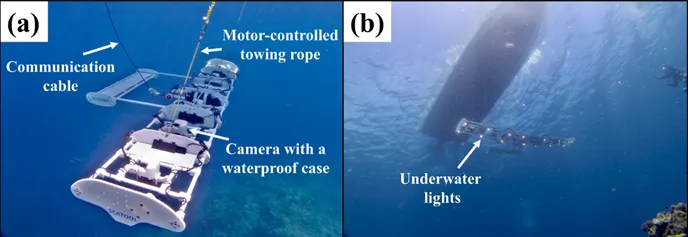
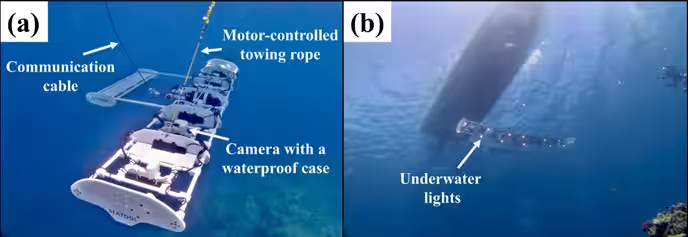
The Speedy Sea Scanner is a state-of-the-art towed seabed mapping system equipped with six underwater DSLR cameras. It enables rapid acquisition of continuous seabed images by being towed behind a small vessel. The innovative Coral-Lab employs cutting-edge AI to accurately detect coral across various regions globally, utilizing historical and contemporary coral images from the study area for training its detection algorithms.
Traditionally, divers manually surveyed coral reefs, which was both time-consuming and limited in scope. However, with this new approach, extensive surveys can now be conducted swiftly and with greater accuracy, significantly improving the speed and reliability of marine environmental assessments. This development will facilitate timely identification of the discharge points from OTEC and enable ongoing monitoring to evaluate and mitigate environmental impacts more effectively.
Commitment to Environmental Responsibility
MOL aims to achieve net-zero emissions across its operations by 2050, through its environmental vision
Topics Environment)

【About Using Articles】
You can freely use the title and article content by linking to the page where the article is posted.
※ Images cannot be used.
【About Links】
Links are free to use.