



Successful Development of Asymmetric Alloying Method for Chiral Gold-Silver Ion Clusters with Photoluminescent Properties
Development of Asymmetric Alloying Method for Chiral Gold(I) Ion Clusters
A collaborative research team led by Professor Mitsuhiko Shionoya at Tokyo University of Science has successfully developed an innovative technique for the asymmetric alloying of chiral gold(I) and silver(I) ion clusters. By incorporating silver salts into a carbon-centered gold(I) ion cluster, they achieved the formation of a chiral alloy cluster that exhibits remarkable optical properties and stability. This discovery could pave the way for advanced applications in photofunctional materials.
Key Research Findings
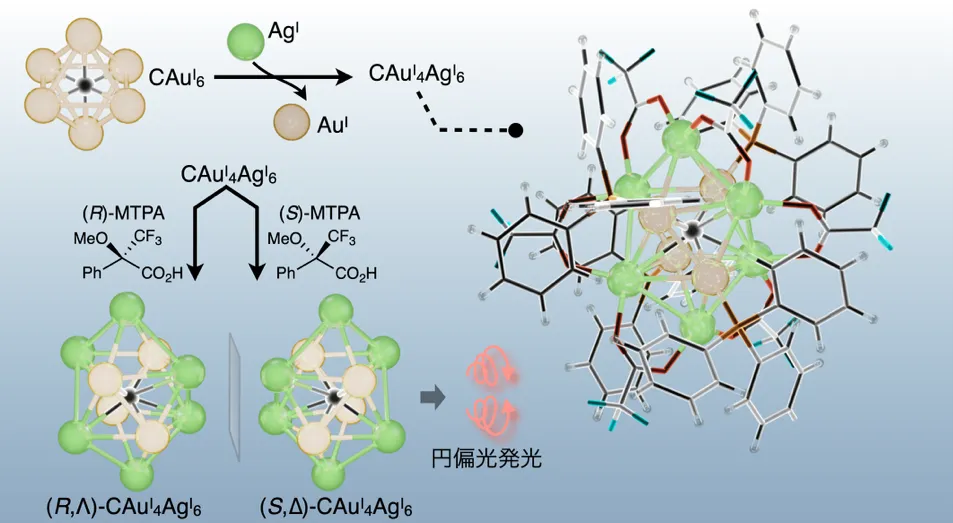
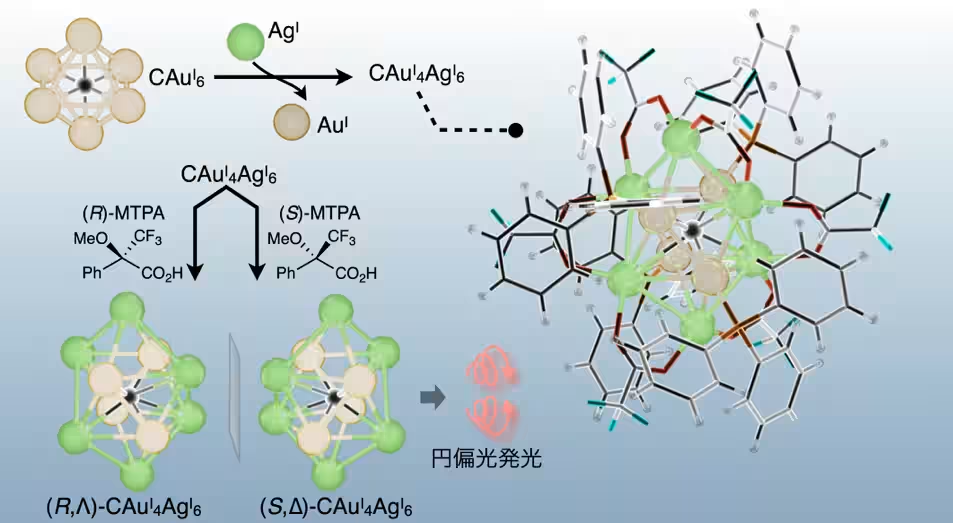
The research team synthesized a chiral gold(I) ion cluster where one carbon ion is bound by six gold(I) ions. To form the alloy cluster, they introduced silver(I) ions via etching, which led to a reduction in the number of gold(I) ions. The resulting racemic cluster was subsequently treated with homochiral carboxylic acids, successfully achieving the formation of an optically pure alloy cluster through asymmetric alloying techniques.
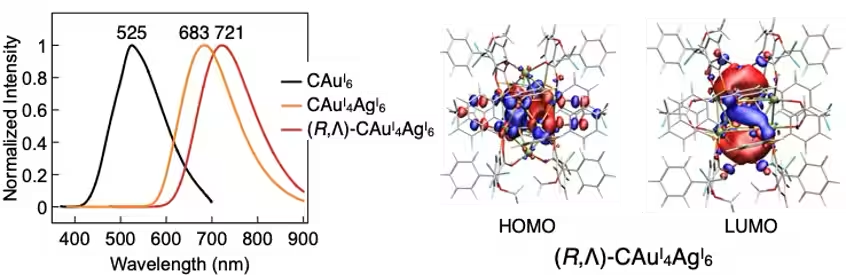
The newly formed alloy clusters demonstrated long-lasting phosphorescence emitted in the red to near-infrared region. Additionally, the homochiral alloy clusters showcased significant circular dichroism and circularly polarized luminescence, with theoretical calculations revealing the underlying bond characteristics and emission mechanisms.
Synthesis Process
The innovative synthesis process involved adding silver trifluoroacetate to a highly symmetrical gold(I) ion cluster protected by triphenylphosphine ligands. This step initiated the alloying process alongside the etching of gold(I) ions, resulting in the creation of a dual square-pyramidal polyhedral structure. Further addition of homochiral carboxylic acid successfully induced asymmetric alloying, resulting in efficient and selective synthesis of homochiral alloy clusters.
Theoretical and Experimental Insights
Upon analysis of the bond characteristics of the CAuI4AgI6 core structure, researchers found distinct bonding patterns: strong coordination between the central carbon ion and gold(I) ions, relatively weak interactions between carbon and silver(I) ions, and hierarchical interactions among the metal ions themselves. This asymmetry in bonding contributes to structural stabilization and the manifestation of carbon-centered chirality.
The synthesized alloy clusters exhibited a significant shift in their photoluminescence characteristics. The emission spectrum in the red to near-infrared range displayed a remarkable quantum yield of about 34%, indicating robust luminescence properties that hold potential for optical material applications.
Future Applications
The technique developed in this study demonstrates promising capabilities in the controlled design of chiral luminescent nanomaterials. This method could significantly enhance the efficiency and selectivity of alloying processes at the sub-nanometer scale, contributing to the advancement of new photofunctional materials.
Conclusion
This breakthrough research signifies a major step forward in the synthesis of chiral metal-ion clusters, merging theoretical and practical approaches to create materials with advanced optical functionalities. Results from this study have been published online in the prestigious journal Nature Communications on June 5, 2026.
Acknowledgments
This work was supported by grants from the Japan Society for the Promotion of Science (JSPS) and the Ministry of Education, Culture, Sports, Science, and Technology (MEXT). The team, comprising researchers from Tokyo University of Science and Fuzhou University, aims to further explore the realm of chiral luminescent nanomaterials, opening new pathways for innovative material sciences.
Topics Consumer Products & Retail)
【About Using Articles】
You can freely use the title and article content by linking to the page where the article is posted.
※ Images cannot be used.
【About Links】
Links are free to use.