



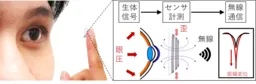
Wearable Smart Contact Lens for Wireless Eye Pressure Monitoring Demonstrated for Glaucoma Assessment
Introduction to Smart Contact Lens for Intraocular Pressure Measurement
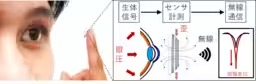
A pioneering research initiative led by Professor Takeo Miyake of Waseda University, along with his counterparts from Yamaguchi University, has heralded a new era in ophthalmic diagnostics with the development of a smart contact lens. This innovative lens is engineered to wirelessly measure intraocular pressure (IOP) with unprecedented sensitivity, making it an impactful tool for glaucoma assessment.
Key Highlights of the Research
- - The research team successfully incorporated strain sensor antennas into soft contact lenses.
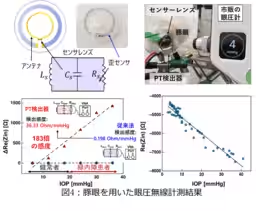
- - Employing a new circuit combining parity-time (PT) symmetric resonant coupling and wireless strain sensors, the lens achieved sensitivity levels 183 times greater than traditional methods, reaching 36.333 Ω/mmHg.
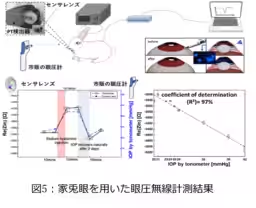
- - A significant correlation with conventional tonometers was confirmed (with R² values of 0.93 for porcine eyes and 0.97 for rabbit eyes). Additionally, the lens demonstrated remarkable transparency (over 80% visible light transmission) and biocompatibility.
- - This innovation aims to support early detection and monitoring of glaucoma in healthy individuals (with IOP ranging from 10 to 21 mmHg).
Background of the Research
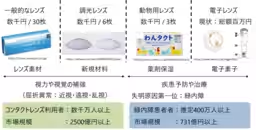
Contact lenses have evolved from simple corrective devices into advanced wearable medical technologies. Recent trends have focused on the integration of electronic devices with contact lenses, paving the way for 'smart' contact lenses that transition the functionality from merely 'seeing' to 'diagnosing.' The need for medical devices that can detect glaucoma—Japan's leading cause of blindness—has heightened, with estimates suggesting over 4 million individuals (5% of those over 40 and 10% over 70) are affected by the condition. Thus, the development of these smart lenses is both timely and necessary.
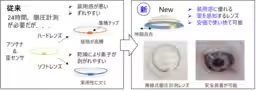
Glaucoma progression, often exacerbated by nighttime IOP fluctuations, necessitates round-the-clock monitoring. Conventional measuring devices like the Goldman tonometer are inadequate for nocturnal assessments, creating an impetus for smart contact lenses that facilitate continuous IOP monitoring.
However, previous attempts using rigid contact lens materials posed comfort and cost challenges. The research team tackled these issues by utilizing an innovative approach combining soft lenses with strain sensor antennas that remain intact even when the lens dries out. This advancement contributes to a more user-friendly and accessible self-care product.
Results of the Research
The research successfully developed a multi-layer resistive sensor composed of conductive and adhesive polymers (PEDOT:PSS and PVA), integrated with a wireless detector based on PT symmetry principles. This configuration yielded a sensitivity of 36.333 Ω/mmHg over a range of 6 to 36 mmHg, representing a 183-fold increase in sensitivity compared to traditional methods.
Experiments using porcine eyes and rabbits demonstrated a strong linear correlation with commercial tonometers, affirming that this smart lens can continuously and non-invasively monitor IOP. The excellent levels of transparency and cell viability—over 90% in human corneal epithelial cells—validate the safety of this lens.
Societal Impact and Future Prospects
The development of this high-sensitivity smart contact lens is expected to significantly enhance the early detection and management of glaucoma. Continuous IOP measurements, including during nighttime or home settings, will provide crucial insights into pressure fluctuations, ultimately improving patient quality of life (QoL) and reducing the risk of blindness.
Furthermore, the potential applicability of this technology spans beyond ophthalmology. The principles of PT symmetry presented here could revolutionize monitoring devices in cardiovascular, dermatological, and respiratory health sectors, contributing to advancements in the wearable medical device market and related industries.
Plans are underway to transition this innovation from the research phase to clinical applications in collaboration with ophthalmology departments. By forging partnerships with manufacturers, the researchers aim to bring this groundbreaking technology to the public, promising a future where eye health management becomes as straightforward as wearing a contact lens.
Conclusion
The smart contact lens developed by this research team marks a significant leap forward in the realm of eye health technology. With its impressive sensitivity, biocompatibility, and usability, it stands to revolutionize how glaucoma and other related conditions are monitored and managed—ultimately fostering a healthier future for patients worldwide.
Topics Health)
【About Using Articles】
You can freely use the title and article content by linking to the page where the article is posted.
※ Images cannot be used.
【About Links】
Links are free to use.