



Successful Production of Novel 2D Iron Oxide with Unnatural Structure
Breakthrough in Material Science: Unveiling 2D Iron Oxide
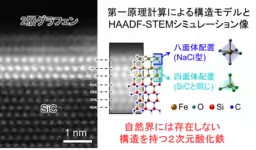
In an unprecedented achievement, researchers from Waseda University and other institutions have successfully synthesized a two-dimensional (2D) iron oxide with a structure that does not exist in nature. This ground-breaking discovery has the potential to revolutionize various applications, including spintronic devices and the exploration of new quantum properties in materials.
Key Highlights of the Research
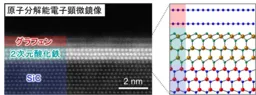
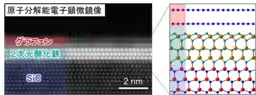
1. New Material Synthesis: The team developed a novel methodology to introduce iron and oxygen at the interface of graphene, a 2D material, and silicon carbide (SiC), a three-dimensional medium. This interface is critical for the formation of the unique iron oxide structure.
2. Quantum Properties: The resulting 2D iron oxide is expected to enhance our understanding of quantum materials, potentially leading to new functionalities in future technologies.
3. Published Findings: The research was documented in the journal Small Methods, which emphasizes the significance of the findings within the scientific community.
The Context of the Research
The study focused on transition metal oxides which exhibit a plethora of electronic properties, ranging from insulators to superconductors. Among them, iron oxides like magnetite (Fe3O4) and hematite (Fe2O3) have historical significance and are known for their magnetic properties. Understanding and manipulating the structure of these oxides can lead to advancements in practical applications.
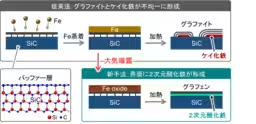
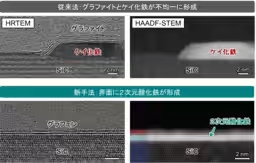
Graphene and similar 2D materials have attracted considerable attention due to their unique electronic and physical properties that differ significantly from 3D counterparts. The interface between a 2D material and a 3D substrate is a fertile area for research, as it can give rise to new physical phenomena and materials through a process known as intercalation. Historically, introducing elements into graphene/SiC structures has been challenging due to the high reactivity of iron with carbon and silicon, often leading to the formation of undesired compounds.
New Approaches in Material Synthesis
This research has opened up new avenues for synthesizing 2D iron oxide by treating the graphene/SiC interface as a growth field for new 2D structures. The researchers employed an innovative method for intercalation. They first deposited iron onto a buffer layer of graphene and exposed the sample to atmospheric conditions before applying heat in a vacuum, which facilitated the formation of 2D iron oxide rather than conventional iron compounds.
Implications and Future Directions
The achievement of synthesizing this 2D iron oxide is not only significant in fundamental material sciences but also has far-reaching implications for applied technology. As this material exhibits intriguing magnetic properties, including a transition from paramagnetism at room temperature to antiferromagnetic ordering at low temperatures, it could influence the design of next-generation magnetic materials and devices.
Furthermore, the techniques developed in this research can potentially be applied to other transition metal oxides. By exploring different materials at the graphene/SiC interface, researchers foresee the possibility of discovering high-temperature superconductors and materials with exceptional magnetoresistance.
Conclusion
This pivotal study marks a step forward in the quest for novel materials that can provide functionalities that are currently impractical or impossible with existing substances. As scientists continue to push the boundaries of what's achievable through material innovation, the formation of 2D iron oxide at the graphene/SICS interface exemplifies how interdisciplinary collaboration can lead to groundbreaking discoveries in material science.
Topics Consumer Technology)

【About Using Articles】
You can freely use the title and article content by linking to the page where the article is posted.
※ Images cannot be used.
【About Links】
Links are free to use.