



Keiju General Hospital Uses BizRobo! to Achieve Annual Reduction of 12,000 Business Hours
Keiju General Hospital's Transformative Journey with BizRobo!
In recent developments, Keiju General Hospital, a prominent healthcare provider in Nanao City, Ishikawa Prefecture, has taken a significant leap towards operational efficiency and quality of care by implementing the RPA tool BizRobo! and generative AI. This move aims to address the ongoing labor shortage in the healthcare sector while achieving a remarkable annual reduction of 12,000 hours of work. This initiative not only marks a step towards better efficiency but also underpins the hospital's commitment to nurturing an ideal environment for healthcare delivery.
Addressing Labor Shortages through Digital Transformation
The journey towards automation began in light of the diminishing population trends observed in Ishikawa Prefecture since the 2010s. Keiju General Hospital faced critical personnel shortages, emphasizing the need for innovative solutions. Despite initial attempts to increase employment among women and seniors, the results plateaued, making it essential for the hospital to explore digital transformation (DX) as a pathway to enhance operational efficiency and improve productivity through task shifting and sharing.
The hospital introduced BizRobo! Lite+ in 2021, alongside significant infrastructure changes such as the cessation of landline and PHS systems. Instead, they opted for mobile electronic medical records using iPhones, enhancing their digital footprint.
The introduction of RPA was inspired by Dr. Masahiro Jinno, the hospital's chief director, who learned about these tools in early 2021. Following this, the hospital organized seminars and connected with various vendors to explore how RPA could effectively combat labor shortages. It was in this exploration that BizRobo! emerged as the ideal solution, thanks to its proven success in other hospitals of similar scale within the region.
Practical Applications of RPA at Keiju Hospital
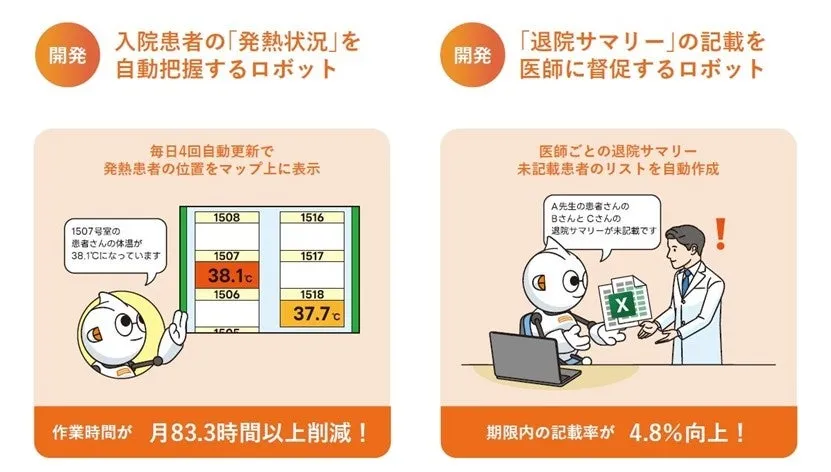
Currently, more than 130 robots are operational at Keiju General Hospital, managed by a dedicated team from the data center and information management. These robots assist nurses, medical staff, and clerical workers in performing essential tasks. For instance, a robot is tasked with automatically tracking fever levels among hospitalized patients. This robot gathers data from electronic health records and updates a room map in real time, ensuring that medical staff always has the latest information on patient conditions.
Another key application involves automating reminders for doctors to complete discharge summaries. The robot extracts necessary data and notifies the respective medical staff via printed lists or emails, significantly improving the consistency and timeliness of documentation.
Despite constraints on simultaneous operations due to licensing, the hospital has established a systematic schedule for these robots to ensure that essential tasks are completed efficiently. Through this strategy, Keiju General Hospital achieved its incredible 12,000-hour reduction, reinforcing operational efficiency and contributing to an enhancement in both healthcare quality and revenue.
Potential projects for automation come from various hospital departments, which submit requests for developing robots focused on task automation, ensuring that RPA deployment is thoroughly evaluated for effectiveness before proceeding with development.
Future Directions: RPA and Generative AI Integration
Looking ahead, Keiju General Hospital has set two key priorities for furthering its digital transformation. First, there is a commitment to continually enhance operational improvements through RPA. The hospital has made it a point to quantify how various departments are leveraging RPA and the corresponding reductions in workload, publicizing this data across all staff. This transparency cultivates a sense of ownership and mindfulness towards operational improvements among previously hesitant departments and staff.
Second, the hospital is keen on integrating generative AI with RPA, optimally positioning healthcare professionals to focus on patient care rather than administrative tasks. The hope is that this synergy will not only attract top-tier medical talent but also improve the overall quality of medical services provided.
Open Inc., the parent company supporting Keiju General Hospital, actively seeks to break the cycle of labor shortages and associated accidents through its RPA and AI advancement initiatives. Despite the increasing pace of population decline in the region, the company aims to stabilize healthcare delivery by empowering healthcare professionals to focus on what matters most, supported by digital solutions that foster a progressive working environment.
About BizRobo!
BizRobo! is a leading software robot platform that revolutionizes productivity for white-collar workers by helping organizations automate routine processes and redefine the future of work. By utilizing both robots and IT, it aims to free white-collar workers from repetitive tasks, thereby enhancing overall productivity in the corporate arena and society at large.
In healthcare settings, the integration of BizRobo! leads to improved operational efficiency, enhanced medical quality, and increased revenue generation. For more detailed information, visit its product page at BizRobo! Product Page.
This forward-thinking approach not only reshapes the operational landscape at Keiju General Hospital but sets a precedent for healthcare facilities facing similar challenges worldwide.

Topics Health)
【About Using Articles】
You can freely use the title and article content by linking to the page where the article is posted.
※ Images cannot be used.
【About Links】
Links are free to use.