




Unraveling the Complex Role of Human-Specific Pseudogenes in Stem Cells and Cancer
Discovering the Intricate Functions of Pseudogenes in Human Development
A groundbreaking study from Okayama University has shed light on the multifaceted role of the human-specific pseudogene POU5F1P1, commonly referred to as PG1, in the regulation of stem cells and cancer behavior. Published online on February 27, 2026, in the international academic journal iScience, this research has implications that could revolutionize our understanding of cellular control mechanisms in humans.
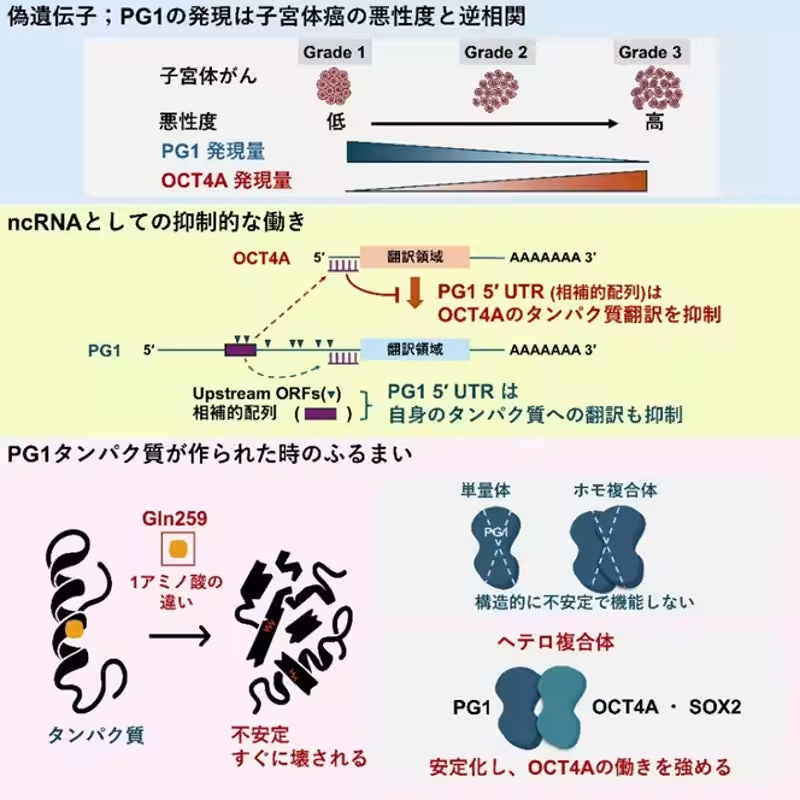
The research team, led by graduate student Kyohei Irie and supported by Professor Ayano Kawaguchi and others, has uncovered the intricate relationship between the gene POU5F1, also known as OCT4, and its pseudogene counterpart PG1. For a long time, PG1 was perceived primarily as a non-functional relic of evolution—a copy of its parent gene that harbored no significant roles in biological processes. However, the latest findings challenge this notion by presenting PG1 as a dynamic regulator.
The Dual Nature of PG1
In their work, the researchers discovered that PG1 has a dual role: it acts as both a 'brake' and an 'accelerator' in certain conditions. Under typical circumstances, PG1 primarily functions as a non-coding RNA, dampening the activity of its parent gene, OCT4, thus regulating stem cell behavior. However, when exposed to specific conditions such as in cancer cells, PG1 can switch roles to enhance the function of OCT4, promoting cellular proliferation.
This remarkable flexibility not only highlights the complexity of gene regulation but also raises essential questions about how such mechanisms evolved during the transition from primate ancestors to modern humans. The insights gleaned from this study provide a crucial foundation for future research into stem cell applications and cancer therapies.
Implications for Future Research
While the present study is rooted in basic research, it holds significant promise for future medical advances. A better understanding of PG1 and its intricate regulatory mechanisms might pave the way for new strategies in cancer treatment and regenerative medicine. As Kyohei Irie states, what was once deemed 'noise' in the genetic landscape may, in fact, hold critical answers to pressing medical challenges today.
In reflecting on the potential impacts of their work, the research team emphasizes the importance of continued investigation into the role of pseudogenes in human health. The evolution of these unique genetic structures poses fascinating questions about human biology and the potential for targeted therapies in the future.
Research and Funding
This study was made possible with the support of various grants, including those from the Japan Society for the Promotion of Science (JSPS) and the Japan Agency for Medical Research and Development (AMED). Collaborative efforts are essential for driving this innovative research forward.
For more detailed information, the complete research findings can be accessed through the official publication in iScience here.
The research team, consisting of eight scholars, continues to explore the implications of their findings in both the scientific community and medical practice. Their work at Okayama University exemplifies the interplay between academia and practical advancements in our understanding of biology.
Conclusion
The intricate dance between genes and their pseudogenes could serve as a cornerstone in advancing human health, particularly in combating cancer and enhancing stem cell research. Irie and his colleagues are dedicated to further illuminating these pathways that define what it means to be human.






Topics Health)
【About Using Articles】
You can freely use the title and article content by linking to the page where the article is posted.
※ Images cannot be used.
【About Links】
Links are free to use.