



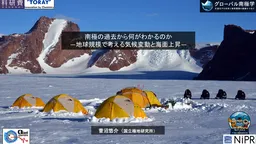
Understanding Climate Change and Sea Level Rise Through Antarctic History
Exploring the Critical Link Between Antarctica and Climate Change
The Japan Global Infrastructure Research Foundation (Japan GIF) recently held an online seminar titled "What Can We Learn from Antarctica's Past? - Thinking Globally About Climate Change and Sea Level Rise" on May 15, 2026. Led by Professor Yusuke Suganuma from the National Institute of Polar Research and the Graduate University for Advanced Studies, the seminar focused on the implications of Antarctic research for assessing climate change risk and future infrastructure planning.
Purpose of the Seminar
The seminar addressed a pressing challenge faced by Pacific island nations, which are significantly threatened by rising sea levels due to climate change. To improve risk assessment accuracy, it is essential to understand not only localized phenomena but also the broader, long-term mechanisms driving sea level changes globally. Antarctica, being a crucial player in this context, was highlighted as a key focus in understanding potential future sea level rise.
During the seminar, Professor Suganuma shared his extensive research experience in Quaternary geology, paleoclimate, oceanography, and paleomagnetism, emphasizing the importance and necessity of Antarctic studies. He provided a clear explanation of why these investigations into the Antarctic region are vital and what new revelations they have uncovered.
Professor Suganuma introduced his latest research on "tipping cascades"—a mechanism through which ice melt in one region can instigate melting in another, potentially leading to accelerated changes. This highlights the importance of translating scientific findings into actionable strategies for climate change adaptation, disaster preparedness, and enhancing infrastructure resilience.
Key Highlights from the Presentation
1. Rising CO2 Levels and Arctic Warming
- Atmospheric CO2 concentration has risen from 280 ppm before the industrial revolution to 433 ppm as of April 2026, indicating ongoing global warming.
- The effects are particularly evident in the Arctic and Antarctic regions, making the understanding of polar climate change essential.
- Ice types are categorized as glaciers, ice sheets, ice shelves, icebergs, and sea ice. While melting sea ice does not contribute to sea level rise, the discharge of land-based ice sheets into the ocean ultimately increases sea levels.
- The area of Arctic sea ice has halved since 1979, and the Greenland ice sheet has lost approximately 5,000 gigatons of ice in the past 20 years—projecting a potential sea level rise of around 7 meters if all ice were to melt.
2. Impact of Antarctic Ice Sheet Melting
- The melting of ice shelves in relatively warm areas of Antarctica has accelerated since around 2001, leading to an increase in the flow of the ice sheet due to the loss of restraining forces.
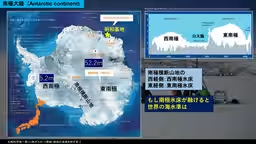
- Projections estimate sea level rise from West Antarctica at approximately 5.2 meters and East Antarctica at about 52.2 meters. Even a 5-meter rise could inundate significant portions of Japan’s major urban areas.
- While a large-scale melting of ice sheets is deemed less likely due to surrounding cold waters, recent observations have revealed the melting of coastal ice shelves.
- Understanding the dynamics of these large-scale ice sheet melt mechanisms requires reconstructing ice sheet changes since the last Ice Age around 20,000 years ago.
3. Personal Experiences in Antarctic Research
- Professor Suganuma has participated in seven Antarctic expeditions, collecting data from exposed rock areas transitioning from inland to coastal.
- His investigations confirmed that significant ice sheet elevation declines in East Antarctica began around 9,000 years ago, correlating with peak temperature and sea level rise, suggesting that sea level dynamics may have initiated ice sheet reduction.
4. Processes of Ice Sheet Melting and the Role of Circumpolar Deep Water
- Research on the relationship between warm deep water influx and ice sheet melting was conducted through sediment core drilling in the Ritsuo Holm Bay and the Sōya Coast.
- This involved obtaining cores nearly 5 meters long for detailed CT imaging analysis.
5. Triggers for Large-Scale Ice Sheet Melting
- Re-analysis of sediment cores collected 20 years ago through modern CT technology revealed changes indicative of past ice sheet and ice shelf retreat patterns.
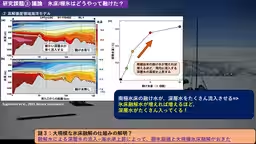
- Simulations indicated that ice melt could transition into a positive feedback loop, accelerating the flow of warm deep water, which changes ocean circulation.
- Approximately 9,000 years ago, a combination of regional sea level rise and meltwater from the ice sheets likely expedited the collapse of ice shelves and outflow of icebergs, resulting in significant ice sheet melting events. The phenomenon of tipping cascades suggests that once initiated, such large-scale melting processes can be difficult to halt, emphasizing critical information for future sea level rise predictions.
During the following Q&A session, various topics arose, including the contemporary implications of past large-scale ice sheet melting, the current status of tipping cascades, timeframes for future sea level considerations, comparisons of sea-level rise countermeasures internationally, and the challenges faced in Antarctic observational methods.
Post-seminar feedback was overwhelmingly positive, with all 22 participants finding the session engaging. They expressed particular interest in the segments discussing the influence of Antarctic ice sheet melting on sea level rise, the intricacies of the melting processes, and the triggers for extensive melting, highlighting the seminar’s value in understanding these crucial issues.

Topics Environment)
【About Using Articles】
You can freely use the title and article content by linking to the page where the article is posted.
※ Images cannot be used.
【About Links】
Links are free to use.