




New Insights into Thylakoid Membrane Reconstruction at Okayama University
Introduction to Thylakoid Membranes and Photosynthesis
Photosynthesis is a vital process where plants convert sunlight into chemical energy, essential for life on Earth. During this process, carbon dioxide is transformed into organic substances, releasing oxygen in the process. Central to this phenomenon is the thylakoid membrane, which houses the molecular machinery necessary for this conversion of light energy. Despite its significance, the mechanisms behind thylakoid membrane formation have not been fully understood.
The Role of VIPP1 Protein
Recent research from Okayama University, specifically Professor Wataru Sakamoto and his team from the Institute of Resource Plant Science, sheds new light on the thylakoid membrane's structural components. The team focused on a crucial protein known as VIPP1 (Vesicle-Inducing Protein in Plastids 1), which is fundamentally required for the development and maintenance of the thylakoid membrane.
Historically, the evolutionary origins of VIPP1 have remained ambiguous, prompting an investigation into whether its features are a remnant of ancient microorganisms. Interestingly, the study identified that a specific amino acid sequence, referred to as Vc, associated with VIPP1, also exists in ancestral proteins from extremophiles, shedding light on how early life forms adapted to harsh environments. This suggests that the evolution of stress resistance in membranes may have been critical even before the advent of photosynthesis.
Insights from Gloeobacter
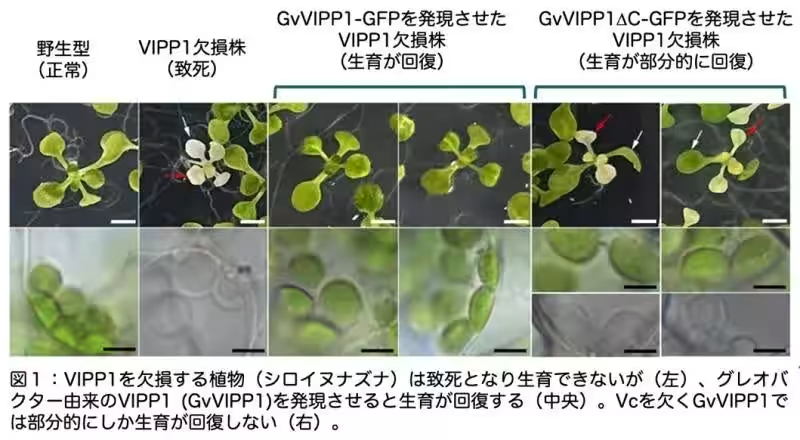
A significant breakthrough came from investigating the thylakoid-less cyanobacterium Gloeobacter violaceus, which, surprisingly, still possesses the VIPP1 protein. This discovery led to the understanding that when this protein is introduced into the chloroplasts of higher plants, it enables the formation of thylakoid membranes. The study highlighted how VIPP1 and the Vc region are essential for thylakoid architecture, suggesting a conservation of molecular mechanisms throughout evolutionary history.
The implications of this finding are profound. By understanding how to reinforce thylakoid membranes using VIPP1, researchers envision enhancing plant resilience to environmental stresses and improving photosynthetic efficiency. This advancement could lead to significant innovations in crop science and biotechnology.
Future Directions and Applications
The research team's findings, published in the journal Plant Physiology, open avenues for potential applications aiming to bolster plant adaptability in an era of climate change. By enhancing photosynthetic performance, scientists could contribute to agriculture with improved crop yields and sustainability. In doing so, they also pave the way for developing plants that can thrive under extreme environmental conditions.
The research, supported by grants from Japan’s Scientific Research Fund, underscores the necessity of further studies to unravel the complex evolutionary narrative linked to photosynthesis and plant biology.
Conclusion
In conclusion, the investigation into thylakoid membrane formation by Okayama University represents a significant leap forward in our understanding of plant biology and photosynthesis. By elucidating the roles of proteins like VIPP1, researchers are not only piecing together evolutionary puzzles but also laying the groundwork for future agricultural innovations that may help secure food sources in changing climates. As studies continue, the potential for discovering novel enhancements to plant resilience and efficiency remains a promising area of scientific exploration.





Topics Health)
【About Using Articles】
You can freely use the title and article content by linking to the page where the article is posted.
※ Images cannot be used.
【About Links】
Links are free to use.