



Innovative Multi-Stage Dimming Blinds Developed for Modern Homes
Innovative Multi-Stage Dimming Blinds Developed for Modern Homes
Introduction
In a remarkable advancement in home technology, a research team from the National Institute of Advanced Industrial Science and Technology (AIST) has developed a cutting-edge multi-stage dimming blind. This new product employs specially designed polarizing sheets created through nanostructure imprinting technology, enabling simple adjustment of light intensity without the need for an electrical power source.
The Concept
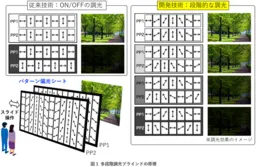
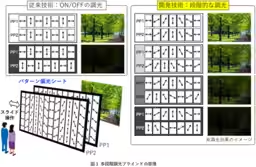
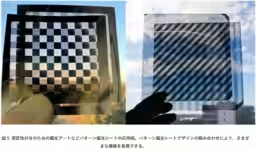
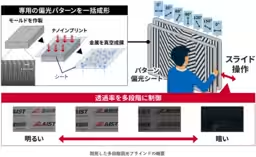
Blinds and curtains serve the essential function of controlling natural light entering spaces, tailored to individual lifestyles. Traditionally, dimming control has been achieved through methods like liquid crystal glasses, which require electricity, thereby limiting their application scope. The newly developed dimming blind allows users to control light intensity by sliding two overlapping polarizing sheets only a few millimeters apart, offering a practical solution for a range of settings.
Technical Innovation
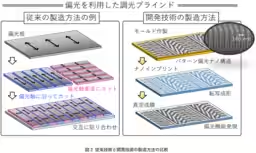
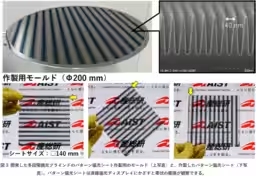
The team, led by senior researchers Ryohei Hokari, Genki Kuwano, Kazuma Tsujika, and Kazuma Kurihara, has innovatively addressed existing challenges in light control. Unlike previous models that only provided binary on/off light states, this advanced system enables nuanced control across multiple intensity levels, affording users with the flexibility to adjust brightness to their liking. The polarizing sheets were designed with nanostructured patterns made possible through advanced manufacturing techniques, ensuring visible light control without reliance on electric power.
Energy Efficiency and Future Applications
Beyond just visible light adjustment, these dimming blinds present exciting prospects for energy efficiency. They can particularly benefit residential settings by controlling heat through near-infrared and infrared light, potentially leading to significant energy savings. As global interests move toward carbon neutrality, technologies that enhance energy efficiency in daily operations become invaluable.
The Research Journey
The journey to this innovation has been marked by various technological endeavors. These blinds were developed using polarizing sheets designed in a layout featuring multiple polarizing axis directions. This design overcame the inherent limitations of traditional polarizing systems, making the manufacturing process not only more efficient but enabling the creation of various photonic states effectively. Ongoing efforts aim to expand the range of dimming capabilities, allowing for even broader applications across diverse environments, including offices and transportation.
Future Prospects
The potential applications for the multi-stage dimming blind extend far beyond residential windows. Their simple installation and operation make them suitable for use in offices, meeting spaces, vehicles, and lighting apparatuses. As research progresses with the aim of large-scale implementation, collaborations with companies are anticipated, paving the way for societal integration of this technology.
Exhibition Information
The innovative dimming blinds will be showcased at the upcoming MEMS Sensing & Network Systems Exhibition 2026, held from January 28 to 30, 2026, at Tokyo Big Sight. Attendees can witness firsthand the unique operational capabilities of this groundbreaking product.
- - Event Name: MEMS Sensing & Network Systems Exhibition 2026
- - Dates: January 28-30, 2026
- - Location: Tokyo Big Sight, East Hall 2, Booth No. 2W-A34
- - URL: MEMS Exhibition
Conclusion
In summary, the creation of these multi-stage dimming blinds marks a pivotal step towards enhancing everyday living conditions through advanced technology, focusing on energy efficiency and user-friendliness. As this technology matures, it holds the promise of shifting norms in how we interact with light in our living and working environments.
Topics Consumer Products & Retail)






【About Using Articles】
You can freely use the title and article content by linking to the page where the article is posted.
※ Images cannot be used.
【About Links】
Links are free to use.