



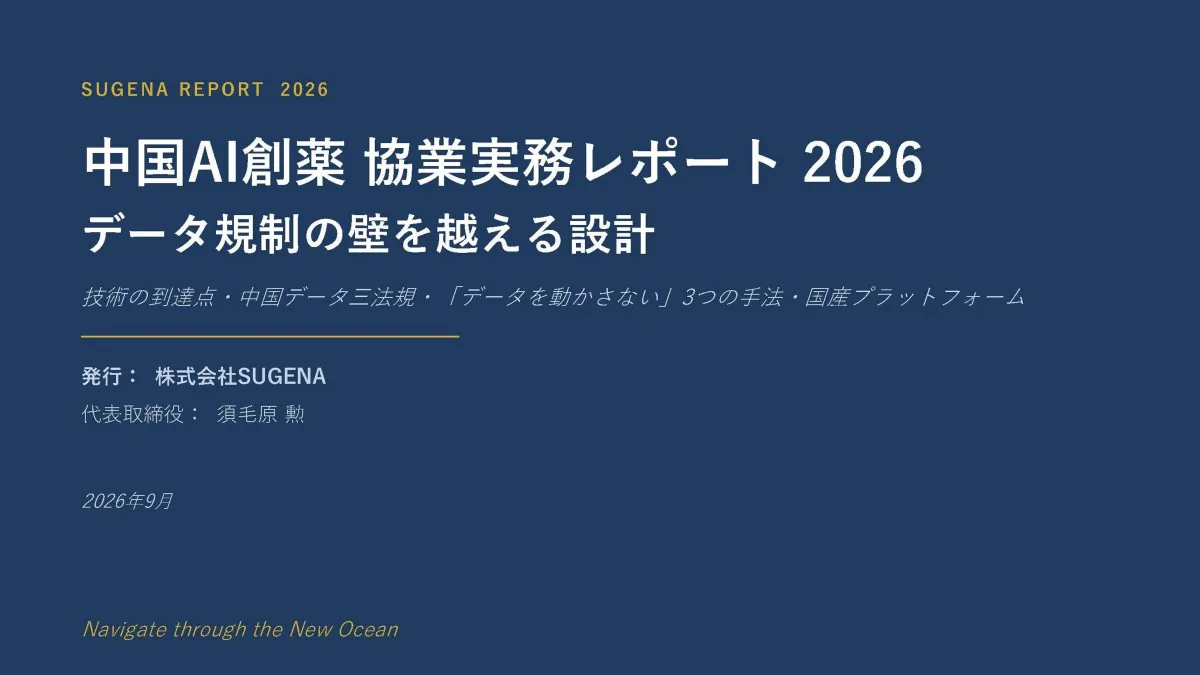
SUGENA's Report on Collaborating with Chinese AI Drug Companies Amid Data Regulations
SUGENA's Insightful Report on AI Drug Development Collaboration
On September 1, 2026, SUGENA Co., Ltd., a Shibuya-based company dedicated to supporting the exploration of Chinese biotech and partnerships with Japanese firms, made a significant move by publishing a report titled "Practical Report on Collaborating with Chinese AI Drug Companies 2026 – Overcoming Data Regulation Barriers". This insightful document is now available for free on their website. The report aims to assist Japanese pharmaceutical companies in navigating the complexities of collaboration with Chinese AI drug companies, identifying data regulation as the primary obstacle rather than technical evaluation.
Understanding the Landscape of Data Regulations
As Japanese pharmaceutical companies consider partnerships with their Chinese counterparts, they often encounter tough data regulations. China enforces a layered application of three key laws: the Personal Information Protection Law (PIPL), the Data Security Law (DSL), and the Human Genetic Resources Management Regulations (HGR Regulations). Among these, the HGR Regulation is particularly significant, as it places restrictions even on the digital transfer of genomic sequence data. This means that, regardless of physical sample transfers, the AI learning data itself falls under these regulations, necessitating safety evaluations for over 500 cases of genomic data.
Often, the implications of these data barriers only come to light after confidentiality agreements are signed or joint research plans materialize, leading to considerable setbacks at that juncture. Notably, a revision of the HGR Regulations will come into effect on May 1, 2024, transferring oversight from the Ministry of Science and Technology to the National Health Commission, a change that is discussed in detail in the report.
Moving Beyond Barriers to Collaboration
The primary value of the report lies in its practical solutions for overcoming these data-related hurdles, rather than merely identifying the obstacles. It presents three distinct methodologies to facilitate collaboration without the need to transfer data:
1. Site-Fact Model: This approach focuses on processing data at its source, allowing only the results to be shared, mitigating regulatory concerns.
2. Federated Learning: Under this model, AI learning occurs within China, and only the statistical outcomes are obtained, ensuring compliance with local regulations.
3. Data Clean Room: This setup executes permitted queries and acquires only the analysis results, further protecting sensitive data.
In particular, in the fields of cellular and gene therapy, manufacturing cells for Japanese patients domestically could ensure that Chinese data remains static, thereby enhancing regulatory clarity.
Reevaluating AI's Role in Drug Innovation
The report also takes a balanced stance against overestimating AI's role in drug development. Despite numerous claims, there are still no known cases of AI independently completing a new drug. All drugs supposedly discovered by AI have undergone human validation. However, it is acknowledged that AI has successfully reduced discovery timelines to between 12 and 18 months.
Consequently, SUGENA's evaluation strategy prioritizes the inherent technological innovation of drug development over whether AI is utilized.
Key Insights from the Report
Highlights from the report include:
- - The scope of the Chinese AI drug market and its structural advantages.
- - The evolution of AI technologies and their current limitations.
- - The intersecting application of China's three data regulations and practical decision-making processes.
- - The innovative strategies to overcome data-related barriers.
- - Insights for Japanese companies contemplating collaboration with Chinese AI drug firms.
- - A checklist of seven essential items to confirm during initial inquiries.
Who Should Read This Report?
This report is particularly beneficial for:
- - Representatives from pharmaceutical companies considering partnerships with Chinese AI drug firms.
- - Those anxious about data sharing with Chinese companies.
- - Individuals seeking a grounded understanding of AI drug development realities.
How to Access the Report
The report can be downloaded for free through the following link: Download SUGENA's Practical Report
About SUGENA Co., Ltd.
Founded in Shibuya, Tokyo, SUGENA Co., Ltd. specializes in supporting Japanese enterprises in their international ventures, partnerships, and open innovation. They primarily focus on exploring and monitoring Chinese biotech and facilitating collaborations with Japanese pharmaceutical companies.
- - Headquarters: 8-7 Daikanyama-cho, Shibuya, Tokyo
- - CEO: Isamu Sugahara
- - Website: SUGENA
Contact Information
For further inquiries, please contact:
SUGENA Public Relations: Noriko Ohata
Email: [email protected]
Topics Business Technology)






【About Using Articles】
You can freely use the title and article content by linking to the page where the article is posted.
※ Images cannot be used.
【About Links】
Links are free to use.