



Okayama University's New Discoveries in Visible-Light Photocatalysts Unraveled, Leading to Clean Energy Innovations
Understanding the Breakthrough in Visible-Light Photocatalysts at Okayama University
In a significant advancement within the field of clean energy, researchers at Okayama University have unraveled long-standing mysteries regarding visible-light photocatalysts. This groundbreaking research provides vital insights into enhancing both the reactivity and lifespan of these materials, which utilize visible light—one of the most abundant forms of solar energy.
The Research Team and Their Findings
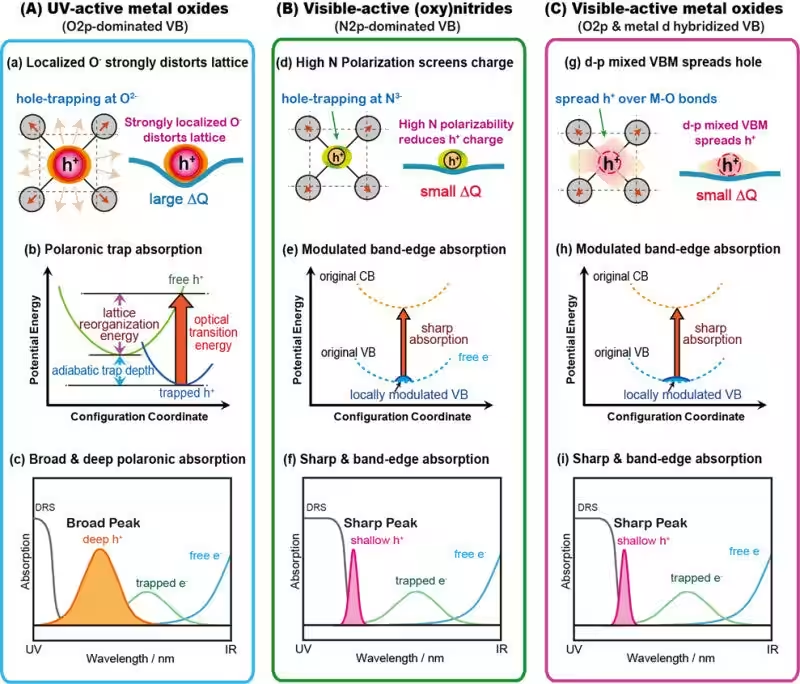
Led by Professor Akira Yamakata of the Interdisciplinary Research Institute at Okayama University, along with collaborators from Shinshu University, this team has categorized the behavior of holes (the absence of electrons), a phenomenon that has puzzled scientists for years. By employing time-resolved transient absorption spectroscopy, the group revealed that in visible-light photocatalysts, holes tend to remain in a "shallow trap state" near the conduction band edges, rather than falling into deeper trap states as seen in traditional ultraviolet light photocatalysts. This characteristic enables improved reactivity and reduces loss of activity over time, marking an essential advancement in material science.
Deep vs. Shallow Trap States
The distinction between deep and shallow trap states is critical. In ultraviolet photocatalysts, the holes become strongly localized due to lattice distortions, creating deeper traps that significantly hinder the material's performance. Conversely, the research indicates that the anions' high polarizability and orbital mixing in visible-light photocatalysts prevent lattice relaxation, which allows these holes to remain in the shallow trap state. This behavior not only promotes a sharper absorption peak but also ensures better catalytic activity even in the presence of defects—demonstrating intrinsic defect tolerance.
Implications of the Discovery
The implications of this important finding are far-reaching. By providing a unified understanding of hole trapping mechanisms, it establishes clear guidelines for designing efficient and long-lasting photocatalysts. With the capacity to utilize visible light, these photocatalysts represent a promising avenue for developing sustainable energy solutions and could pave the way for practical hydrogen production technologies based on clean energy principles.
According to Yamakata, the quest to understand why visible-light responsive photocatalysts exhibit specific trapping behaviors began a decade ago. This recent study categorized the behaviors into three distinct patterns, offering cohesive explanations for their origins. He comments that this discovery not only elucidates the absorptive behavior of trapped holes but also underlines the inherent resilience of these materials against defects.
Recognition in Scientific Community
The research was recognized for its contributions to the field and was published online in the prestigious Journal of the American Chemical Society on March 26, 2026. The study was further featured on the cover of the April 22 issue of the same journal, underscoring its significance.
Additionally, this research aligns with broader efforts supported by the Ministry of Education, Culture, Sports, Science and Technology (MEXT) and various academic institutions, demonstrating the collaborative spirit in advancing energy research. With backing from Japan Society for the Promotion of Science (JSPS) and other funding agencies, the study exemplifies the kind of interdisciplinary initiatives that can result in groundbreaking technological innovations.
Conclusions and Future Outlook
With the study's significant findings, it paves the way towards the practical realization of hydrogen generation using photocatalysts. As the world increasingly aims for sustainable energy solutions, the advancements made by Okayama University not only contribute to the scientific community but also offer practical technologies for future clean energy applications. The expectation is now set for these discoveries to facilitate a new wave in the commercialization of photocatalytic materials, propelling the energy sector into a more sustainable era.
For more information, please refer to the detailed document outlining the research findings
here.
References




Topics Environment)
【About Using Articles】
You can freely use the title and article content by linking to the page where the article is posted.
※ Images cannot be used.
【About Links】
Links are free to use.