


Hitachi and Kyoto University Develop a Community Symbiosis Model Using Social Prescribing
Introducing the Community Symbiosis Model
Hitachi Ltd., through a collaborative study with Kyoto University, has developed a model aimed at fostering community symbiosis by using the concept of social prescribing. This innovative model aspires to bridge connections between residents and local resources, promoting an intertwined approach of high-risk interventions and population-level strategies in the realm of health and welfare.
Understanding Social Prescribing
Social prescribing is a concept that emerged in the UK during the 1980s, primarily addressing health issues that cannot be effectively tackled through medical intervention alone. Instead of merely prescribing medication, healthcare professionals also recommend activities such as hobbies, volunteering, and community engagement to enhance individuals' social connections and overall health. In light of rising concerns about isolation and dementia risks due to Japan's aging population, the need for social prescribing has become increasingly pertinent. The Japanese government is also advocating for social prescribing as part of a broader preventive healthcare strategy, recognizing the critical role of community engagement.
Features of the New Model
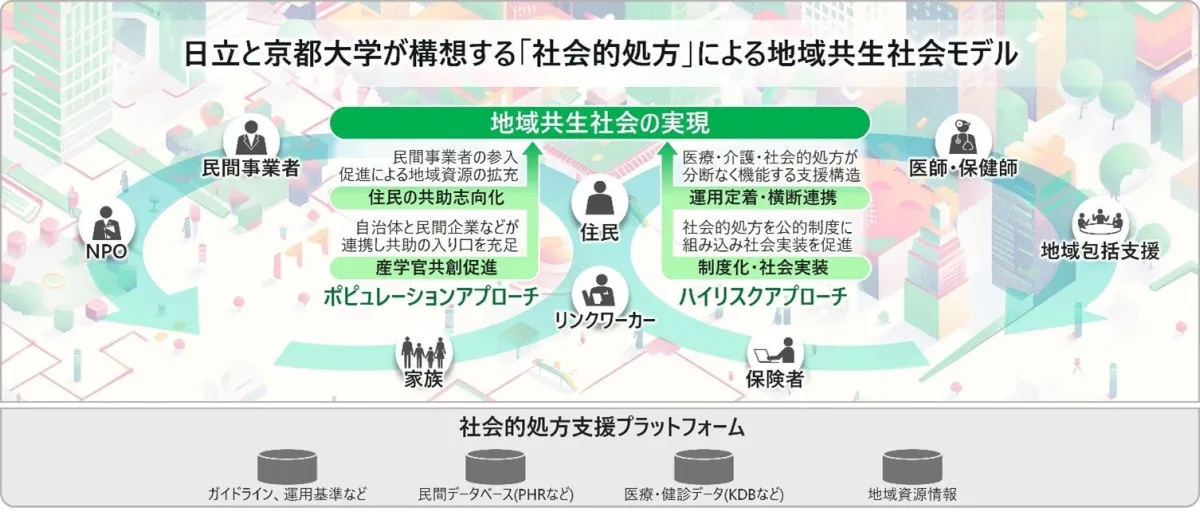
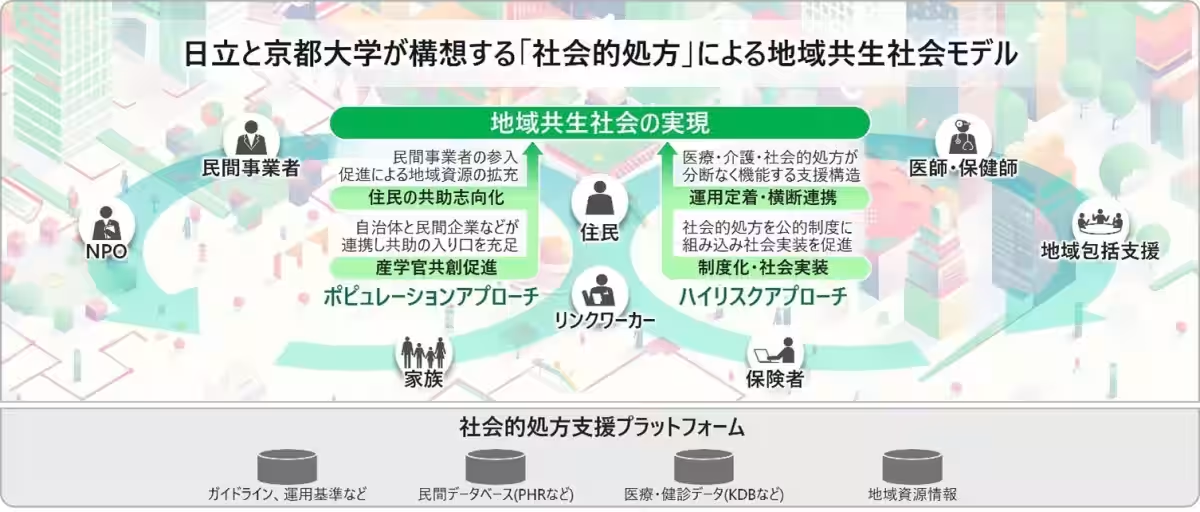
The collaborative research with Kyoto University has led to the establishment of a dual-cycle model through social prescribing that aims to enhance both individual health and community connections. The model utilizes both high-risk and population approaches, establishing a systematic framework for social prescriptions. In this envisioned society, residents receive tailored support based on their health and lifestyle from healthcare facilities and consult with local health practitioners. With the aid of link workers, individuals are guided to find and participate in local community activities, facilitated by private enterprises and NGOs. The positive outcomes of these individual behaviors contribute to the strengthening of preventive measures and the overall collaborative support framework within the community.
The foundation supporting this model includes cooperative networks among healthcare providers, local governments, and private enterprises, which are crucial for the successful implementation of the social prescribing support platform. This platform analyzes both health data and social participation metrics to enhance preventive strategies and optimize healthcare costs in the community.
Implementation of High-Risk Approach
Under the high-risk approach, social prescribing targets individuals with specific health challenges, including those at risk of lifestyle-related diseases. This method aims to construct a circulatory system that connects healthcare services and local resources, ultimately leading to improved health outcomes. By doing so, it contributes to addressing health issues beyond what can be achieved through medical interventions alone and aids in the rationalization of healthcare and caregiving costs.
Encouraging the uptake of social prescribing requires creating incentive structures for healthcare institutions and local governments and professionalizing link workers. The study in partnership with Kyoto University focuses on the development of this model and the necessary frameworks for its future societal implementation. Furthermore, Hitachi has developed a link worker support system that utilizes generative AI to enhance the efficiency of interviews and improve the quality of resident support.
Implementation of Population Approach
The population approach within the model aims to preemptively mitigate risks related to lifestyle diseases and social isolation by establishing a social prescribing cycle for the entire community. Continuous engagement with residents through private enterprises, NGOs, and link workers fosters regular opportunities for social participation and health improvement. This, in turn, reinforces the preventive foundation and builds a healthy, interconnected community.
Hitachi is also working on a healthcare check-up service in collaboration with Yabu City in Hyogo Prefecture, designed to facilitate early detection of cognitive decline and reduce isolation, thus improving individual well-being.
Future Prospects
Going forward, Hitachi intends to explore the institutionalization of this model alongside continuous learning from implemented social prescriptions in local governments. The aim is to create synergistic processes that integrate insights from both high-risk and population approaches, allowing for the return of successful interventions and data to enhance community health initiatives. By fostering a dual-cycle relationship, this sustainable social prescribing model intends to simultaneously optimize healthcare expenditures and invigorate local communities.
Conclusion
As societal challenges continue to deepen in Japan, Hitachi leverages its rich experience in providing integral systems for public sector projects. In the medical and caregiving sectors, the company promotes a vision centered around preventive cultural practices, striving to create a society where everyone can access optimal care. The recent formulation of the community symbiosis model with Kyoto University represents a significant step towards realizing this vision.
Invitation to the International Symposium
This innovative community symbiosis model will be presented during an upcoming talk session at the International Symposium on Social Prescribing and Cultural Prescribing (ISPC2026), hosted at Kyoto University from May 27-28, 2026. The event will highlight Japan's progressive initiatives in social prescribing as well as the model developed through this collaboration.
For more information, please contact:
Hitachi Ltd.
Public Systems Sales Headquarters
Customer Relations Center
140-8512 Tokyo, Shinagawa-ku, Minami-Oi 6-23-1
Hitachi Omori Building
Hitachi Public IT Inquiry
Topics Health)


【About Using Articles】
You can freely use the title and article content by linking to the page where the article is posted.
※ Images cannot be used.
【About Links】
Links are free to use.