



Tech Doctor Unveils Advanced SLE Research Findings at EULAR 2025 Conference
Tech Doctor Unveils Research at EULAR 2025
Tech Doctor, represented by CEO Kazushige Minato, showcased its promising research on predicting disease activity in systemic lupus erythematosus (SLE) at the European League Against Rheumatism (EULAR 2025) conference, held from June 11 to 14 in Barcelona, Spain. This presentation is part of a project supported by the Japan Agency for Medical Research and Development (AMED) under its 'Challenge Type' program for medical device research.
This innovative study, led by Dr. Masaru Hoya from Science Tokyo University, reveals an algorithm that enhances the prediction of achieving the Lupus Low Disease Activity State (LLDAS) by integrating clinical indicators, medication data, patient-reported outcomes (PROs), and biometric information acquired from wrist-worn devices like Google Fitbit. Notably, the presentation was selected for a poster tour due to its significant research implications.
Background and Study Overview
SLE is a chronic autoimmune disease that can cause inflammation in various organs, making it one of the more complex conditions to manage effectively. Although recent advancements in pharmacological treatments have improved acute care outcomes, standardizing maintenance therapy and determining safe drug tapering or cessation remain persistent challenges in clinical practice.
Physicians often face limitations in accessing comprehensive information during examinations, leading to potential gaps in understanding overall disease activity. In response, data derived from patient-reported symptoms and continuous metrics captured by wearable devices—such as heart rate, sleep patterns, and step counts—could play a critical role in better understanding the disease.
The objective of this research was to develop a predictive model for achieving LLDAS in SLE patients by leveraging such data.
Study Details
The research project, titled 'Development of Software to Visualize SLE Activity for Safe and Appropriate Treatment Management,' was conducted between July 2023 and September 2024, involving 274 SLE patients aged 15 and over, 112 of whom consented to wear the Fitbit Inspire3 device. The validation metrics included medical records, treatment history, examination data, and self-reported symptoms analyzed through visual analog scales (VAS) and the LupusPRO questionnaire.
Employing advanced machine learning methodologies including Random Forest, CatBoost, XGBoost, and LightGBM, the researchers aggregated biometric data averaged over a seven-day span around consultation dates, utilizing LLDAS assessments made by physicians as baseline labels for prediction model creation.
Research Findings
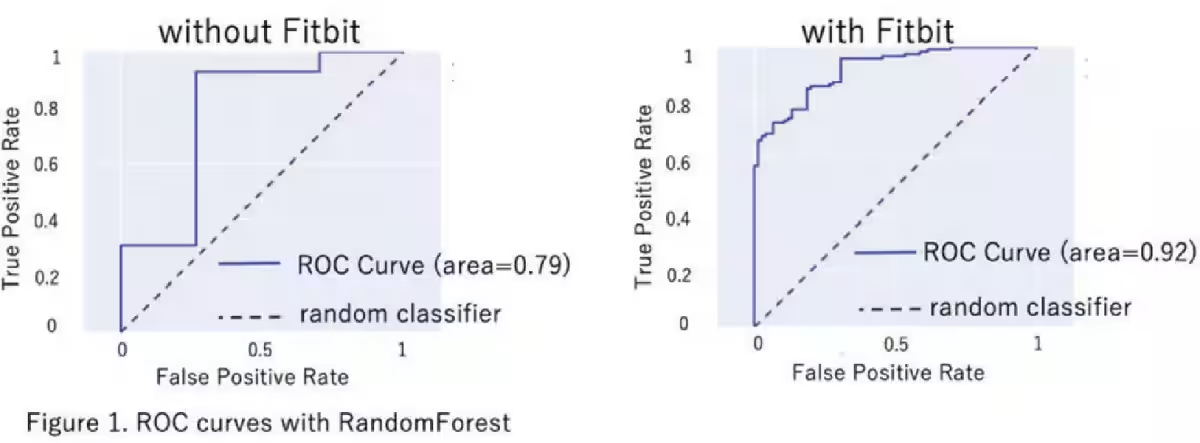
Results indicated no significant differences in gender, age, or LLDAS achievement rates between the 112 Fitbit users and the 162 non-users, suggesting the groups were statistically similar. When comparing predictive models, one using solely clinical indicators and PROs against another incorporating Fitbit data, the latter consistently showed improved ROC-AUC scores across all four machine learning models. These findings confirm the added value of health-related data in predicting disease activity.
This study suggests that combining continuous biometric data reflecting patient condition changes with traditional medical information may lead to a more accurate understanding of SLE disease status.
Social Significance and Future Prospects
The recent findings highlight significant potential for utilizing everyday data from SLE patients—especially in managing a rare disease where treatment options are still under development. Both Science Tokyo University and Tech Doctor aim to continue building on these results, striving for individualized medical care and patient-centered treatment across various chronic diseases, especially autoimmune disorders. They are focused on developing digital biomarkers and realizing remote monitoring technologies for broader societal implementation.
Reference Information
- - Conference: EULAR 2025 (European Alliance of Associations for Rheumatology)
- - Date: June 11-14, 2025
- - Location: Barcelona, Spain
- - Official Site: EULAR Website
- - Abstract Archive: EULAR Abstracts
The EULAR conference is recognized as the world’s largest convention in the rheumatology field, expected to attract around 14,000 participants globally.
About Systemic Lupus Erythematosus (SLE)
SLE ranks as Japan's third most common difficult-to-treat illness. It is characterized by the immune system mistakenly attacking the body’s own tissues, leading to chronic inflammation across various organs and resulting in a range of symptoms. While recent treatment advancements have improved the management of acute phases, addressing the management of flare risks and determining when to taper medications under safe conditions remain pressing clinical challenges.
About Tech Doctor
Founded on June 21, 2019, Tech Doctor is dedicated to leading the evolution of healthcare data usage. By developing digital biomarkers derived from sensing data collected through wearable devices, it seeks to deliver insights for improved health outcomes. Collaborating with medical, pharmaceutical, and food-related industries, Tech Doctor aims to actualize AI-driven healthcare solutions.
Website: Tech Doctor
Digital Biomarkers Definition: Digital biomarkers refer to indicators derived from daily biometric data collected through smartphones or wearable devices, offering continuous and objective evaluations of disease presence, changes in condition, and treatment efficacy, setting them apart from traditional biomarkers measured in clinical settings.
Topics Health)
【About Using Articles】
You can freely use the title and article content by linking to the page where the article is posted.
※ Images cannot be used.
【About Links】
Links are free to use.