



Innovative Techniques for Alcohol Detection via Wearable Devices Presented at the 32nd Japanese Behavioral Medicine Conference
Revolutionary Alcohol Detection Through Wearable Technology
At the 32nd Japanese Behavioral Medicine Conference, held on December 6-7, 2025, at the Sagamihara City Industrial Hall, Tech Doctor Inc. presented impressive findings on the development of a multivariate prediction model for detecting alcohol consumption using wearable devices. This groundbreaking research aims to objectively assess the impact of alcohol intake on daily life, utilizing biometric data collected from such devices.
Background of the Research
For many years, alcohol consumption data has relied heavily on self-reported questionnaires, which are often subject to recall bias and social desirability issues. Recognizing these limitations, this study sought to create a new approach for automatically detecting alcohol intake by leveraging real-time biometric data from wearable devices. The ultimate goal is to establish an accurate detection method that can genuinely reflect drinking behavior and its potential health implications.
The research period spanned from May 1, 2022, to September 10, 2024, involving a sample of 21 consenting participants aged 20 and over. The evaluation criteria included both subjective assessments, such as the presence of drinking the previous day, and objective data gathered from wearable devices.
Methodology
The analysis employed a machine learning model known as XGBoost, using daily questionnaire data regarding alcohol consumption as the correct labels. By comparing this with data on heart rate, sleep patterns, and activity levels obtained from wearable devices, researchers effectively predicted the presence or absence of alcohol consumption. They also analyzed key features to identify essential biometric indicators contributing to alcohol estimation, considering differences in accuracy based on gender, age, and consumption levels. Additionally, the study explored the impacts of drinking on sleeping patterns and activity levels.
Research Findings
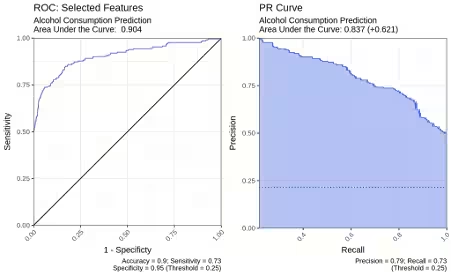
The study revealed a high identification accuracy of approximately 90% (AUC 0.92) in distinguishing between drinkers and non-drinkers. Significant biometric indicators were identified, such as changes in heart rate during sleep and elevated heart rates during non-walking periods. However, variations were observed in accuracy depending on the participants' gender, age, and alcohol consumption level, underscoring the need for further model enhancement. Despite the clear tendencies linking alcohol consumption with changes in sleeping patterns and daily activities, individual differences in the extent of these impacts were also noted.
Social Implications and Future Directions
These findings represent a promising initial step in utilizing consumer-oriented wearable technology to detect alcohol consumption accurately and objectively. The potential applications are vast, ranging from early detection of health risks associated with drinking to preventive interventions and personalized healthcare support tailored to individual drinking habits. The study also opens doors to refine research in other areas by isolating the effects of alcohol on biometric data, which in turn increases the accuracy of analyses in unrelated fields.
Looking ahead, the project aims to refine its algorithms and expand data collection to develop a technology that can be safely utilized by diverse populations. Tech Doctor is actively seeking research partners and collaborators to advance this initiative. Notably, the analytical techniques developed in this study are currently undergoing patent application.
About Tech Doctor Inc.
Founded on June 21, 2019, Tech Doctor Inc. operates under the vision of ushering in an era where health insights are driven by data. The company collaborates with medical, pharmaceutical, and food industries, advancing the development and social implementation of 'digital biomarkers' derived from daily sensing data.
Contact Info
CEO: Kazushi Minato
Address: 4th Floor, Kyobashi Edogrand, 2-2-1 Kyobashi, Chuo City, Tokyo
Website: Tech Doctor
Digital biomarkers represent a continuous, objective measurement of health indicators derived from everyday biometric data sourced from smartphones and wearables. Unlike traditional biomarkers—which can only provide 'point data' acquired in medical settings—digital biomarkers offer continuous 'line data' indicative of overall health, opening avenues for early disease detection, therapeutic monitoring, and a new framework for drug development. The interest in digital biomarkers has surged, both globally and within Japan, since they began to emerge in 2019.
Topics Health)
【About Using Articles】
You can freely use the title and article content by linking to the page where the article is posted.
※ Images cannot be used.
【About Links】
Links are free to use.