




The Extraordinary Renal Function of Freshwater Rays: A Closer Look at Their Urinary Adaptation
The Extraordinary Renal Function of Freshwater Rays
Introduction
The remarkable adaptation mechanisms of freshwater rays, particularly the species Hemitrygon akajei, are coming into focus following collaborative research from prestigious institutions including the University of Tokyo, the National Institute of Genetics, and Okayama University. The study offers groundbreaking insights into how these rays adjust their urinary output to thrive in diverse salinities, emphasizing their unique renal capabilities among vertebrates.
Key Findings
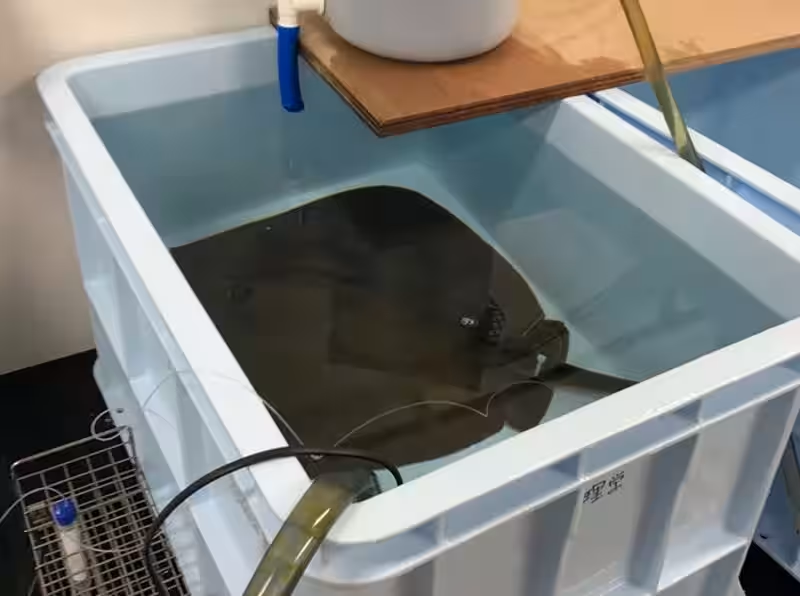
Utilizing a specially designed non-invasive urinary collection device, researchers discovered that Hemitrygon akajei can increase its urine production by nearly 90 times when transitioning from seawater to freshwater. This astounding ability underscores the ray's exceptional renal efficiency, already known to surpass that of many other vertebrates.
The study elucidated two primary factors contributing to this extraordinary urinary output: the increased glomerular filtration rate in the kidneys and the specific expression control of water channel genes. This advanced renal function is vital for maintaining physiological balance within hypoosmotic environments.
Research Methodology
Under the guidance of Naotaka Aburatani from the University of Tokyo, along with experts such as Wataru Takagi and Susumu Hyodo, the research team carried out detailed urinary output measurements without anesthesia. This innovative approach allowed for continuous urine collection and accurate volume assessments—an essential progress in understanding how these organisms manage water retention against osmotic stress.
The findings demonstrated that when subjected to low salinity conditions (approximately 56 mOsm/kg, 1/20th diluted seawater), the urine production soared to 6.4 mL/kg/h. This figure stands out as one of the highest recordings of urine output among vertebrates, highlighting the evolutionary advantage of the ray in fluctuating aquatic environments.
Implications of the Research
The insights gained from this study not only contribute to our understanding of fish adaptability but also open pathways for applications in biomedical research, particularly regarding kidney diseases. The mechanisms identified may help inform therapeutic strategies and interventions for renal dysfunction.
Flexibility of Renal Function
Further investigation showed that rays acclimatized to low salinity could quickly revert their urine production levels upon reintroduction to seawater, confirming the kidneys' high plasticity to environmental changes. This adaptability is a crucial evolutionary trait that enables survival across various aquatic environments, ranging from salt-rich oceans to freshwater habitats.
Conclusion
The pioneering work by researchers at Tokyo University, the National Institute of Genetics, and Okayama University underscores the sophisticated nature of renal functions in freshwater rays. This expanding knowledge base enhances our comprehension of vertebrate physiology, ecosystem interactions, and the evolutionary trajectory of aquatic species. Future research endeavors may uncover even more secrets about renal adaptability in both natural and clinical settings.
Researchers engaged in this project are hopeful that their findings will inspire further studies into the dynamic relationships between organisms and their environments—enhancing conservation efforts and advancing medical science. Full details of the research can be accessed in the journal iScience under the title: Extensive urine production in euryhaline red stingray for adaptation to hypoosmotic environments. The DOI for the publication is 10.1016/j.isci.2025.113274.
Contact Information
For inquiries related to this research, please contact:
- - Naotaka Aburatani, Michigan University, researcher
- - Wataru Takagi, University of Tokyo
For press-related questions, please reach out to the public relations departments of the respective universities involved.





Topics Health)
【About Using Articles】
You can freely use the title and article content by linking to the page where the article is posted.
※ Images cannot be used.
【About Links】
Links are free to use.