



Breakthrough Discovery of Antileishmanial Compound from Okinawa Sponge: A New Hope for Treatment
Breakthrough Discovery of Antileishmanial Compound from Okinawa Sponge
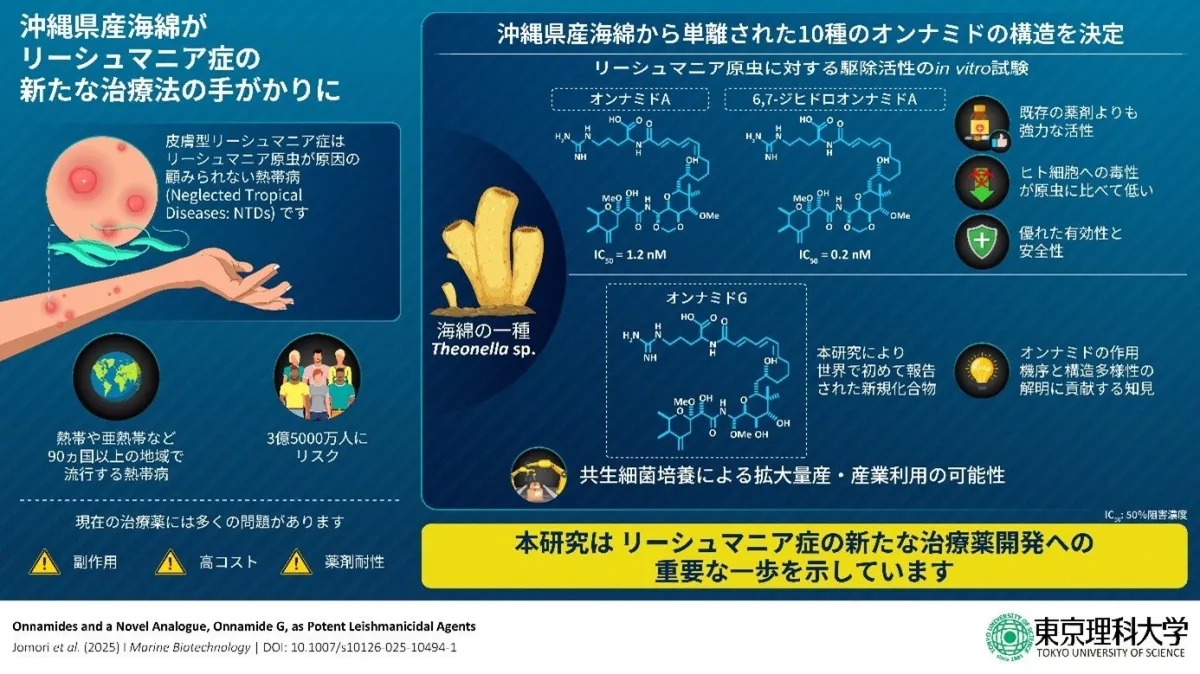
In a significant scientific advancement, a research team has successfully isolated potent compounds from sponges found in Okinawa, Japan. These compounds, particularly `onnamide G`, exhibit remarkable activity against the causative parasites of leishmaniasis, a tropical disease that affects populations in over 90 countries worldwide. This discovery could pave the way for novel treatments to combat this devastating illness, especially the skin form of leishmaniasis, which often leads to painful skin ulcers and long-term physical disability.
Understanding Leishmaniasis and Current Treatment Challenges
Leishmaniasis is a parasitic disease caused by the Leishmania species, which are transmitted through the bites of infected sandflies. The disease presents several forms, with cutaneous leishmaniasis being the most prevalent. Current treatment options for this condition are severely limited, plagued by issues such as high toxicity, significant side effects, and the growing concern of drug resistance.
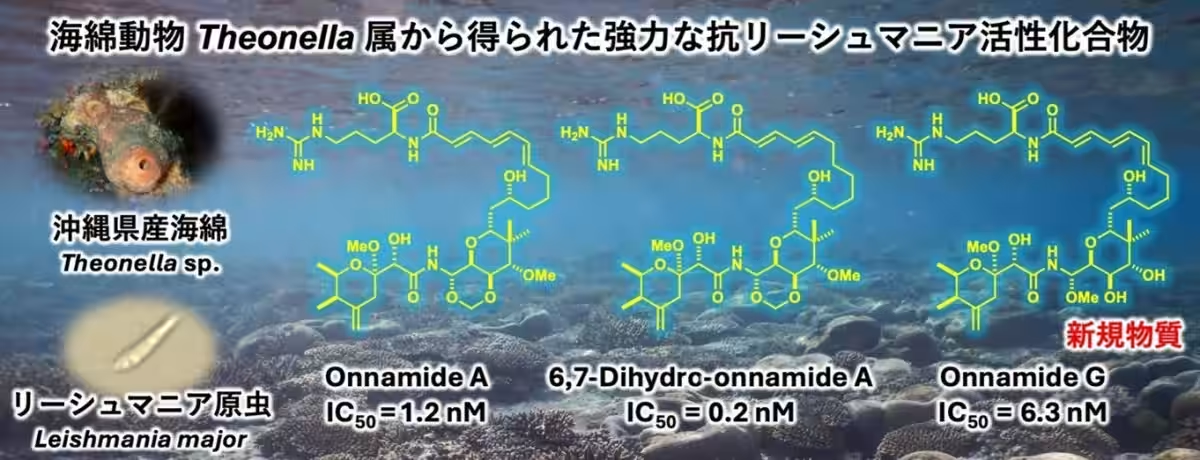
In ongoing research efforts, a group led by Kanami Yasumoto from Tokyo University of Science, along with collaboration from several institutions, has focused on the exploration of natural products derived from Okinawan marine resources. Their work has yielded ten different natural compounds, including `onnamide G`, which show exceptional leishmanicidal properties against the parasites responsible for the disease.
The Discovery Process
The compounds were extracted from the sponge species Theonella sp., collected from the waters off the coast of Okinawa. Notably, `onnamide A` and `6,7-dihydro-onnamide A` exhibited up to 53 times and 315 times greater leishmanicidal activity than existing treatments such as amphotericin B, respectively. Additionally, these compounds displayed a remarkably low toxicity level to human cells, demonstrating a selectivity index exceeding 1000. This is a powerful indicator of their potential as a safe and effective treatment option.
Notably, the structural elucidation of `onnamide G` is the first of its kind, enhancing the understanding of the diversity and action mechanism of onnamides. This new insight could lead to further advancements in the field, strengthening the viability of these compounds as treatments for leishmaniasis.
Implications for Future Research
The implications of this research extend beyond just the scientific community; they resonate deeply with the global health crisis posed by leishmaniasis. Approximately 12 million people are currently infected, with an estimated 350 million at risk. The urgent need for effective, accessible treatment options in endemic regions is more relevant than ever.
The current strategies for treating leishmaniasis often hinge on toxic compounds like liposomal formulations of amphotericin B and antimonial drugs, which come with a hefty price tag and adverse effects that deter patients from seeking treatment. Researchers stress the importance of discovering new compounds from nature that can serve as therapeutic agents, citing the historical success of penicillin as an example.
The distinct characteristics of onnamides, a subclass of nitrogen-containing polyketides, were identified during the initial extraction phases, revealing their potential as functional pharmaceutical agents. Previous studies have shown that derivatives like `onnamide A` demonstrate high anticancer activity, suggesting their broad-spectrum potential as medicinal compounds.
Overcoming Challenges
Despite the promising results, further studies are needed to explore the molecular complexity of these compounds for large-scale synthesis and application. The research group acknowledges that the intricate molecular structures of onnamides may pose challenges in chemical synthesis, emphasizing the necessity of in vivo studies and further analysis of their mechanisms of action.
Kanami Yasumoto remarked, “It is crucial to contribute to treatment options for diseases that may not be prevalent in Japan but impact lives around the world. When I think about patients living in areas where effective drugs are unavailable, it pulls at my heartstrings. We aim to tackle global healthcare challenges by leveraging the natural resources available in Okinawa and Japan.”
Takahiro Jomori, a researcher at Ryukyu University, further emphasized the importance of Okinawa's rich marine biodiversity. He shared his aspirations to continue the search for new medicinal compounds, highlighting the evolving threat of drug resistance and the importance of finding innovative solutions for future patients.
Conclusion
This research marks a significant step forward in the field of tropical medicine, offering hope for new treatments targeting leishmaniasis. The findings were published online in Marine Biotechnology on September 5, 2025, highlighting the collaborative efforts fueled by Japanese governmental support through various scientific grants.
The success of this research could lead to substantial advancements in global health initiatives, enhancing the quality of life for millions affected by leishmaniasis as new therapeutic strategies emerge from the depths of the Okinawan sea.
Topics Health)
【About Using Articles】
You can freely use the title and article content by linking to the page where the article is posted.
※ Images cannot be used.
【About Links】
Links are free to use.