



First Observation of Positronium Diffraction Phenomena in Quantum Physics
The Historic Observation of Positronium Diffraction Phenomena
In a groundbreaking step for quantum physics, a research team from Tokyo University of Science has achieved the world's first observation of diffraction phenomena associated with positronium, a unique neutral particle composed of an electron and its antiparticle, the positron. This monumental feat was reported by Professor Yasuyuki Nagashima, Associate Professor Yugo Nagata, and PhD student Riki Mikami, who utilized a positronium beam and directed it through a graphene film, capturing diffraction effects that had previously remained elusive in scientific studies.
The Significance of This Research
This observation stands as a significant milestone in quantum physics, celebrating 100 years since the birth of quantum mechanics. The successful implementation of high-quality positronium beams facilitates the exploration of quantum interference phenomena and potentially unlocks new avenues for crystallography and foundational physics research. The results were published online in the prestigious journal Nature Communications on December 23, 2025.
Understanding Positronium
Positronium emerges when electrons and positrons—particles with equal mass but opposite charge—bind together through Coulomb forces. This particle resembles a hydrogen atom but possesses only 1/1000th of its mass. Within a fleeting lifetime ranging from 125 picoseconds to 142 nanoseconds, positronium behaves as a neutral atom before decaying into gamma rays in a process referred to as “positronium annihilation.” Despite their incredibly short lifespans, positronium manifests wave-like properties consistent with quantum mechanics, leading researchers to believe that diffraction and interference could be observable.
The Experiment: Creating the Positronium Beam
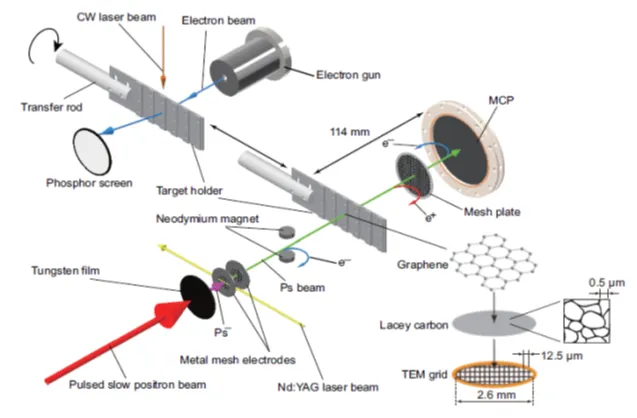
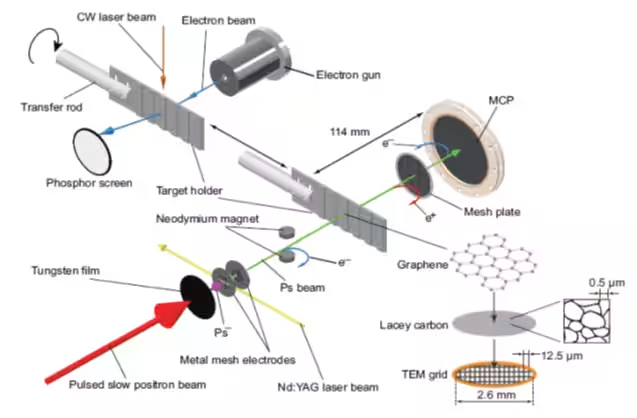
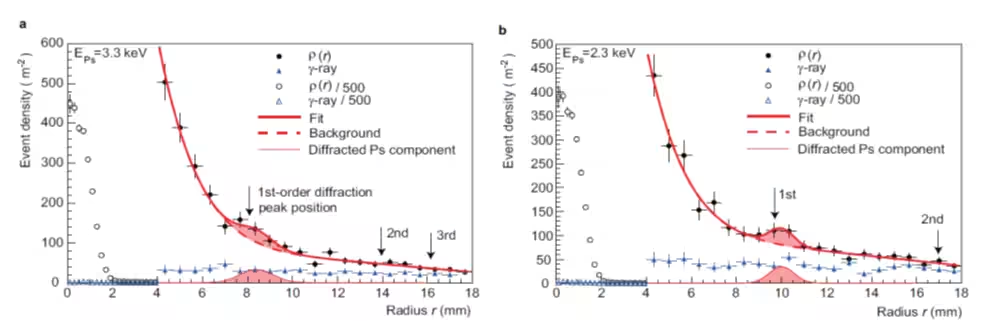
To observe the diffraction of positronium, the research team developed a novel technique to accelerate positronium by first converting it into a negatively charged ion. They created positronium negative ions, which were then accelerated by an electric field. Following that, a laser was used to remove one electron, producing a beam of positronium with specific energies of 2.3 keV or 3.3 keV directed towards a graphene film for observation.
Graphene, known for its remarkable strength and one-atom-thick layer, was essential for this study. Previous experiments had demonstrated electron diffraction patterns upon passing through graphene; hence the team sought to ascertain whether positronium could exhibit similar behavior.
The Challenges of Measurement
The research process was arduous, spanning over two years, largely due to the low intensity of the positronium beam produced by their unique method. Despite these challenges, the team successfully detected diffraction patterns attributable to positronium interacting with the graphene atoms. The findings showed distinctive peaks at 8.1 mm and 10.0 mm distances, consistent with theoretical predictions for positronium diffraction based on the location of graphene’s atomic structure.
Implications for Future Research
The successful demonstration of diffraction and quantum interference in positronium opens exciting prospects for future studies. One of the key implications includes the potential application of positronium in crystallography, where it could serve as a valuable tool, analogous to X-rays and electron beams, for analyzing the atomic structure of materials. Moreover, the wavefunction behavior exhibited by positronium suggests possibilities for innovative gravity measurements, an area that has yet to be successfully explored using either electrons or positrons due to the predominance of electromagnetic forces in experimental environments.
As the wavefunction of positronium reveals quantum interference effects, researchers can utilize this to design positronium interferometers, capable of examining how positronium navigates the gravitational field of the Earth, bringing this long-sought experiment into the realm of reality.
Acknowledgments
This research was supported by the Japan Society for the Promotion of Science (JSPS) KAKENHI grants JP25H00620, JP21H04457, and JP17H01074.
For additional insights into this groundbreaking research, please refer to the complete article published in Nature Communications:
- - Title: Observation of positronium diffraction
- - Authors: Yugo Nagata, Riki Mikami, Nazrene Zafar, and Yasuyuki Nagashima
- - DOI: 10.1038/s41467-025-67920-0
Topics Consumer Technology)
【About Using Articles】
You can freely use the title and article content by linking to the page where the article is posted.
※ Images cannot be used.
【About Links】
Links are free to use.