



New Insights into the Causal Structures of Turbulence Dynamics from Observation Data
Understanding Turbulence Dynamics
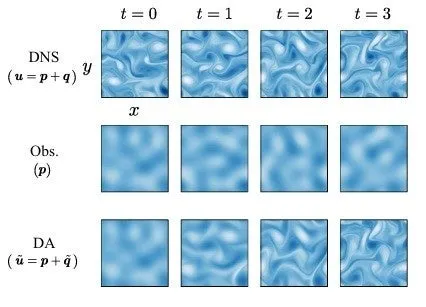
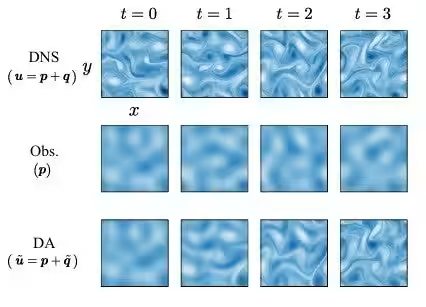
Recent studies into the Navier-Stokes equations, which govern the motion of fluids like air and water, have led to groundbreaking insights into the synchronization properties of turbulence. A collaborative research effort between Associate Professor Masanobu Inubushi from Tokyo University of Science and Professor Colm-Cille Patrick Caulfield of the University of Cambridge has unveiled new findings regarding causal structures hidden within turbulence dynamics.
The Navier-Stokes Equations: An Overview
The Navier-Stokes equations are fundamental in describing fluid flow and play a vital role in various applications, including the design of vehicles, aircraft, and weather forecasting. Despite their importance, many aspects of these equations remain poorly understood, prompting ongoing research efforts. Recently, scholars have become increasingly interested in applying data assimilation techniques—an intersection of numerical analysis and statistical science—to improve prediction accuracy through effective use of observational data.
Synchronization in Two-Dimensional Turbulence
A distinct focus of this research was on the synchronization properties of the two-dimensional Navier-Stokes equations. Traditional fluid motion is typically three-dimensional; however, in scenarios such as ocean currents, the depth scale is significantly smaller than the horizontal scale, resembling the proportion of an A4 paper's thickness to its length. Thus, understanding two-dimensional turbulence is crucial for accurate modeling of fluid dynamics.
The researchers found that the properties of the Navier-Stokes equations depend heavily on the spatial dimensions involved. Their results indicate a notable difference in synchronization behavior between two-dimensional and three-dimensional turbulence. In contrast to three-dimensional flows, which require data resolution up to the 'minimum vortex' to achieve synchronization, the two-dimensional case can synchronize with observations limited to the 'maximum vortex' information, showcasing a fascinating relationship.
Observational Challenges and Innovations
Typically, observations from satellites lack resolution to capture smaller vortices, limiting the ability to predict fluid motion accurately. For instance, when predicting ocean currents based on large-scale vortex data from satellite observation, the inability to account for smaller vortex movements can lead to significant errors in simulation forecasts, often referred to as the
Topics Other)
【About Using Articles】
You can freely use the title and article content by linking to the page where the article is posted.
※ Images cannot be used.
【About Links】
Links are free to use.