


Innovative Challenges in Paper Recycling Initiatives from Universities
Innovative Paper Recycling Initiatives from Universities
In an ambitious effort to address pressing social issues surrounding paper recycling, the Japan Paper Recycling Promotion Center (located in Chuo, Tokyo) has partnered with universities to develop new models for fostering human resources and changing behaviors related to recycling.
Amidst declining paper demand and a reduction in the quantity of waste paper generated, the need for effective sorting and recycling of mixed paper has emerged as a nationwide challenge. This situation cannot be remedied solely through institutional or technological advancements; instead, it's essential to inspire younger generations in local communities to engage with resource circulation actively. The initiative aims to provide opportunities for these youths to think about and act on the recycling of resources.
Recently, the Japan Paper Recycling Promotion Center launched two distinct initiatives at Tohoku Fukushi University in Sendai, Miyagi, and Chiba University. Each project focuses on unique approaches to enabling students and communities to collaborate on local recycling issues.
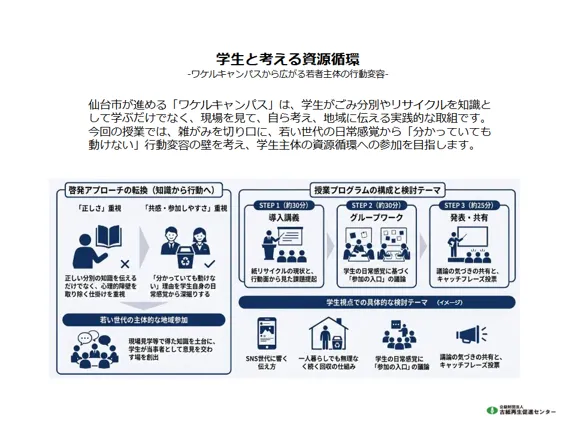
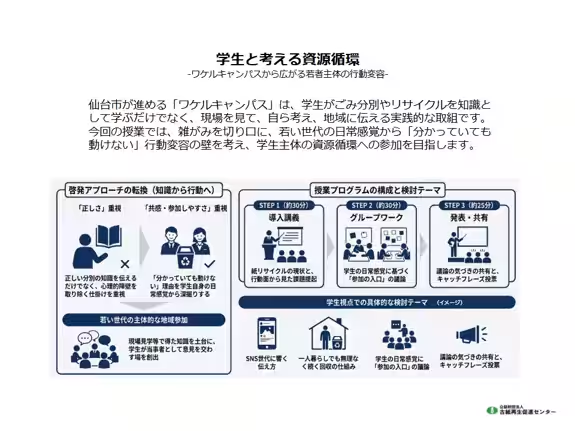
The “Wakeru Campus” Model at Tohoku Fukushi University
The initiative at Tohoku Fukushi University is dubbed the “Wakeru Campus,” where local government, universities, and industry associations join forces to address community challenges. In collaboration with the local city's Resource Circulation Department, the university hosted a special lecture as part of this project. The initiative builds upon the long-standing efforts by Sendai to promote waste reduction and resource circulation seamlessly.
Students before attending the lecture received insights into the city's waste reduction strategies and sorting systems. The lecture addressed critical topics, including why mixed paper often ends up in combustible waste, the status quo of paper recycling, and practical examples of successful initiatives across Japan. The course fostered a broader understanding of the challenges young individuals face and promoted a fresh approach to engaging in resource circulation.
The Student-Led Project at Chiba University
At Chiba University, the “Mixed Paper Sorting and Behavior Change Project” aims to encourage students to actively promote mixed paper sorting and reduce combustible waste. This project empowers students to investigate the current situation on campus, identify challenges, and create solutions while managing the planning, implementation, and evaluation processes themselves.
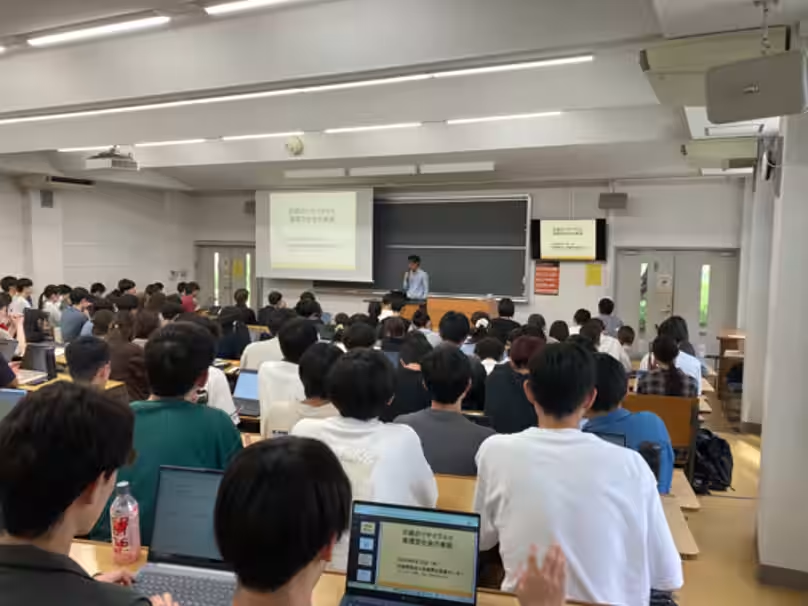
Before launching the project, a lecture on paper recycling was conducted. Initially planned for project members, the session expanded through the collaboration of the Environmental ISO Student Committee and an instructor, welcoming about 180 students from an “Environmental Issues B” course.
This lecture covered the current state of paper recycling, challenges, the issues surrounding mixed paper, and the specific sorting rules on campus, along with the project's objectives. Post-lecture surveys indicated an increased understanding of recycled paper issues and a heightened awareness of sorting practices.
New Models Promoting Action Based on Knowledge
Both initiatives diverge in their teaching methods, as the objective is not merely to deliver lectures. The model at Tohoku Fukushi University emphasizes collaboration between government, academia, and industry to delve into community issues. Conversely, Chiba University adopts a student-led model where participants are fully accountable for discovering problems, creating solutions, and evaluating their impact.
Despite their different approaches, both initiatives underscore a shared aim: to transcend the mere acquisition of knowledge and promote independent thought and action among students.
The Japan Paper Recycling Promotion Center plans to continue expanding its collaborations with universities, local governments, and communities, honing initiatives that harness each institution's unique characteristics while fostering a culture of resource recycling.
As noted by Masatoshi Kawakami, Executive Director of the Japan Paper Recycling Promotion Center, behavior change in paper recycling hinges on individual actions within daily life. A significant ongoing theme will be how to convey these behavioral changes to future generations. Given the varying characteristics of universities—such as their local contexts and educational environments—it’s vital to engage with communities and not to confine to a singular model across all institutions. This approach nurtures human resources and contributes to building a sustainably interconnected society.
Topics Other)

【About Using Articles】
You can freely use the title and article content by linking to the page where the article is posted.
※ Images cannot be used.
【About Links】
Links are free to use.