



Innovative Fully Automated AED from Okayama University Aims to Enhance Survival Rates
Transforming Life-Saving Methods with Fully Automated AEDs
In a country where cardiac arrest remains a leading cause of death, the development of easily operable Automated External Defibrillators (AEDs) is paramount. Okayama University, a national university corporation, has pioneered research demonstrating that fully automated AEDs reduce the hesitation often faced by bystanders during emergencies. This breakthrough could be crucial for improving survival rates amid increasing cardiac emergencies.
Research Findings
A collaborative research initiative led by Tsuyoshi Nojima, a special lecturer at Okayama University’s Graduate School of Medicine, Dentistry, and Pharmaceutical Sciences, has shown significant preferences between different types of AEDs. The study analyzed the experiences of 443 participants, comprising both medical professionals and the general public, who obtained training on CPR and AED usage between 2021 and 2022.
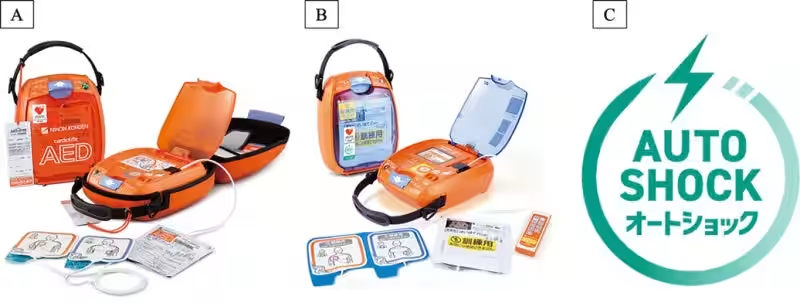
The findings, published in the international medical journal Internal Medicine, indicate that laypersons express a distinct preference for fully automated AEDs. These devices operate independently, alleviating the psychological burden regarding whether to press the device’s button to administer a life-saving shock. In contrast, medical professionals appeared to prefer semi-automated AEDs, as these are the devices with which they are most familiar. Some medical personnel even expressed concerns regarding the safety of fully automated models, pointing towards a potential discrepancy in acceptance based on experience.
The Importance of Fast Response
In cases of sudden cardiac arrest, the rapid response of bystanders can significantly impact the victim's prognosis. The global importance of training laypersons in the use of AEDs cannot be understated, especially as studies demonstrate that immediate action often dictates survival outcomes. Nojima emphasizes, “The ability to act without hesitation can drastically change the fate of an individual experiencing a cardiac event. The fully automated AED significantly reduces the psychological barrier of the 'button press' for the general public, making it easier for anyone to respond accordingly.”
Training and Education
Despite the clear advantages highlighted in the study, the prevailing CPR training courses have not sufficiently included education regarding fully automated AEDs. This is a point of concern that the research group has decisively underscored, advocating for a reevaluation of training content to better prepare civilians for emergencies.
The necessity to teach the proper usage of all available AEDs, especially the fully automated versions, is vital. The aim is to cultivate a society where individuals can confidently and promptly utilize these life-saving devices without hesitation.
Comments from the Researchers
The researchers at Okayama University, including Nojima and professor Atsunori Nakao, call for enhanced training to ensure that irrespective of the circumstances, any civilian can competently and decisively use an AED. As more public facilities begin to incorporate fully automated AEDs, increasing awareness and education becomes a priority. “Knowing how to operate these devices can genuinely make a difference when seconds count,” they assert.
Conclusion
The introduction of fully automated AEDs represents a significant advancement in life-saving technologies, aligning with the goals of increasing public awareness and access to effective emergency medical response tools. In the years ahead, as Okayama University continues to lead research and education initiatives around AED usage, the impact of these efforts could transform the landscape of emergency health care in Japan and beyond. By fostering a better understanding and comfort with these devices among the public, we may witness an uplift in survival rates during critical medical emergencies.
For further information, refer to the published paper titled 'Differences in the Usability of Fully Automated External Defibrillators between Medical and Nonmedical Professionals,' which provides deeper insights into this vital research. The research backs the call for better AED training, which could prove to be life-saving in vital moments.
For more details, visit Okayama University's official press release.


Topics Health)
【About Using Articles】
You can freely use the title and article content by linking to the page where the article is posted.
※ Images cannot be used.
【About Links】
Links are free to use.