




Revolutionary Findings in Metal Oxides: Major Resistivity Reduction of Chromium Oxide Thin Films Paves Way for Future Memory Devices
Discovering the Potential of Chromium Oxide Thin Films
In the realm of advanced materials, the research surrounding transition metal oxides continues to shed light on intriguing properties and applications. A recent study conducted by a collaborative team from various prestigious institutions in Japan, including the University of Tokyo and Tohoku University, has uncovered a groundbreaking advancement in the electrical properties of layered chromium oxide thin films.
Summary of Findings
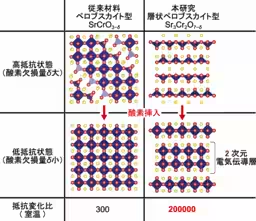
The team, led by Assistant Professor Daichi Oka and graduate student Zhaochen Ma from Osaka University, along with notable contributors from Tohoku University, synthesized high-quality epitaxial thin films of the layered perovskite-type chromium oxide Sr3Cr2O7-δ using a straightforward oxidation process. What sets this discovery apart is the astonishing reduction in electrical resistivity — achieving a staggering decrease to approximately 1/200,000 of its previous value at room temperature. This remarkable transformation highlights the potential of this new oxide material for applications in the development of next-generation memory devices and highly sensitive sensors.
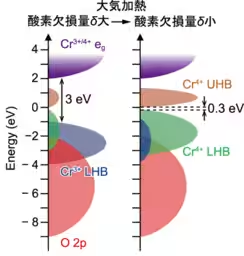
Upon synthesizing these thin films, they initially exhibited minimal electrical conductivity. However, upon heating in air, oxygen was introduced into the crystal structure, significantly enhancing their electrical properties. This intriguing shift represents over a 600-fold improvement in resistivity change compared to previously studied three-dimensional chromium oxides. By analyzing the electronic states more thoroughly, researchers found that the specific positions of oxygen vacancies and the oxidation states of chromium ions played essential roles in the conductivity of the material, leading to this profound resistivity variation.
Key Highlights of the Study
- - Successful synthesis of layered perovskite type Sr3Cr2O7-δ thin films containing oxygen vacancies using pulsed laser deposition (PLD).
- - Introduction of oxygen while maintaining the layered structure drastically reduced room temperature resistivity, achieving a 1/200,000 decrease.
- - A thorough investigation revealed that the unique arrangement of oxygen vacancies coupled with changes in chromium oxidation states worked interactively to enhance resistivity change dramatically.
Background: The Need for Advanced Materials
Transition metal oxides exhibit remarkable properties due to robust electron correlation effects. Their electrical and magnetic characteristics can be modulated through variations in structure and chemical composition. In particular, materials with non-stoichiometric oxygen content have emerged as promising candidates for next-generation memory devices due to their ability to control electronic properties by the removal or insertion of oxygen. However, existing three-dimensional perovskite structures have limitations in practical applications, necessitating the exploration of new materials that could showcase even greater resistivity changes.
Research Methods and Outcomes
The researchers carefully selected Sr3Cr2O7-δ due to its two-dimensional electrical conduction layers that significantly enhance electron mobility impacted by oxygen deficiencies. Following repeated processes of pulsed laser deposition, the high-quality epitaxial thin films consisted of numerous oxygen vacancies, initially leading to high resistivity levels.
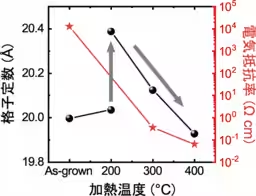
The crucial experimental step involved heating these films in air, where the temperature elevations resulted in deviations in lattice parameters while preserving the layered perovskite structure. This non-linear change demonstrated the complex rearrangement of ordered oxygen vacancies into a more disordered state followed by progressive oxygen insertion.
Notably, as the thin films were heated to around 400°C, the resistivity dramatically dropped to less than 1/200,000 of the original value. This unprecedented improvement would likely encourage further studies comparing it to the resistance change ratios reported in SrCrO3, which were significantly lower by a factor of 600. The detailed electronic state measurements using KEK's Photon Factory indicated that the films predominantly exist in hybrid oxidation states (Cr3+ and Cr4+), with the Cr3+ ions increasing the Mott gap, a critical finding in understanding the mechanism behind the observed resistivity changes.
Significance and Broader Implications
This research emphasizes the critical role of dimensionality in enhancing resistivity change in transition metal oxides, marking a significant milestone in materials science. The successful synthesis of layered oxide epitaxial thin films also adds to the limited repertoire of materials that could be explored. Given the diverse structures and compositions of transition metal oxides, this study’s insights into material design can foster the development of new materials exhibiting substantial resistivity changes.
Oxygen-insertable materials have great potential in emerging applications such as memristors, which mimic synaptic functions in neural systems for artificial intelligence. As the demand for energy-efficient computing devices grows, advancements achieved through this study could contribute significantly to reducing the energy consumption of future technology.








Topics Consumer Products & Retail)




【About Using Articles】
You can freely use the title and article content by linking to the page where the article is posted.
※ Images cannot be used.
【About Links】
Links are free to use.