



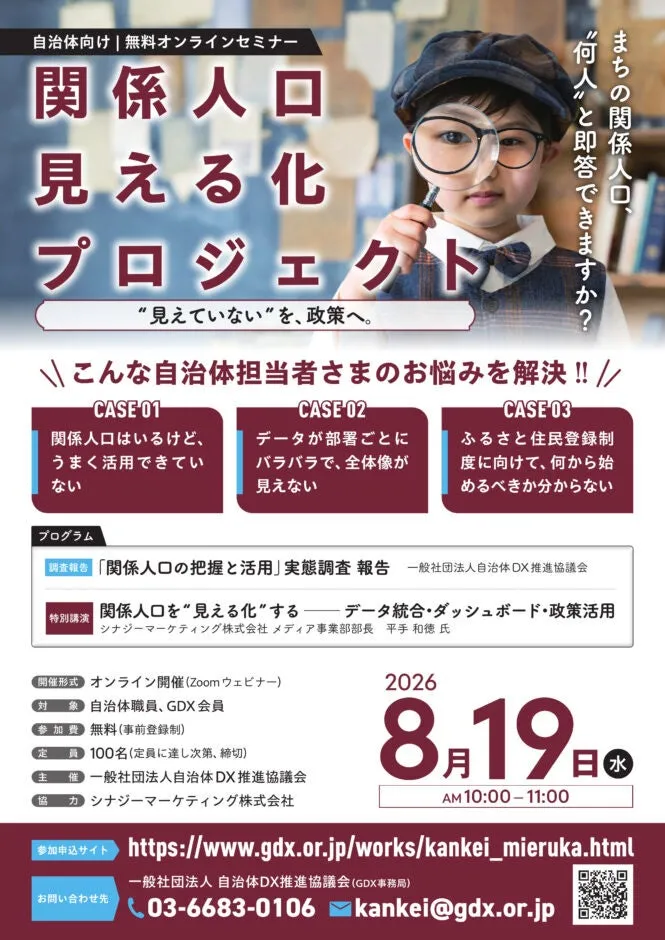
Understanding Relationship Population: A Deep Dive into Local Government's Challenges
The General Association for Local Government DX Promotion (GDX) conducted a significant investigation into how Japan's local governments perceive and manage their relationship populations – a term used to describe individuals and communities from outside regions who maintain connections with local areas. This study involved 242 municipalities across 46 prefectures and was carried out between July and August 2026.
The survey aims to shed light on the pressing issues of population decline and labor shortages that have become a national concern. The results indicate that an overwhelming 97.5% of municipalities acknowledge a sense of crisis regarding these challenges. Among them, 57.4% report feeling a very strong sense of urgency to address these issues. The respondents understand the necessity to utilize their relationship populations in various ways beyond just encouraging local immigration and residency.
Further, the research identified that while local governments maintain an average of 4.2 channels for interaction with their relationship populations, only 7.4% are able to quantify the total number of these individuals. Individuals who have engaged with local governments through mechanisms like hometown tax donations, events, and social media connections constitute the various channels available. A striking 80.6% of municipalities report having interactions with donors of hometown tax, followed closely by 66.1% who engage with individuals seeking migration advice or trial residency opportunities. 59.5% have connections through websites and social media platforms, indicating a robust yet under-leveraged network.
Despite these connections, many local governments lack a comprehensive understanding of their relationships with populations beyond their immediate jurisdiction. Data reveals that while 59.9% claim to have partial insights, only a small fraction can make informed decisions based on comprehensive data. The fact that just 4.5% of respondents indicated they continuously track interests and sentiments highlights a glaring gap in local governance structure.
In response to these findings, GDX will host a free online seminar titled 'Understanding Relationship Population: A Survey on Grasp and Utilization', set for August 19, 2026. The seminar will provide an avenue for local officials and interested stakeholders to discuss the implications of the survey and brainstorm solutions for addressing the disparities in data and outreach. Participation in this webinar is free of charge but requires advance registration.
This initiative is not just an effort to revitalize declining populations but also to forge deeper ties between local governments and their constituents—drawing from a pool of potential engagements that are often overlooked. As local officials seek to navigate these changes, the findings point to the urgent need for improved data management strategies in order to harness and engage effective relationships with those outside their municipal boundaries.
The implications of study findings are manifold. They hint at the necessity for a multi-faceted approach to understanding the dynamics that drive relationship populations. With the upcoming launch of the 'Hometown Resident Registration System' by the Ministry of Internal Affairs and Communications, local governments are equipped with an additional tool to refine their tracking processes, potentially expanding the relevance and utility of relationship populations. This system underscores a commitment to an informed approach in promoting sustainable community growth.
What emerges is not just a statistics report. It is a call to action for every local government to venture beyond conventional governance methods and openly embrace the strengths and insights that relationship populations can bring. As Japan faces demographic changes, evolving strategies to harness these connections will be essential for survival. The stage is set for local governments to take the first steps toward tangible change in their communities.
The survey aims to shed light on the pressing issues of population decline and labor shortages that have become a national concern. The results indicate that an overwhelming 97.5% of municipalities acknowledge a sense of crisis regarding these challenges. Among them, 57.4% report feeling a very strong sense of urgency to address these issues. The respondents understand the necessity to utilize their relationship populations in various ways beyond just encouraging local immigration and residency.
Further, the research identified that while local governments maintain an average of 4.2 channels for interaction with their relationship populations, only 7.4% are able to quantify the total number of these individuals. Individuals who have engaged with local governments through mechanisms like hometown tax donations, events, and social media connections constitute the various channels available. A striking 80.6% of municipalities report having interactions with donors of hometown tax, followed closely by 66.1% who engage with individuals seeking migration advice or trial residency opportunities. 59.5% have connections through websites and social media platforms, indicating a robust yet under-leveraged network.
Despite these connections, many local governments lack a comprehensive understanding of their relationships with populations beyond their immediate jurisdiction. Data reveals that while 59.9% claim to have partial insights, only a small fraction can make informed decisions based on comprehensive data. The fact that just 4.5% of respondents indicated they continuously track interests and sentiments highlights a glaring gap in local governance structure.
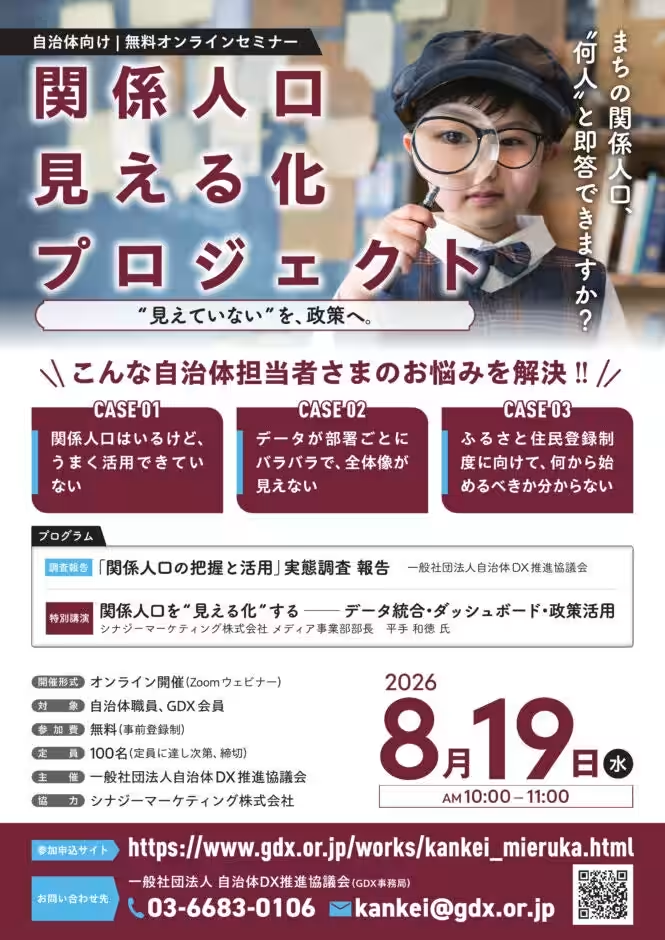
In response to these findings, GDX will host a free online seminar titled 'Understanding Relationship Population: A Survey on Grasp and Utilization', set for August 19, 2026. The seminar will provide an avenue for local officials and interested stakeholders to discuss the implications of the survey and brainstorm solutions for addressing the disparities in data and outreach. Participation in this webinar is free of charge but requires advance registration.
This initiative is not just an effort to revitalize declining populations but also to forge deeper ties between local governments and their constituents—drawing from a pool of potential engagements that are often overlooked. As local officials seek to navigate these changes, the findings point to the urgent need for improved data management strategies in order to harness and engage effective relationships with those outside their municipal boundaries.
The implications of study findings are manifold. They hint at the necessity for a multi-faceted approach to understanding the dynamics that drive relationship populations. With the upcoming launch of the 'Hometown Resident Registration System' by the Ministry of Internal Affairs and Communications, local governments are equipped with an additional tool to refine their tracking processes, potentially expanding the relevance and utility of relationship populations. This system underscores a commitment to an informed approach in promoting sustainable community growth.
What emerges is not just a statistics report. It is a call to action for every local government to venture beyond conventional governance methods and openly embrace the strengths and insights that relationship populations can bring. As Japan faces demographic changes, evolving strategies to harness these connections will be essential for survival. The stage is set for local governments to take the first steps toward tangible change in their communities.
Topics General Business)
【About Using Articles】
You can freely use the title and article content by linking to the page where the article is posted.
※ Images cannot be used.
【About Links】
Links are free to use.