



Demand for High-Quality Offices Drives Tokyo's Real Estate Market Growth
The Rising Demand for Quality Offices in Tokyo's Real Estate Market
The commercial real estate landscape in Tokyo is undergoing significant transformation, particularly in the Grade A office market across the central five wards. According to the latest report from Cushman & Wakefield's 'Office Marketbeat Q3 2026', there has been a marked increase in demand for high-quality office spaces. As businesses prioritize location, environmental performance, and employee experience, the demand for premium office spaces is propelling market growth.
Economic Performance Insights
Recent findings from the Bank of Japan's September Tankan survey reveal a notable improvement in business sentiment across all industries. The Diffusion Index (DI) for business conditions has enhanced by three points from the previous survey conducted in June, reaching a significant 21. Despite concerns about rising oil prices and increased costs due to higher interest rates, the overall corporate outlook shows resilience, particularly in the manufacturing sector. The corporate outlook for revenue in FY2026 forecasts a 4.1% increase year-on-year, signaling a cautious yet optimistic approach by businesses.
The anticipated rise in revenue and operating profit, transitioning from a decline of 2.4% to an increase of 2.3%, indicates a shifting landscape favoring companies within emerging sectors, notably data centers and AI.
Office Supply and Rental Trends
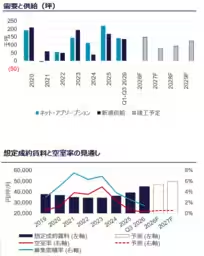
By the end of Q3 2026, the average expected rental price for Grade A offices in central Tokyo has risen to ¥45,139 per tsubo, marking an 18.2% increase year-on-year and a 4.7% rise since the previous quarter. The vacancy rate has astonishingly remained below 1% since Q3 2025, dipping to an unprecedented 0.3% in the latest quarter—a crucial indicator of the market's competitiveness. Despite approximately 60,000 tsubo of new supply entering the market this quarter, the occupancy rate for new completions reached an impressive 97.7%.
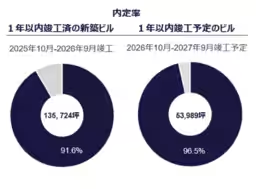
While many new properties show average occupancy rates at 91.6%, some are still struggling to fill spots more than six months post-completion, particularly those with rates below 90%. Firms continue to exercise caution amid dwindling options, focusing on key attributes such as rental prices and geographical advantages, reflecting a trend towards selecting high-performing properties even with rising rent costs.
Key Areas Exhibiting Growth
The rental prices across all submarkets have seen significant double-digit increases compared to the previous year. Notable regions include:
- - Kyobashi, Yaesu, and Nihonbashi Areas: Over the past year, these areas introduced around 78,000 tsubo of new supply, expanding their total leasable floor area by approximately 29%. This influx has driven rental rates to rise dramatically by 29.6%, bringing them to ¥58,259 per tsubo.
- - Otemachi and Marunouchi Areas: This elite sector has witnessed a 9.2% increase in expected rental prices, reaching ¥58,460 per tsubo, surpassing neighboring Kyobashi and making it the area with the highest average rent.
Demand remains robust, prompting rental prices of existing buildings to trend upwards as well, with some Grade A offices commanding mid ¥80,000 per tsubo.
For a more comprehensive analysis, refer to the downloadable PDF report detailing Q3 2026's commercial office market dynamics.
About Cushman & Wakefield
Cushman & Wakefield (NYSE: CWK) stands as one of the foremost global firms offering comprehensive commercial real estate services. Operating across over 350 locations in about 60 countries, the company employs roughly 53,000 individuals. In 2025, it recorded a revenue of $10.3 billion, driven by its commitment to 'Better never settles'—a mantra reflecting its pursuit of value creation and excellence. For further insights, visit www.cushmanwakefield.com.

Topics Consumer Products & Retail)



【About Using Articles】
You can freely use the title and article content by linking to the page where the article is posted.
※ Images cannot be used.
【About Links】
Links are free to use.