




Exploring Differences in Satellite Systems of Jupiter and Saturn Through Magnetic Fields
Unraveling the Mysteries of Jupiter and Saturn's Satellite Systems
A collaborative research team from Kyoto University, Okayama University, and the National Astronomical Observatory of Japan has made significant strides in understanding the differences between the satellite systems of Jupiter and Saturn. This research highlights the crucial role of magnetic field intensity on the surface of gas giants in determining the architecture of their satellites.
The study, led by Assistant Professor Yuri Fujii from Kyoto University and Associate Professor Masahiro Ogihara from Shanghai Jiao Tong University's Lee Kuan Yew Institute, along with Associate Professor Yasunori Hori from Okayama University's Graduate School of Environmental and Life Science, investigates how varying magnetic field strengths influence the formation and evolution of moons around these two major gas planets.
Traditionally, the variations between the satellite systems of Jupiter and Saturn have remained an enigma. To tackle this mystery, the researchers simulated the internal structure of gas giants shortly after their formation, calculating the magnetic field intensity at the planet's surface. They performed detailed analyses of gas flow around the planets and conducted numerical simulations using advanced computational servers at the National Astronomical Observatory.
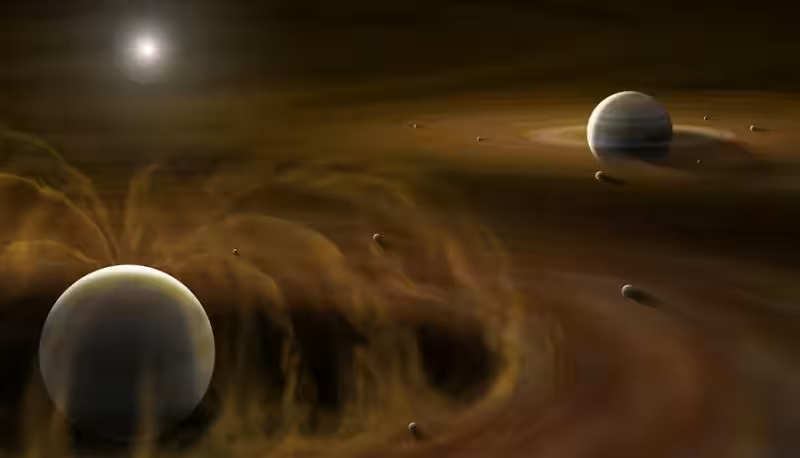
The findings revealed that Jupiter possesses a much stronger magnetic field compared to Saturn, leading to the phenomenon of magnetospheric accretion. Essentially, this process allows gas to flow along Jupiter's magnetic field lines, creating an environment conducive to the formation of multiple large satellites nearby. In stark contrast, Saturn's weaker magnetic field does not support such accretion, resulting in a solitary large moon positioned much farther from the planet. This pivotal difference touches upon the underlying reasons for the distinct satellite characteristics of both gas giants.
Throughout the research, the team also focused on how this new understanding could inform future explorations of exoplanets and their potential satellite systems. By anticipating the structures of satellite systems, scientists can prepare better for future discoveries in exoplanetary research.
The work was officially published online on April 2, 2026, in the renowned international journal, Nature Astronomy. The paper, titled “Different architecture of Jupiter and Saturn satellite systems from magnetospheric cavity formation,” not only contributes to the field of planetary sciences but also sets the stage for new avenues of research into how magnetic fields may affect planetary formation processes across different celestial bodies.
In conclusion, this research showcases the importance of inter-university collaboration in tackling complex scientific questions and highlights the potential for significant advancements in our understanding of the universe. As we continue to explore the cosmos, studies like this provide essential insights into the mechanisms governing celestial phenomena and prepare us for future explorations with open skies ahead.
If you're interested in learning more about the methodologies or results, the paper is accessible via DOI: 10.1038/s41550-026-02820-x.
For media inquiries or further information about this groundbreaking research, please contact:
- - Assistant Professor Yuri Fujii, Kyoto University, Human and Environmental Studies, Tel: 080-2675-7026.
- - Associate Professor Yasunori Hori, Okayama University, Academic Research Institute, Tel: 086-251-7884.
- - Kyoto University Public Relations Office, Tel: 075-753-5729.





Topics Other)


【About Using Articles】
You can freely use the title and article content by linking to the page where the article is posted.
※ Images cannot be used.
【About Links】
Links are free to use.