



Survey Reveals Positive Outcomes for Local Population Initiatives in Japan
Insights from Recent Survey on Local Population Initiatives
In a comprehensive study commissioned by GLOCOM at International University, significant findings have emerged regarding local government initiatives aimed at fostering population engagement in Japan. Conducted across 473 municipalities, the survey explored topics such as local population creation policies, a hometown resident registration system, and digital transformation (DX) in relocation promotion efforts.
Background of the Survey
As Japan faces critical issues like declining birth rates, concentration of its population in Tokyo, and a shortage of regional workforce, the government has introduced various policies aimed at expanding ties with local communities. Notably, initiatives such as the creation and expansion of “related population” and “relocation without job change” are part of the measures being implemented to overcome these challenges. The Hometown Resident Registration System is also gaining importance, with the government set to launch model projects in fiscal 2026.
While these initiatives have been introduced, data on their actual implementation and perception at the municipal level was previously limited. This survey, directed by GLOCOM's Masato Ito, aimed to fill that gap by gathering quantifiable insights from various local governments across Japan.
Key Findings of the Survey
1. Majority Recognize Achievements in Related Population Initiatives
Out of the municipalities surveyed, 65.7% are actively implementing policies to create a related population, with 81.4% of those acknowledging that they have achieved certain results from these initiatives. This highlights a significant recognition of effectiveness among local entities.
2. Positive Evaluation of Hometown Resident Registration System
A substantial 68.3% of municipalities positively evaluated the guidelines for the Hometown Resident Registration System. However, a notable 31.7% expressed concerns about the proposed framework, reflecting the need for clarity and mutual understanding about its implications.
3. Interest versus Implementation Gaps in DX for Relocation Promotion
With 83.1% of municipalities expressing interest in digital transformation for relocation initiatives, only 48.8% confirmed they are taking concrete steps in this direction. This disparity underscores a gap between enthusiasm for digitization and its practical application in governance.
4. Focus of DX on Information Dissemination
Among the municipalities engaged in DX, a majority have implemented changes primarily focused on information dissemination (93.8%) and consultation (71.4%), while support for community engagement and outcome measurement remains limited, posing a potential challenge for future assessments of success.
5. Commitment to Relocation Without Job Change
About 58.1% of municipalities reported that they are implementing policies for relocation without job change, indicating a strong commitment to this initiative despite the challenges that remain.
6. Limited Public Telework Facilities
Only 21.6% of municipalities have established public teleworking facilities, highlighting a significant gap in infrastructure to support telework-driven relocations, with many needing to catch up in this area.
Implications of the Findings
The survey corroborates an increasing expectation for new forms of community engagement through initiatives like the creation of related populations and the implementation of the hometown resident registration system. However, it also highlights key issues:
- - A gap between interest and actual implementation, particularly with DX in relocation promotion.
- - The necessity for municipalities to enhance the scope of their DX initiatives beyond mere information sharing to address genuine community interactions and outcomes.
- - The polarized views on the hometown resident registration system emphasize the need for better communication and public understanding to avoid misunderstandings and resistance.
These insights offer a valuable reference point for future discussions on local government policies and collaborative efforts between public and private sectors to effectively engage populations and promote relocation.
Upcoming Discussions and Further Research
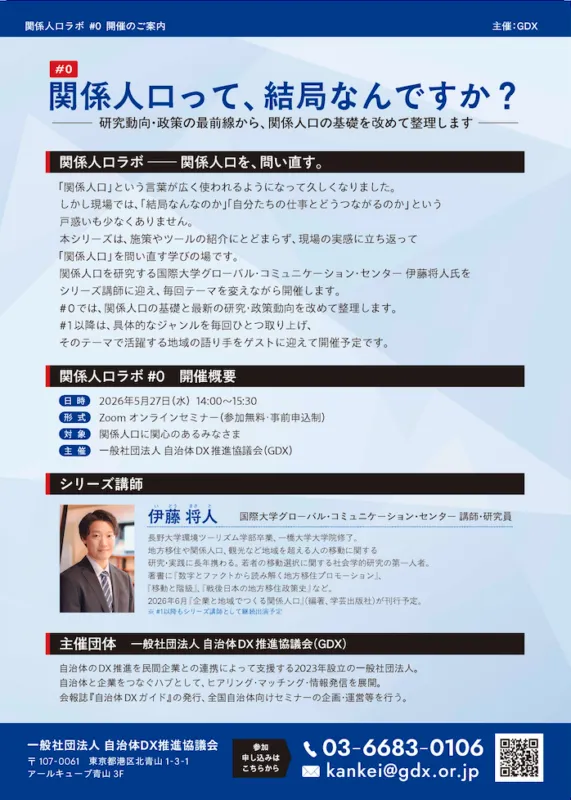
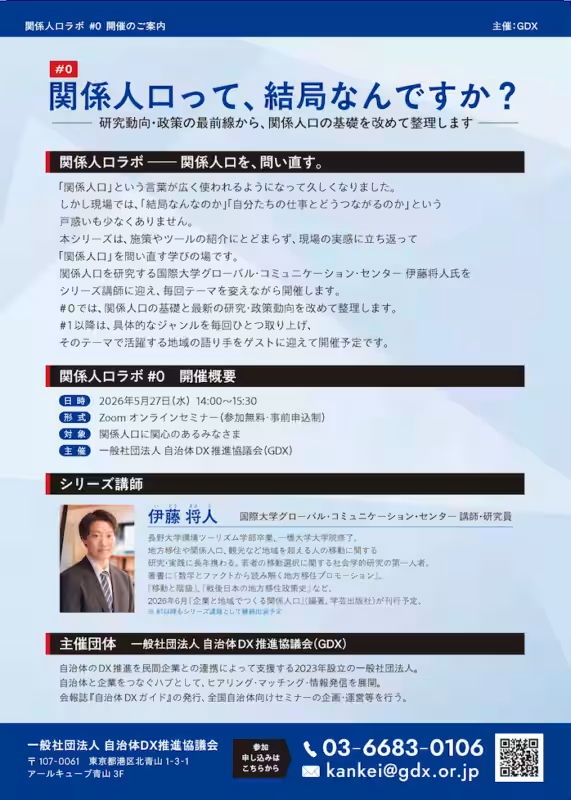
Some of these results will be presented at the upcoming seminar hosted by GDX titled ‘What Exactly is Related Population?’ scheduled for May 27, 2026. This event aims to delve into the underlying concepts of population engagement and share insights from the survey, thereby facilitating further discourse on best practices and strategies moving forward.
Conclusion
The findings from this survey not only shed light on the current state of public policy regarding population engagement in Japan but also highlight areas for growth and development. It is imperative that municipalities rethink their approaches to ensuring that new policies effectively serve both residents and their communities.



Topics People & Culture)
【About Using Articles】
You can freely use the title and article content by linking to the page where the article is posted.
※ Images cannot be used.
【About Links】
Links are free to use.