



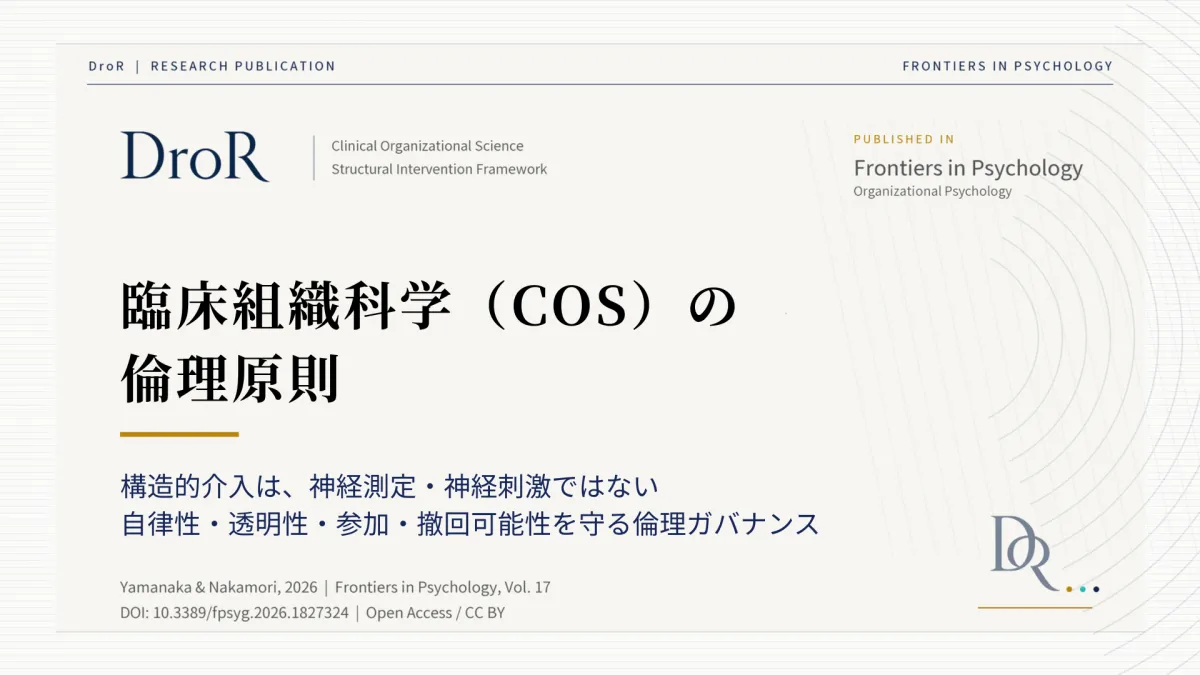
Exploring the Ethical Governance Principles of Clinical Organizational Science
Ethical Governance in Clinical Organizational Science (COS)
In recent years, the field of Clinical Organizational Science (COS) has gained attention for its innovative approach to understanding and fostering organizational change through structural interventions rather than direct manipulation of individual behaviors or neurological states. The ethical governance of COS establishes principles that delineate its practices from less transparent methodologies, addressing both the complexity of human behavior and the need for ethical transparency within organizational settings.
Defining Clinical Organizational Science
Clinical Organizational Science integrates complex systems science, neuroscience, organizational psychology, and behavioral science to theorize and intervene in the structural dynamics of organizations. Unlike traditional models that focus on individual behavior transformation, COS views organizational change as a transition of organizational attractors. Central techniques proposed in COS include Field Gradient Theory, Loop Conversion Design, and Neural Base Design, each aiming to create a conducive environment for emergent behaviors rather than imposing behavior changes directly.
At the core of this inquiry lies the concept of the 'emergence bridge,' which connects individual habits to organizational-level transformations, thus reinforcing the interconnectedness of personal and collective behavior in achieving effective organizational practices.
The Necessity of Ethical Governance
The use of neuroscientific concepts within COS carries potential risks of misinterpretation. Two main risks arise:
1. The perception that COS directly manipulates neurological states.
2. The suspicion that language from neuroscience could be used to justify opaque influences or to bypass organizational member autonomy.
To counter these misreadings, the principles of ethical governance in COS must unequivocally clarify its stance. COS does not involve measuring neural activity, stimulating neural states, or bypassing the autonomy and dignity of organizational members. Instead, it focuses on fostering the conditions under which desired behaviors and interactions can naturally emerge.
What COS Does Not Do:
- - Measure neural activity
- - Engage in neural stimulation
- - Conduct pharmacological interventions
- - Implement opaque influence operations
- - Circumvent member autonomy in interventions
- - Design dependency structures that are difficult to revoke
- - Force specific behaviors
COS specifically intervenes at the behavioral and social conditions where neural processes unfold. This includes focusing on interaction structures, feedback architectures, established practices, and the rhythms of the organization.
The Four Ethical Principles
The ethical governance framework of COS consists of four key principles:
1. Autonomy: Treating the autonomy and dignity of organizational members as an inviolable constraint in intervention design.
2. Transparency: Clearly stating the intent, methods, expected outcomes, and the context in which neuroscientific concepts are employed.
3. Participation: Designing and implementing interventions not against the organization, but in collaboration with its members.
4. Revocability: Ensuring that intervention structures can be retracted or modified upon request from the client organization or individual members.
In-depth Look at the Principles
- - Autonomy is foundational, highlighting that COS is not about coercing specific actions but rather enhancing the availability of choices and increasing the likelihood of particular interactions occurring naturally.
- - Transparency serves as an operational principle, ensuring clarity regarding the methodology, objectives, expected results, and the contextual use of neuroscience, which aids in situating neuroscience as a theoretical backdrop rather than direct intervention tool.
- - Participation emphasizes collaborative intervention design, aligning with Schein's process consultation tradition, ensuring that organizational members are part of the transformation journey rather than passive subjects of intervention.
- - Revocability underscores accountability, maintaining that any structure of intervention must be adjustable and that designs fostering dependency or difficulty in withdrawal are contrary to COS ethical principles.
Structural vs. Direct Interventions
In COS, interventions are distinctly structural, meaning they involve designing the environmental conditions where behaviors or neural processes occur, not manipulating them directly. For example, creating walkable urban designs can influence health behaviors but does not equate to a medical treatment. Similarly, altering the feedback loops and interaction patterns within an organization influences member behaviors and relationships without directly manipulating their neural states. This distinction is critical for maintaining the ethical integrity of COS practices.
Ensuring Transparency in International Discourse
A recent English news release on EurekAlert! elucidates that COS is a framework developed through practices at DroR, with the authors being affiliated with the organization. It confirms that the paper is not an empirical report but a conceptual analysis that does not involve external funding. Phys.org's coverage reiterates that COS does not include neural measurements or opaque operations, aiming to provide a clear understanding of COS to researchers, practitioners, and readers.
In summary, COS is defined not just as a novel methodology but as a comprehensive theoretical framework that integrates complex system science, neuroscience, organizational psychology, and behavioral science. The ethical governance principles ensure that the practice remains open to scrutiny and independent validation, thus safeguarding the integrity of organizational interventions.
Topics People & Culture)






【About Using Articles】
You can freely use the title and article content by linking to the page where the article is posted.
※ Images cannot be used.
【About Links】
Links are free to use.