




Revolutionizing Broadcast: AI-Driven 5G Multicast for Cable Television Stability
Introduction
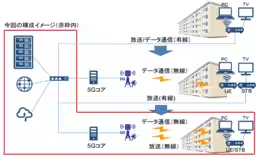
Cable television has long been an essential infrastructure for delivering nationwide broadcasts and emergency information. Yet, older apartment buildings often face high costs and logistical challenges when needing to upgrade to fiber optic connections. In response, researchers are now turning to a promising solution: utilizing 5G radio waves for simultaneous broadcasting to numerous households. The technique, known as 5G Multicast/Broadcast Services (5G MBS), leverages the capabilities of 5G technologies to accommodate the specific needs of various living environments.
Breakthrough in 5G Technology
A research group from Waseda University, led by Professor Jiro Katto in collaboration with NEC Networks and Systems Integration Corporation, has developed an AI-powered approach to ensure the stability of 5G broadcasts. This innovative model predicts future radio wave conditions in real-time, thereby preventing video interruptions—an issue that has plagued previous multicast systems.
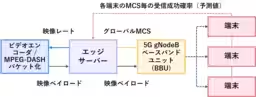
The AI can forecast radio service quality up to 0.1 seconds in advance, allowing for adaptive changes to transmission methods, thereby achieving consistent video feeds. The technology was validated in real-world 5G networks and confirmed effective at maintaining high-quality playback ratios on standard smartphones.
Bridging Digital Gaps
One of the significant contributions of this technology is its potential to address local 'information gaps'. In areas where construction of new wiring is impractical, the stable delivery of high-definition television and critical emergency broadcasts can be realized, fostering a more equitable access to broadcasting services across diverse communities.
The Challenges of Multicast Broadcasting
Traditionally, the multicast broadcasting of 5G has faced substantial hurdles due to the lack of feedback channels. Unlike typical 5G communications, designed for two-way transmission with built-in error correction, multicast broadcasting lacks a system for resending undelivered data. Therefore, any lost data results in stopped video streams or dropped frames. Furthermore, choosing the right Modulation and Coding Scheme (MCS) is vital, as it dictates the signal’s performance and quality of the broadcast.
Finding an optimal balance between high-quality delivery and reliability is complicated, especially as transmission settings must cater to varied reception environments among users. This challenge emphasizes the necessity for a robust MCS control technology.
New AI Insights
The innovative aspect of this study is its shift in communication objectives. It refocuses from purely maximizing video quality to ensuring reliable transmission. The AI model evaluates the success rates for receiving data across 28 different MCS settings and adjusts accordingly to optimize overall performance.
Unique Features of the AI Model
The new model's unique attributes include:
1. Flexible Outcome Generation: It generates success probabilities for all transmission settings, permitting an equilibrium between image quality and the risk of disruptions.
2. Rigorous Learning Approach: By applying strict penalties to overly optimistic predictions, the model is designed to mitigate the risk of video stoppages caused by excessive settings.
3. Data Utilization: With approximately 26 million data points gathered from real-world 5G networks, it adeptly responds to instantaneous fluctuations in radio conditions.
4. Real-time Operations on Standard Devices: By minimizing the input data required from smartphones, the model operates in real-time, ensuring that users experience no noticeable delay during broadcasts.
In practical terms, around 87% of video segments are successfully transmitted without errors using this AI-based configuration, significantly outperforming traditional methods, which only achieved about 32% reliability.
Societal Impact
The implications of this research extend beyond merely enhancing television broadcasts. It is a versatile technology applicable to any broadcast-type wireless communication where data cannot be resent, such as satellite communications or autonomous systems. This advances the vision of AI-native communication, wherein AI plays a pivotal role in decision-making for communication systems. By unifying broadcasting and communication on a single wireless platform, significant strides can be made towards more efficient technology.
Forward-Looking Perspectives
The technology's versatility means that it can serve various use cases, from emergency broadcasting to different industrial applications, thus having the potential to transform multiple sectors. As local 5G frequencies are increasingly utilized, this study presents a vital step in providing cable television services to underserved areas—contributing greatly to societal welfare and the alleviation of digital divides.
In closing, the research affirms a notable shift towards the practical application of 5G services, positing the potential for broad adoption and accessibility, encouraging equitable technology deployment across all demographics.

Topics Entertainment & Media)









【About Using Articles】
You can freely use the title and article content by linking to the page where the article is posted.
※ Images cannot be used.
【About Links】
Links are free to use.