



Analysis of Human Resource and Employment Practices in Japanese Companies
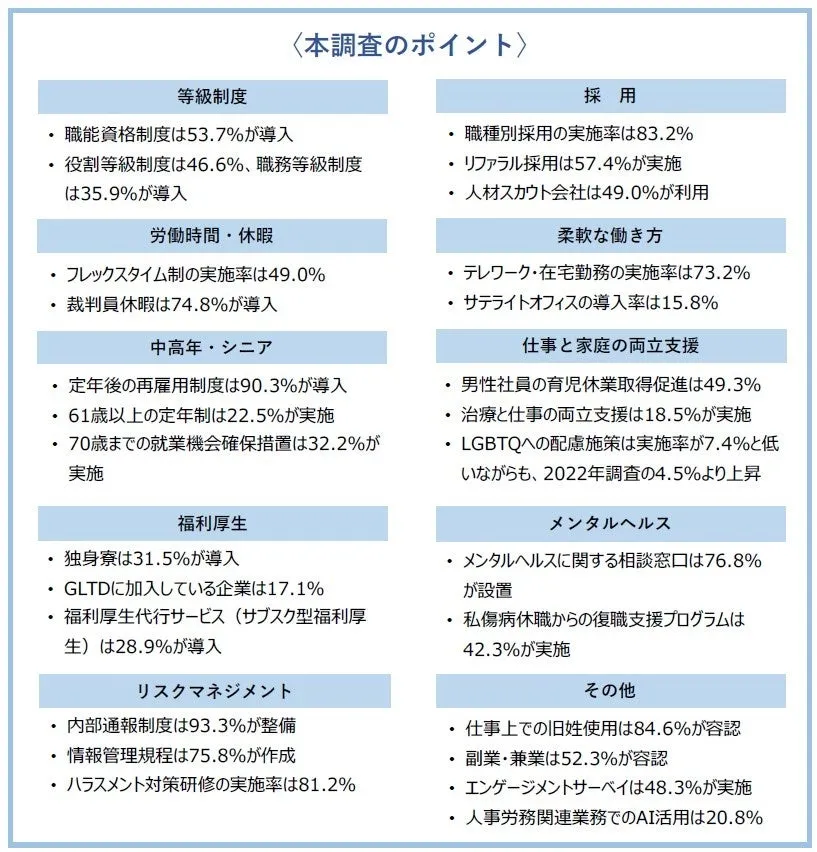
In a comprehensive exploration of human resource practices within Japan's corporate landscape, the Research Institute for Labor Administration conducted a recent survey involving 298 listed companies. This initiative, spearheaded by Chairman Hiromu Inomata and executed by the Institute, specifically scrutinizes the implementation of various labor-related regulations and practices. Adopted widely across businesses, the survey encompasses 20 distinct areas of human resources, evaluating 183 separate measures focused on workforce management. Of these, this article highlights 10 key fields alongside 28 significant practices.
The research showcases high implementation rates for certain policies, notably the 'Internal Whistleblower System' (93.3%) and 'Reemployment After Retirement' programs (90.3%). These figures indicative of commitment to employee well-being and ethical reporting mechanisms underscore a growing trend towards robust labor practices in Japan.
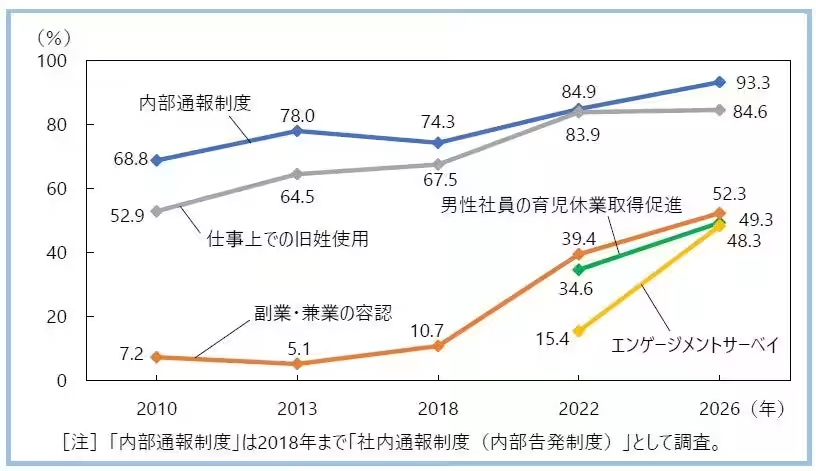
An internal whistleblower policy emerged as one of the most notable successes, achieving a remarkable implementation rate of 93.3%. This development aligns with the revised Whistleblower Protection Act, which was announced in June 2025 and requires businesses to enhance their responsiveness and structure regarding such reports. Therefore, as the law comes into effect, it’s expected that the internal whistleblowing policies will further solidify in corporate structures.
Another progressive policy includes allowing employees to use their maiden names at work. Over 84.6% of surveyed companies have adopted this practice, reflecting a cultural shift towards minimizing the disadvantages women often face post-marriage. The acceptability of such practices is also noted in public documentation, encouraging broader societal acceptance and recognition.
The trend toward accepting side jobs has dramatically increased since the Work Style Reform of 2018, with approval rates skyrocketing from 10.7% in 2018 to 52.3% in 2026. The Ministry of Health, Labour and Welfare has revised guidelines twice (in 2020 and 2022) to foster an environment conducive to supporting dual employment, indicating the government's commitment to shifting the labor landscape.
In response to societal changes, many companies are also fostering initiatives aimed at encouraging male employees to take parental leave. Following the introduction of the 'Postpartum Paternity Leave' program, the acceptance rate for male paternity leave increased from 34.6% in the previous study to 49.3% in the latest survey. This rise suggests that companies are now prioritizing gender equality in parenting responsibilities.
Another significant trend noted in the survey is the implementation of Engagement Surveys. These surveys aim to visualize the organizational climate and strengthen trust between employees and management. The implementation rate has leaped to 48.3%, increasing from just 15.4% previously surveyed. As organizations pursue enhanced employee engagement, they are likely to continue leveraging these tools to gauge satisfaction and performance.
To encapsulate the research, the study defined its parameters around a target pool of 5,467 companies, comprising both listed and unlisted firms across Japan, with data collection occurring from January to March 2026. This marks the 17th iteration of the study, which has been conducted since its inception in 1981, confirming historical commitments to refining employment practices.
As businesses continue adapting to evolving workplace norms and standards, the outcome of this survey not only reflects current practices but also anticipates future trends. Companies are increasingly recognizing the value of a well-structured and responsive organizational framework, ensuring they remain competitive and attractive to today’s workforce. For comprehensive details regarding the full report and additional statistics, interested parties can refer to the official document available in PDF format via the provided link.
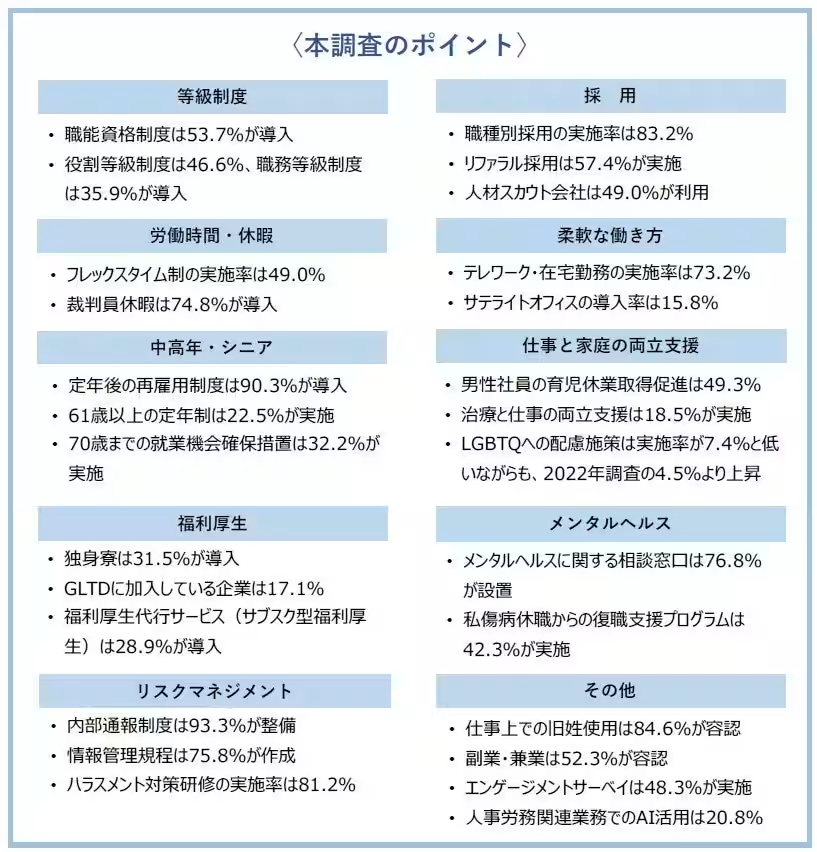
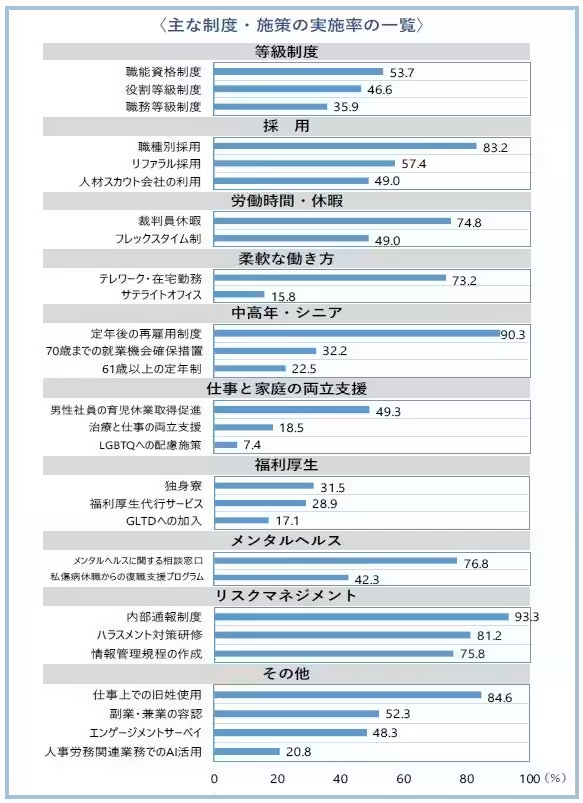
The research showcases high implementation rates for certain policies, notably the 'Internal Whistleblower System' (93.3%) and 'Reemployment After Retirement' programs (90.3%). These figures indicative of commitment to employee well-being and ethical reporting mechanisms underscore a growing trend towards robust labor practices in Japan.
An internal whistleblower policy emerged as one of the most notable successes, achieving a remarkable implementation rate of 93.3%. This development aligns with the revised Whistleblower Protection Act, which was announced in June 2025 and requires businesses to enhance their responsiveness and structure regarding such reports. Therefore, as the law comes into effect, it’s expected that the internal whistleblowing policies will further solidify in corporate structures.
Another progressive policy includes allowing employees to use their maiden names at work. Over 84.6% of surveyed companies have adopted this practice, reflecting a cultural shift towards minimizing the disadvantages women often face post-marriage. The acceptability of such practices is also noted in public documentation, encouraging broader societal acceptance and recognition.
The trend toward accepting side jobs has dramatically increased since the Work Style Reform of 2018, with approval rates skyrocketing from 10.7% in 2018 to 52.3% in 2026. The Ministry of Health, Labour and Welfare has revised guidelines twice (in 2020 and 2022) to foster an environment conducive to supporting dual employment, indicating the government's commitment to shifting the labor landscape.
In response to societal changes, many companies are also fostering initiatives aimed at encouraging male employees to take parental leave. Following the introduction of the 'Postpartum Paternity Leave' program, the acceptance rate for male paternity leave increased from 34.6% in the previous study to 49.3% in the latest survey. This rise suggests that companies are now prioritizing gender equality in parenting responsibilities.
Another significant trend noted in the survey is the implementation of Engagement Surveys. These surveys aim to visualize the organizational climate and strengthen trust between employees and management. The implementation rate has leaped to 48.3%, increasing from just 15.4% previously surveyed. As organizations pursue enhanced employee engagement, they are likely to continue leveraging these tools to gauge satisfaction and performance.
To encapsulate the research, the study defined its parameters around a target pool of 5,467 companies, comprising both listed and unlisted firms across Japan, with data collection occurring from January to March 2026. This marks the 17th iteration of the study, which has been conducted since its inception in 1981, confirming historical commitments to refining employment practices.
As businesses continue adapting to evolving workplace norms and standards, the outcome of this survey not only reflects current practices but also anticipates future trends. Companies are increasingly recognizing the value of a well-structured and responsive organizational framework, ensuring they remain competitive and attractive to today’s workforce. For comprehensive details regarding the full report and additional statistics, interested parties can refer to the official document available in PDF format via the provided link.
Topics Business Technology)

【About Using Articles】
You can freely use the title and article content by linking to the page where the article is posted.
※ Images cannot be used.
【About Links】
Links are free to use.