



Innovative 3D Clinostat and On-Chip Cell Culture System Showcased at Gravity Design Exhibition
Cutting-Edge Technology at the Gravity Design Exhibition
On July 21, 2026, a remarkable exhibition titled "Designing a Life with Different Gravity" took place in Minami Aoyama, Tokyo. This event featured groundbreaking research by the Biological Microfluidics Laboratory of Shibaura Institute of Technology, in partnership with Regeneome Co., Ltd., a subsidiary of Space Seed Holdings. The showcased technology comprised a 3D clinostat integrated with an on-chip cell culture microfluidic device, designed for conducting tabletop experiments.
The Innovative Tabletop Experiment Platform
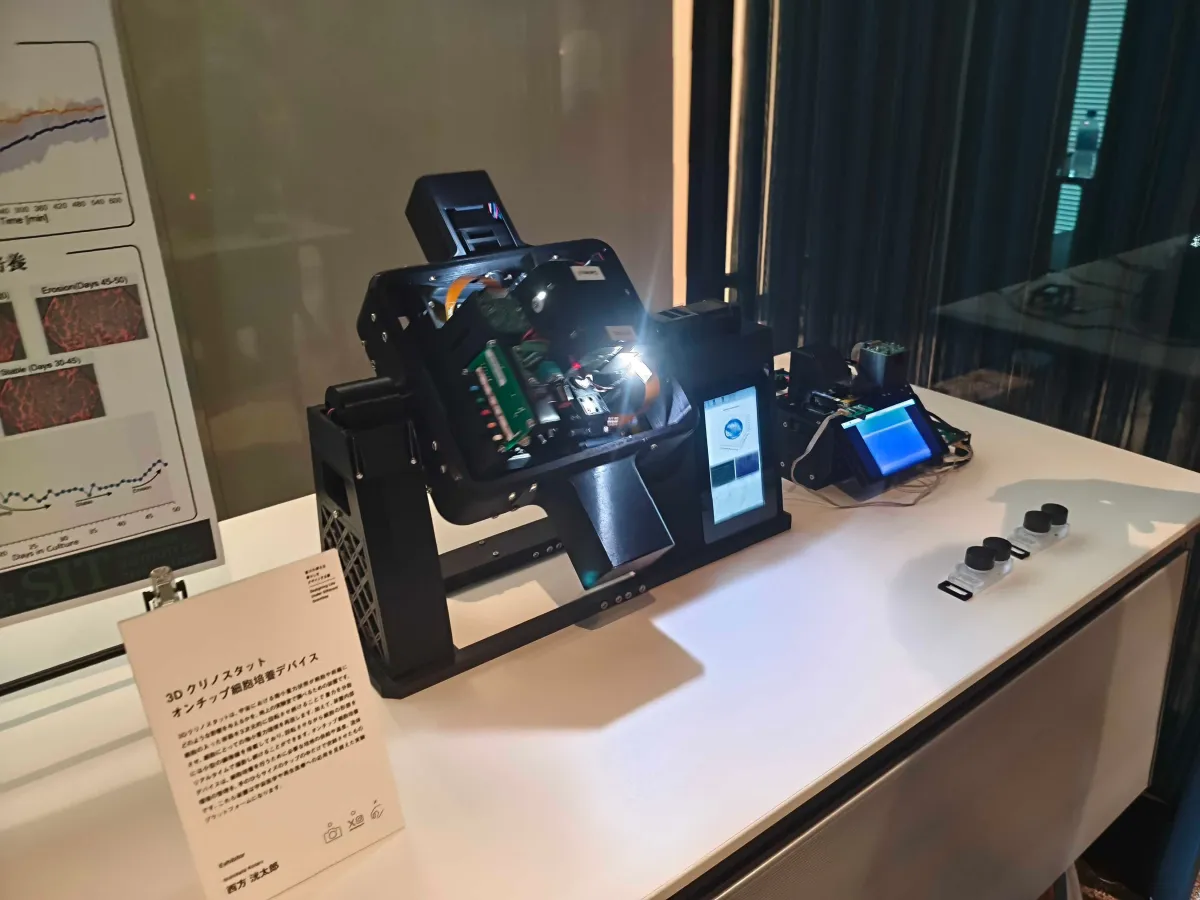
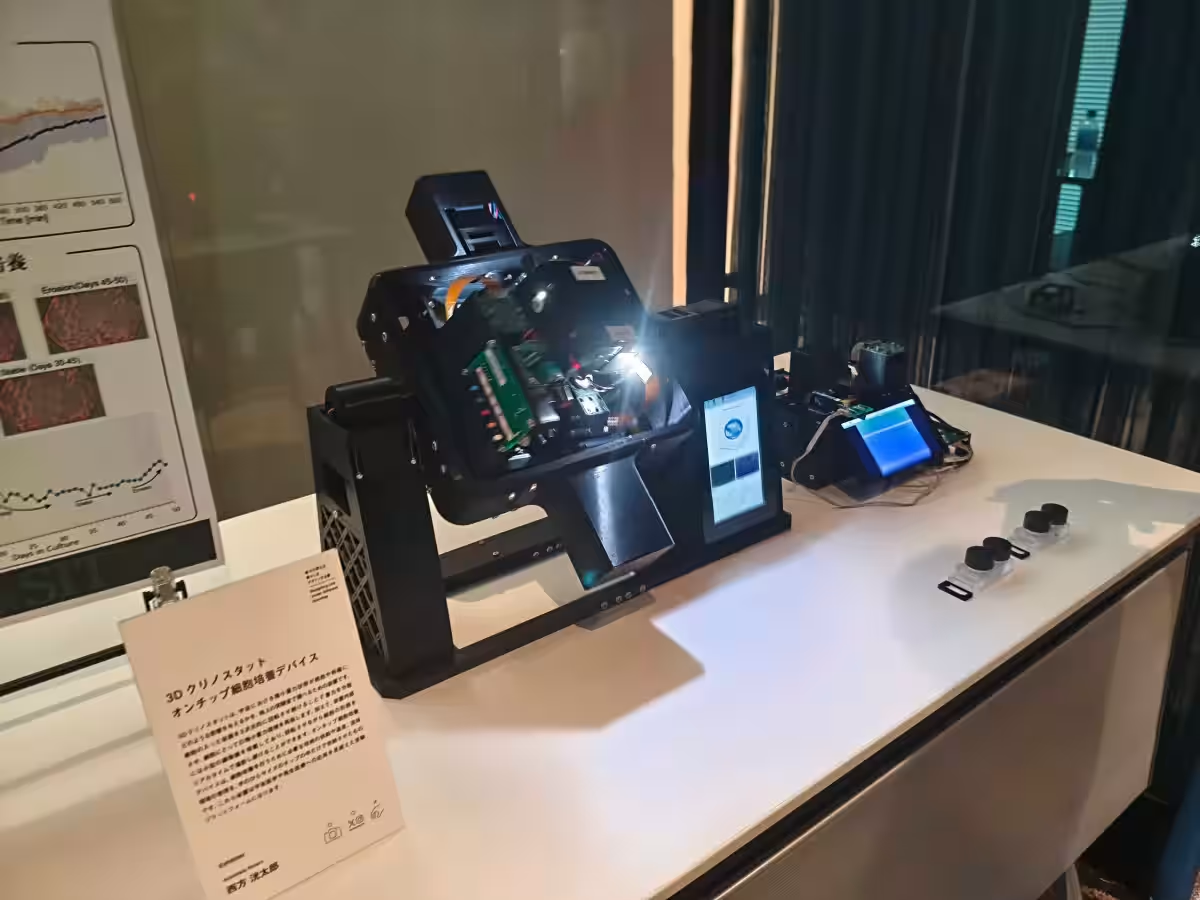
The centerpiece of the exhibition was a unique tabletop platform that combined a 3D clinostat with an on-chip cell culture system. The clinostat has a built-in microscope, and its design allows for the replication of microgravity conditions through three-dimensional rotation, effectively averaging out gravitational forces acting on the cells. This capability enables continuous observation of the cell culture under rotation without interruptions.
At the exhibition, attendees witnessed the clinostat in operation, providing real-time insights into the microgravity simulations.
Microgravity as a Tool for Aging Research
The collaboration between Regeneome and Shibaura's Professor Nobuyuki Niigai defines a microgravity environment as an ideal setting for visualizing vascular changes, emphasizing its utility in space biological science and aging research. Research indicates that vascular endothelial function diminishes with age, which is critical in understanding systemic changes. Observing how blood vessels adapt when reduced gravity is applied can offer clues to the intricacies of aging.
The Featured Technologies in Detail
1. The 3D Clinostat
This device features an outer and an inner frame, both independently rotated by stepping motors, creating microgravity conditions for the cell cultures. Notably, the microscope module is integrated within the inner frame, allowing for uninterrupted observation while the clinostat maintains its rotational motion. An onboard display monitors gravitational vector distribution, culture temperature, rotation speed, and live images of the cells being observed.
2. The On-Chip Cell Culture Microfluidic Device
Constructed with PDMS microchannels on a cover glass, this device allows for efficient gas exchange while maintaining the culture environment without reliance on external CO₂ incubators. The device utilizes actuators originally designed for Braille displays to create a micropump that facilitates perfusion culture directly on the chip, negating the need for external piping or syringe pumps.
Implications for Aging Research
The ability to track processes like vascular remodeling within a single chip under a microscope represents a significant advancement in biological research, particularly in aging studies. Understanding how vascular networks form and regress is fundamentally connected to aging-related changes in tissues, making this platform critically relevant for aging investigations.
Research Background: Addressing Aging Challenges
For humanity to thrive in outer space, understanding and counteracting the effects of microgravity, cosmic radiation, and closed environments on biological systems is paramount. Microgravity is known to cause various physiological changes, including reduced bone density, muscle atrophy, and impaired cardiovascular function—ailments that parallel age-related changes on Earth.
Currently, conducting life science experiments in microgravity faces barriers of rare opportunities and high transportation costs, leading to the utilization of clinostats for terrestrial simulations. However, traditional methods often fall short, being limited to monolayer cultures, thus hindering real-time observations. By overcoming the limitations of maintaining continuous observation of cells in rotating devices, the collaboration between Regeneome and Shibaura aims to eliminate bottlenecks in space biological science and aging research.
Collaborative Research Framework
Regeneome is a biotech venture focused on uncovering and mitigating the root causes of aging. It envisions showcasing anti-aging technologies by 2030, enabling humanity to expand its living domains to the lunar surface by 2040. The ongoing collaboration aims to integrate on-chip cell culture and microgravity simulation technologies with automation and analysis capabilities to promote experimental autonomy and understand microgravity’s effects on aging indicators.
Future Directions
This innovative platform can serve as a foundation for both preliminary orbital experiments and terrestrial control studies. It holds the potential to enhance our understanding of aging through microgravity responses and regenerative medicine research. Regeneome plans to advance its technology towards multi-sample processing and automation while also aiming for comparative validation against actual orbital experiments.
As humanity's presence extends to the moon by 2040, Regeneome is poised to develop and implement crucial technologies that ensure sustained health in extraterrestrial living environments.
Exhibition Overview
- - Event Name: Designing a Life with Different Gravity
- - Organizer: Keio University Graduate School of System Design and Management, Shirakawa Laboratory
- - Management: General Incorporated Association EX Gravity
- - Date: July 21, 2026, from 16:00 to 20:00
- - Venue: Ork'dole Salon Aoyama
- - Number of Exhibits: 12, featuring various creators from architecture, products, research, and art
- - Exhibit Related to Regeneome's Research: 3D Clinostat and On-Chip Cell Culture Device (Exhibitor: Kota Nishikata)
About Regeneome Co., Ltd.
Regeneome aims to utilize nanoparticle technology to provide innovative solutions in aging suppression and regenerative medicine. Located in Takanawa Gateway City, it operates the Longevity Lab, where it accelerates R&D for its healthcare brand "Saisei Lab" and aims to contribute to human space exploration alongside extending health spans.
Regeneome Website
About Space Seed Holdings
Space Seed Holdings is a deep-tech venture builder dedicated to making science fiction a reality through investment, research, and business creation. Their Fermentation and Longevity Fund program aims to support the implementation of longevity technologies to address societal challenges, with a goal to equip humanity with the necessary technologies for habitation in space by 2040.
Space Seed Holdings Website
Topics Health)
【About Using Articles】
You can freely use the title and article content by linking to the page where the article is posted.
※ Images cannot be used.
【About Links】
Links are free to use.