




Insights from a National Survey About FIFA World Cup 2026: Japan's Chances and Public Sentiment
Insights from a National Survey About FIFA World Cup 2026
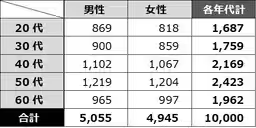
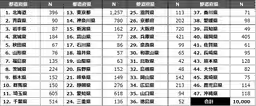
As anticipation builds for the 2026 FIFA World Cup, set to kick off on June 12, the Sports Management Research Institute of Sanno University has conducted a comprehensive nationwide survey. With a focus on public sentiment related to Japan's national football team, the survey encompasses the opinions of 10,000 individuals across all 47 prefectures in Japan. The results shed light on performance expectations and engagement strategies leading up to this significant event.
1. Public Awareness and Expectations
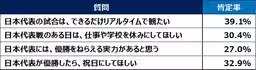
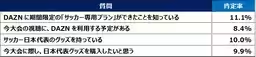
The 2026 FIFA World Cup introduces a new tournament structure where 32 teams will advance to the knockout stage from 12 groups, a shift from the previous format. Awareness of these changes among the public stands at 26%. As the event unfolds in North America, Japan will face challenges due to substantial time differences. For example, the group stage matches against the Netherlands and Sweden are set for early morning and rush hour, respectively. Nearly 40% of respondents expressed a desire to watch live matches, with 30% suggesting work or school holidays for the occasion.
Media coverage is poised to be significant as DAZN announces special pricing and rolling out unique packages to engage viewers. However, it's notable that primary matches will also air on terrestrial networks like NHK, limiting the incentives for dedicated streaming services. In terms of merchandise, interest in Japan's national team goods appears minimal, with only about 10% planning to purchase.
2. Evaluating Japan's Performance
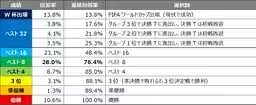
The public is optimistic about the national team's growth, with 27% believing Japan can contend for the championship. The most popular benchmark for a successful tournament performance is advancing to the quarter-finals, indicated by 28% of the participants. Historically, Japan has reached the knockout stage in four past World Cups but has yet to secure a win at that level. Thus, a baseline expectation is that a record of success would hinge on achieving at least two victories in the knockout phase.
3. Predicted Champions
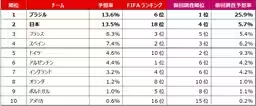
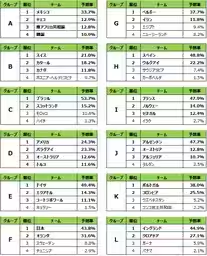
In terms of championship predictions, the survey also sought opinions on likely finalists. Among the top contenders, Brazil, at 53.7%, remains the favorite to proceed to the knockout rounds, followed by Germany and Spain. Notably, Japan received 43.8% support for advancing, marking a significant increase in public confidence compared to previous tournaments. Japan even ranked second in the likelihood to win, pointing towards a burgeoning belief in their capabilities.
4. Highlights of Player Recognition
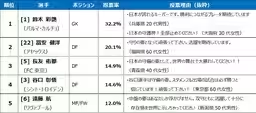
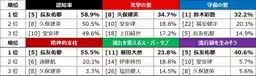
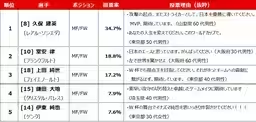
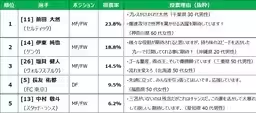
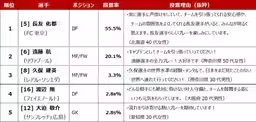
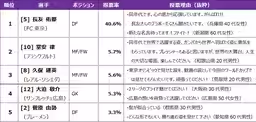
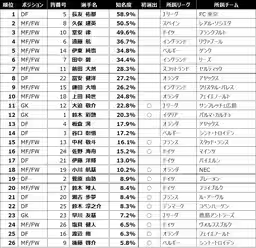
Respondents were asked to identify players they recognize from the national squad. Notably, veterans like Yuto Nagatomo and rising stars such as Takefusa Kubo have high recognition rates, with Kubo distinguishing himself in the attacking department. Interestingly, this year marks a notable fresh inclusion with 13 players debuting at the World Cup, possibly rejuvenating the team's presence on the global stage.
- - ### Key Players:
- Defensive Backbone: Ayase Ueda, described as a formidable presence at the back.
- Emotional Leader: Yuto Nagatomo, praised for his spirited on-field leadership.
- Game-Changer: Daizen Maeda, recognized for a game-changing speed and stamina.
Despite the fresh faces, the data reveal that Japan can rely on an extensively experienced squad, with a majority of players linked to prominent international clubs.
Conclusion
The survey encapsulates a mix of hope and pragmatism, suggesting a robust support system for Japan's national team. With the approaching 2026 FIFA World Cup, public engagement, and an evolving team identity, expectations are high. The findings illustrate not only the enthusiasm for the tournament but also a significant shift in how the Japan national team is perceived on the world stage, hinting at possible celebrations should they achieve their first championship victory.
- ---
Survey Overview
Methodology: Internet survey conducted over five days from May 29 to June 2, 2026.
Participants: 10,000 Japanese residents aged 20 to 69, representing regional demographics.
Supervision: Conducted by Professor Tetsuya Onoda from Sanno University.
Website: Sanno University





Topics Sports)
【About Using Articles】
You can freely use the title and article content by linking to the page where the article is posted.
※ Images cannot be used.
【About Links】
Links are free to use.