


Innovative Ammonia Production from Harmful Nitrogen Oxides: A Step Towards Sustainability
Innovative Ammonia Production Technology
Introduction
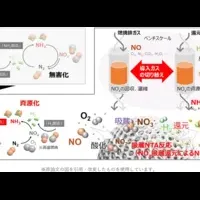
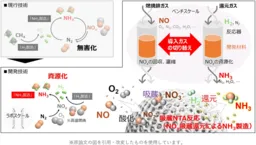
In a groundbreaking development, researchers at the National Institute of Advanced Industrial Science and Technology (AIST) have successfully demonstrated a method to convert harmful nitrogen oxides (NOx) from industrial combustion exhaust into ammonia (NH3). This innovative process not only aims to clean up emissions but also looks to repurpose harmful gases into valuable resources. This dual achievement is particularly significant in addressing both energy and environmental challenges.
Details of the Research
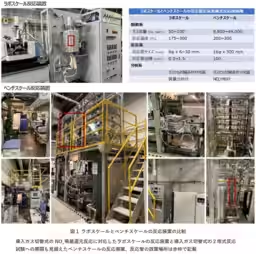
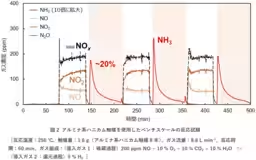
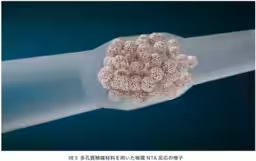
Led by Ryutaro Wakabayashi, a prominent researcher in AIST's Multi-Material Research Institute, along with senior researchers Tomita Atsuko and Kimura Tatsuo, the team utilized a large-scale, bench-scale reactor established at AIST's Fukushima Renewable Energy Research Institute (FREA) to advance their groundbreaking work. They switched between combustion exhaust and reduction gases, successfully converting NOx into ammonia through a unique reaction process known as the adsorption NTA reaction.
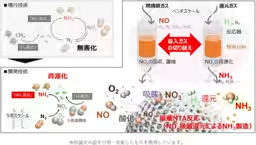
Traditionally, NOx emissions commonly found in combustion processes, such as those from thermal power plants and waste incinerators, are detoxified and converted back to nitrogen (N2). However, the new approach seeks to transform NOx directly into ammonia, achieving both emission purification and resource recovery simultaneously.
The research team previously developed nanocomposite catalyst materials for this reaction using smaller laboratory-scale setups. The recent bench-scale experiments allowed them to refine the process and assess the efficiency of the catalysts in a larger context, leading to a better understanding of the technical challenges faced when scaling up.
Technical Achievements
The bench-scale reactor employed for this research has a volume approximately 100 times larger than previous lab-scale systems, featuring a gas flow rate that exceeds 400 times what was tested in the lab. The experimental setup has progressed from simply understanding the laboratory conditions to real-world applications — the team effectively managed to identify technical barriers and sought solutions to improve efficiency.
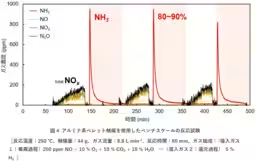
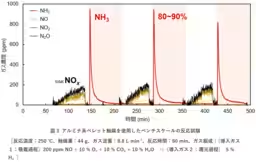
One significant finding was the $60% conversion rate of NOx into NH3 using their newly designed honeycomb catalysts. With further optimization, they have been able to demonstrate conversion rates nearing 90% in specific conditions. The innovations in catalyst design, including the integration of mesoporous materials, showcase not only the effectiveness of the process but also the potential for widespread application in existing industrial exhaust systems.
Social Implications and Future Directions
Given the growing concern regarding environmental pollution and resource scarcity, this technology represents a vital advancement. It is estimated that industrial processes contribute significantly to global NOx emissions, which have serious implications for public health and the environment. Existing legal frameworks impose strict limits on emissions, yet the current methods often rely on additional energy-intensive processes to neutralize these pollutants.
This innovative approach not only mitigates emissions but also repurposes these gases into an essential agricultural and industrial resource, ammonia. Further development of this technology could potentially result in a circular economy for nitrogen compounds, significantly reducing the energy footprint associated with ammonia production.
The research team plans to continue refining the technology for real-world applications, considering larger-scale reactors suitable for processing emissions from waste incineration and other industries. Collaborations with energy and industrial stakeholders will be vital as they move towards social implementation, ultimately contributing to solutions for energy, environmental protection, and sustainability.
Conclusion
The advances made by AIST in the conversion of nitrogen oxides into ammonia illustrate not only the potential for cleaner industrial processes but also a proactive step towards achieving sustainable resource management. As the team continues to optimize their processes and scale their technology, the potential impact on mitigating global nitrogen management issues looks promising.
For more detailed insights on the research, you can visit the press release page here.
Topics Environment)

【About Using Articles】
You can freely use the title and article content by linking to the page where the article is posted.
※ Images cannot be used.
【About Links】
Links are free to use.