



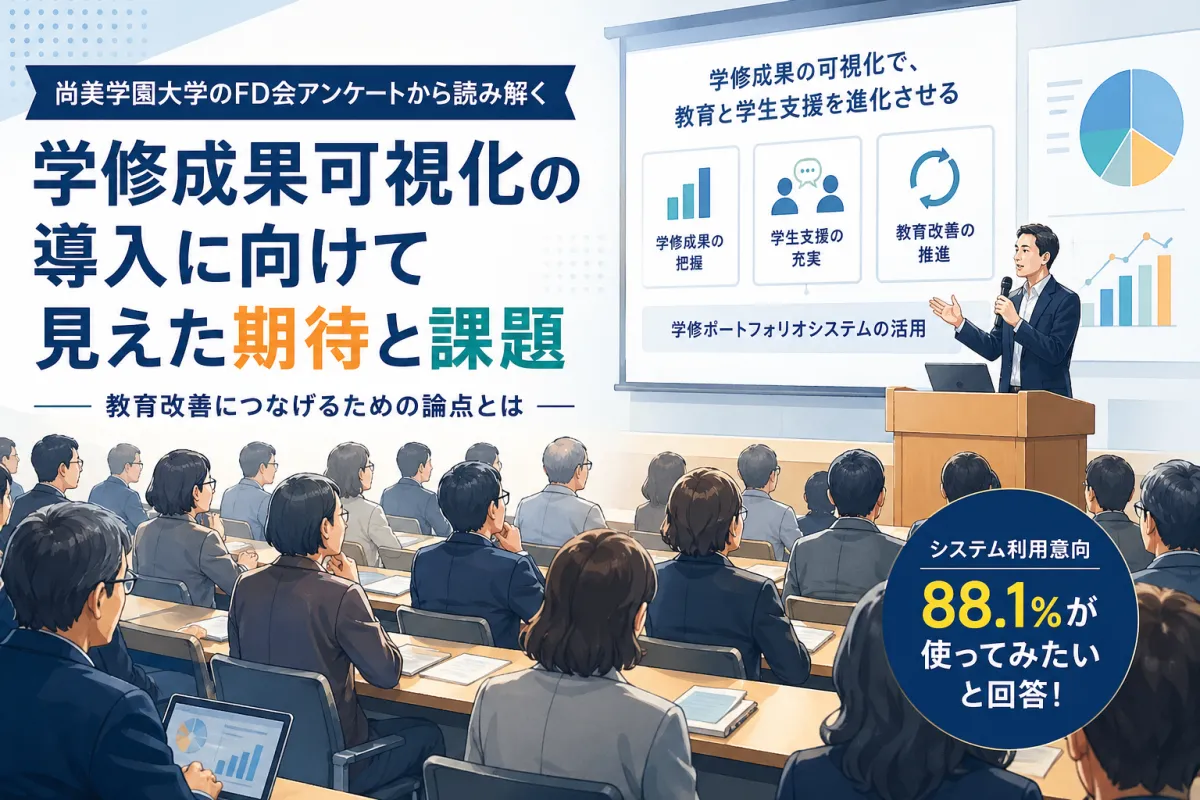
Enhancing Educational Improvement through Learning Outcomes Visualization at Shobi Gakuen University
Introduction
In recent years, universities have increasingly focused on the visualization of learning outcomes and their implications for educational improvement. Instead of merely implementing these systems, the crucial theme is how to use them to enhance educational practices effectively.
Background of Learning Outcomes Visualization
The Central Education Council's recommendations and accreditation evaluation criteria underscore the importance of establishing systems that allow universities to track learning outcomes based on diploma policies, and to use this data for continual educational improvement. Nonetheless, there remain several challenges on the ground, including:
- - Lack of visibility into students' learning and growth.
- - Dispersed and individualistic mentorship records and guidance information.
- - The cumbersome process of sharing information among faculty members.
Shobi Gakuen University’s Initiatives
To tackle these issues, Shobi Gakuen University (located in Kawagoe City, Saitama Prefecture, under President Yoshihisa Nagayama) is preparing for the full-scale introduction of a learning portfolio system in 2027. As part of this preparation, Faculty Development (FD) training has been conducted, with the aim of fostering faculty understanding of how to leverage this system. Approximately 70 faculty members participated in the training, engaging in discussions about:
- - What improvements might be expected through the learning portfolio system?
- - How does this relate to teaching practices and faculty guidance?
The Essence of Learning Outcomes Visualization: Supporting Students' Self-Awareness
During the FD training, it was concluded that the essence of a learning portfolio system lies in allowing students to reflect on their academic achievements and objectively grasp their development—serving as the foundation for implementing a PDCA (Plan-Do-Check-Act) cycle in their learning. In reality, many students struggle with:
- - Not understanding their strengths.
- - Being unable to envision their future path.
Value for Faculty: Balancing Efficiency with Quality
The learning portfolio system not only benefits students but also holds significant value for faculty. The FD training highlighted several potential pathways for enhancing the quality of educational activities:
- - Centralized Student Information Management: Having access to overall academic records, activity histories, and mentorship records helps reduce preparation burdens.
- - Enhancing the Quality of Mentoring: Understanding background information enables timely, consistent dialogue with students.
- - Facilitating Early Support: Faculty can identify students in need of assistance based on indicators such as declining GPA.
- - Systematic Student Support: Information can be shared across departments and faculty, allowing for seamless support structures.
Survey Results: Insights from Faculty on Expectations and Challenges
A survey conducted following the FD training (with 67 responses) gathered diverse opinions from faculty regarding expectations for the new system and key points for future implementation. Notably, 88.1% responded positively to the question of whether they would like to use the system, indicating a growing positive attitude toward its introduction. However, open-ended responses revealed both expectations and concerns:
- - Expectations for Student Support: Many expressed hopes that visualizing learning outcomes would facilitate a more multifaceted understanding of students’ circumstances for guiding and assisting them.
- - Concerns about Operational Burdens: There were cautious views concerning the workload associated with implementing new initiatives and questions surrounding the feasibility of the system sticking. This points to a need for thoughtful operational designs that promote sustainable use.
- - Importance of Operational Design Awareness: There was acknowledgment that not just the system’s functionalities but also clarity in how to effectively utilize it on campus is crucial.
These results reaffirm the importance of considering operational design and support for sustaining the effectiveness of learning outcomes visualization.
Solving Ground-Level Issues and Supporting Operational Sustainability: Learning Outcomes MOE
As highlighted in the FD training outcomes, a successful implementation of the learning portfolio system hinges on designing methods that minimize burdens while ensuring effective utilization. Harmony Plus offers the "Learning Outcomes MOE," which allows for a quantitative and structured visualization of learning outcomes at universities in a comprehensible format. Beyond simply providing systems, we also support manageable operational designs that fit each institution’s context, ensuring the ultimate goal of educational improvement is met. For detailed methods on organizing learning outcomes, external communication, and internal utilization, please see below.
About Learning Outcomes MOE
The Learning Outcomes MOE is a structured indicator and framework that enables universities to visualize and organize learning outcomes in a clear and measurable way. For insights on how to advance the organization of learning outcomes, external communication, and university-specific utilization, please refer to the following link. View Learning Outcomes MOE Details Here.
Contact Information
Harmony Plus Co., Ltd.
URL: https://www.harmony-plus.co.jp/
Address: 7-5, Nibancho, Chiyoda-ku, Tokyo
Phone: 03-6261-5172
Inquiries: Contact Us
Topics Other)








【About Using Articles】
You can freely use the title and article content by linking to the page where the article is posted.
※ Images cannot be used.
【About Links】
Links are free to use.